

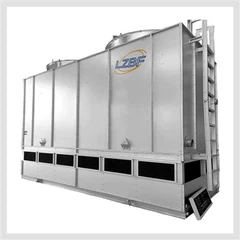
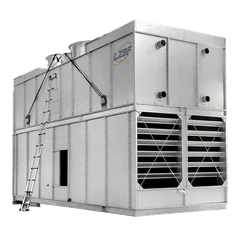
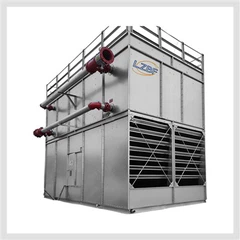
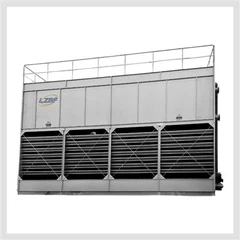

Working Principle and Classification of Open/C_closed Cooling Towers
Oct 21, 2025
Leave a message
Working Principle
Dry air with a low enthalpy value is drawn into the cooling tower through the air intake grille by the fan; hot water molecules with high enthalpy value and saturated vapor pressure flow toward the air with low pressure, and the hot and humid water with high enthalpy value is sprayed into the tower through the water distribution system. When water droplets come into contact with air, on the one hand, direct heat transfer occurs between air and water; on the other hand, due to the pressure difference between the water vapor surface and the air, evaporation takes place under the action of pressure. The evaporation absorbs heat to take away the heat, thereby achieving the purpose of cooling.
Classification of Cooling Towers
(1) According to the ventilation method: natural draft cooling towers, mechanical draft cooling towers, and mixed draft cooling towers.
(2) According to the contact method between hot water and air: wet cooling towers, dry cooling towers, and wet-dry cooling towers.
(3) According to the flow direction of hot water and air: counterflow cooling towers, crossflow (cross-current) cooling towers, and mixed-flow cooling towers. This is a common classification method in data centers.
(4) According to the system structure: open cooling towers and closed cooling towers. This is also a common classification method in data centers.
(5) According to the noise level: ordinary cooling towers, low-noise cooling towers, ultra-low-noise cooling towers, and ultra-quiet cooling towers.
(6) Other types include jet cooling towers, fanless cooling towers, hyperbolic cooling towers, etc.

Differences Between Open and Closed Cooling Towers
The cooling principle of an open cooling tower is to spray circulating water onto fiberglass fillings. Heat exchange is achieved through the contact between water and air; then the fan drives the air circulation in the tower to take out the hot air after heat exchange with water, thereby realizing cooling. This cooling method requires less initial investment but higher operating costs (water and electricity consumption).The cooling principle of a closed cooling tower is simply two cycles: an internal cycle and an external cycle. It has no fillings, and the main core part is a copper tube surface cooler.
Internal cycle: It is connected to the target equipment to form a closed circulation system (the circulating medium is demineralized water). It cools the target equipment and takes the heat from the target equipment to the cooling unit.
External cycle: It cools the cooling tower itself inside the tower. It does not come into contact with the internal circulating water, but only conducts heat exchange and heat dissipation through the copper tube surface cooler in the cooling tower. Under this cooling method, the operation of the motor is set according to the water temperature through automatic control. For the two cycles, when the ambient temperature is high in spring and summer, both cycles need to operate simultaneously. In autumn and winter, the ambient temperature is not high, and only the internal cycle is needed in most cases.
Performance Comparison Between Open and Closed Cooling Towers
Open Cooling Towers
The cooled medium circulates in an open system. The circulating medium is concentrated due to evaporation, so it is necessary to add chemicals and make up water all year round. Moreover, since the cooled medium is in direct contact with air, it is easy to be contaminated. When encountering sulfides, the fluid undergoes an acidic reaction, causing damage to the connected equipment. Frequent shutdowns for maintenance are required, so it is not suitable for systems that need continuous operation. The open operation of the cooled medium and exposure to sunlight are likely to produce algae and salt crystals, thereby affecting the performance of the system. Dry operation is not possible. When the fluid is a volatile, toxic, or irritating solution, there are potential safety hazards in using the open cooling tower operation mode. When the cooled medium circulates in the open system, scaling is likely to occur in the system pipelines and the heat exchanger of the cooled equipment, which reduces the heat exchange efficiency of the cooled equipment and increases the operating cost of the system.
Closed Cooling Towers
The cooled medium flows in closed pipelines without contacting the external air. Heat is transferred between the tube wall of the heat exchanger and the external air, spray water, etc., to finally realize the cooling of the medium. Therefore, the cooled medium will not be contaminated, evaporated, or concentrated, and there is no need to make up water or add chemicals, thus ensuring the performance and service life of the connected equipment, and the daily management is also very convenient. Frequent shutdowns for maintenance are not required, the operation is stable and safe, the failure rate of the connected equipment can be reduced, and it is suitable for systems that need continuous operation. Since the cooled medium is not exposed to sunlight and does not contact air, it will not produce algae and salt crystals, so "there is no need to remove algae and salt", thus ensuring the high-performance operation of the system. Dry operation can be carried out without breeding various bacteria, so it is especially suitable for occasions with air purification requirements and is often used in water-scarce and arid areas. When the fluid is a volatile, toxic, or irritating solution, the use of a closed circulation system will not pollute the environment, so it is widely used in systems with strict requirements on fluids. The cooled medium flows in closed pipelines. The cooled medium is generally demineralized water, so scaling will not occur in the system pipelines and the heat exchanger of the cooled equipment. The cooled equipment operates efficiently, and the entire system operates energy-savingly.
Anti-freezing and Anti-catkin Measures for Cooling Towers
Cooling towers are generally installed in outdoor spaces such as the roof of buildings and are greatly affected by the environment. Anti-freezing work of cooling towers should be considered when the temperature is low, and data centers in some areas will also add anti-catkin work in spring.
Anti-catkin Measures for Cooling Towers
Due to the operation of the cooling tower fan, a fixed air flow organization is formed around the cooling tower. The catkins floating in this area will enter and exit the cooling tower along with the air flow organization, adhere to the fillings, fans, or enter the cooling water system, affecting the normal operation of the cooling system equipment and increasing the operational risks and equipment maintenance costs. To prevent catkins, it is necessary to purchase anti-catkin cotton, closely attach it to the air intake of the cooling tower, and regularly clean the accumulated catkins to avoid affecting the heat dissipation efficiency. (Anti-catkin cotton is not only suitable for cooling towers but also for air conditioning outdoor units.)

Anti-freezing Measures for Cooling Towers
Electric heating rods are installed in the sump of the cooling tower. The general control mode is that when the temperature of the cooling water in the sump drops to 4°C, the electric heating rods start to work; when the temperature of the cooling water in the sump rises to 8°C, the electric heating rods stop working.
Electric heat tracing for pipelines: All outdoor water pipelines are laid with wrapped electric heat tracing to prevent the pipelines from freezing and cracking.
Fan reverse defrosting for cooling towers: Some cooling towers are designed with this function.
Send Inquiry