

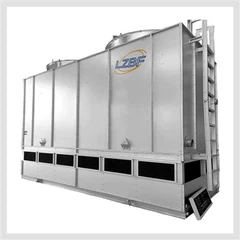
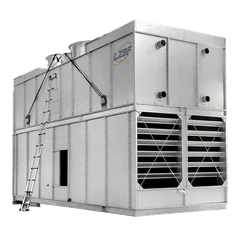
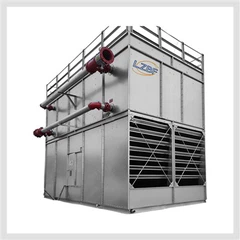
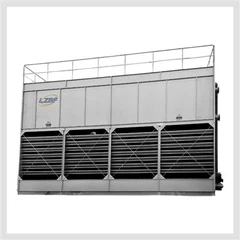

Air-Cooled Steam Condenser
Oct 20, 2025
Leave a message
Working Principle
Heat Exchange Process
The air-cooled steam condenser operates primarily based on the principle of heat exchange. When high-temperature steam enters the condenser, it undergoes heat exchange with the flowing cold air outside. The interior of the condenser is usually equipped with a large number of heat dissipation fins or heat exchange tubes to increase the contact area between the steam and the cold air. When the steam comes into contact with the cold air, it transfers its heat to the cold air, causing its temperature to gradually decrease and condense, transforming from a gaseous state to a liquid state.
In a typical air-cooled steam condenser, high-temperature steam enters the condenser through pipes, and cold air is forced to blow over the heat dissipation fins by a fan. During this process, the heat of the steam is quickly absorbed by the cold air. After heat exchange, the steam condenses into liquid water, which is discharged from the bottom of the condenser, while the heated cold air is discharged from the top, completing the heat exchange cycle.
Condensation Mechanism
The condensation process of steam involves a phase change. Inside the condenser, as the temperature of the steam drops below the dew point temperature, steam molecules begin to gather to form tiny liquid droplets. Under the action of gravity and surface tension, these droplets gradually converge and flow downward along the surfaces of the heat dissipation fins or heat exchange tubes, eventually collecting at the bottom of the condenser and being discharged through the drainage system. To promote the condensation process, some air-cooled steam condensers also adopt special surface treatment technologies to make the surfaces of the heat dissipation fins or heat exchange tubes more conducive to the formation and flow of liquid droplets, thereby improving condensation efficiency.

Performance Advantages
Water and Energy Conservation
One of the greatest advantages of the air-cooled steam condenser is its water and energy conservation. Compared with traditional water-cooled condensers, it does not require a large amount of water resources for cooling. This advantage is particularly prominent in areas with water scarcity or in industrial production where water consumption is restricted. In some power generation enterprises, the adoption of air-cooled steam condensers can save a substantial amount of water resources every year.
Adaptability to Harsh Environments
This type of condenser has a strong ability to adapt to harsh environments. It can operate stably in high-temperature, low-temperature, or high-humidity environments. In high-temperature and arid regions such as deserts, the air-cooled steam condenser is not affected by water scarcity and can work continuously and efficiently.

Application Scenarios
Application in the Power Industry
In the power industry, air-cooled steam condensers are widely used in thermal power plants and nuclear power plants. In thermal power plants, the high-temperature steam discharged from steam turbines is condensed into water by air-cooled steam condensers for recycling, realizing the cyclic utilization of energy. In nuclear power plants, condensers are used to condense the steam generated by steam generators to maintain the normal operation of the nuclear power plants. The application of air-cooled steam condensers has improved the efficiency and stability of power production and reduced the impact on the environment.
Application in the Chemical Industry
Air-cooled steam condensers are also extensively used in chemical production processes. In fields such as petrochemical and coal chemical industries, many chemical reactions generate high-temperature steam that needs to be condensed. In the oil refining process, the steam at the top of the distillation tower is condensed by air-cooled steam condensers, realizing the separation and recovery of oil products.
In view of China's actual situation of water scarcity and tight power resources, vigorously promoting the application of evaporative condensers in engineering will help alleviate the supply-demand contradiction of water and electricity. However, in the process of installation and use, correct construction and operation methods must be adopted, such as ensuring unobstructed air circulation around the equipment, pressure balance between various equipment, water quality inspection, and air release. Only by properly handling these issues can the use effect of evaporative condensers be fully exerted.
Send Inquiry