

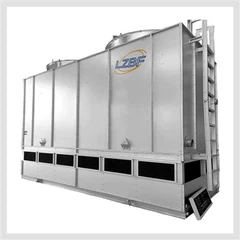
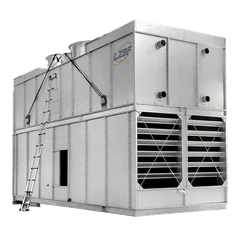
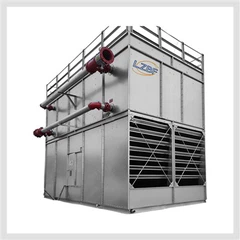
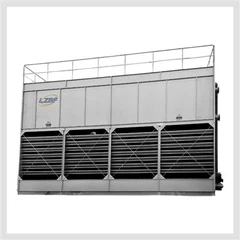

Closed cooling towers are significantly different from open cooling towers
Apr 01, 2026
Leave a message

As common heat exchange equipment in industrial prtion and air conditioning systems, closed cooling towers differ significantly from open cooling towers in working principles, structural design, performance characteristics, and application scenarios. Although both aim to achieve heat dis and cooling, their core design concepts and functional positioning are completely different, which directly affects their selection and operational performance in practical applications. The following is a detailed comparison of the two typeoling towers.

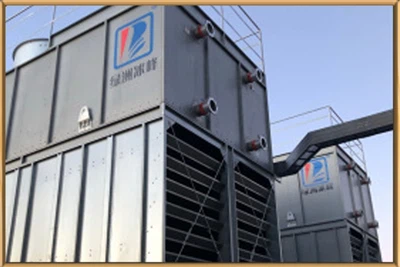
The most fundamental difference between closed and open cooling towers lies in their working principles, which also determine their overall functional characteristics. Open cooling towers use a direct contact heat exchmethod: high-temperature circulating water is evenly sprayed onto the packing layer via a spray system, forming a thin water film that comes into full contact with the air driven by the fa dissipation is mainly achieved through two methods: sensible heat exchange between water and air, and latent heat absorption caused by water evaporation, with evaporative latent heat accountingfor about 80% of the total heat dissipation. After heat exchange, the cooled water falls into the bottom sump and is pumped back into the system for circulation. However, during his process, the circulating water is directly exposed to the air, making it prone to mixing with dust, impurities, and microorganisms from the environment.

In contrast, closed cooling t an indirect contact heat exchange method. The process fluid to be cooled circulates inside a closed coil, having no direct contact with the outside air. The spray system sprays cooling wato the outer surface of the coil, forming a water film. The heat from the high-temperature fluid inside the coil is transferred to the spray water through the tube wall, and e fan drives air flow to carry away the heat through evaporation and convection. The spray water falls into the sump for circulation, while the process fluid remains clean and free from external cntamination. Furthermore, closed cooling towers can switch between full-evaporative mode, dry mode, and hybrid mode according to ambient temperature, balancing energy efficiency and water conservation.

Corring to their different working principles, the structural components of the two cooling towers also differ significantly. Open cooling towers have a relatively simple structure, mainly consisting of the tower body, acking layer, spray system, sump, and drift eliminator. The packing layer is usually made of PVC corrugated plates with a large specific surface ara (up to 200-400 square meters per cubic meter) to enhance contact between water and air. The drift eliminator is used to reduce water drift loss, and the sumply connected to the circulation system. While it is easy to clean, it is also prone to scaling and algae growth.

Closed cooling towers have a more complex structure, with the core comnent being a closed coil, typically made of stainless steel or copper, possessing good pressure resistance (1.6-2.5 MPa) and thermal conductivity. In addition to the pray system, fan, and sump, they are equipped with drift eliminators to prevent spray water from being carried away by the air. Some models are also equipped with anti-freeze ices such as electric heating tapes to adapt to low-temperature environments. Due to the addition of the coil, closed cooling towers have greater air resistance than open cooling towers, so the accompanying fans is usually higher.
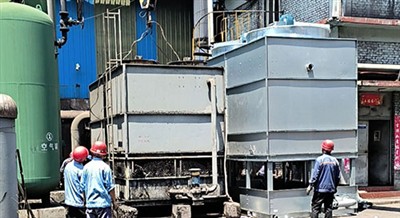
In terms of performance characteristics, both types of cooling towers have distinct advantages and disadvantages. Open cooling towers offer advantages such as high heatn efficiency, simple structure, low initial investment, and low maintenance costs. They can rapidly reduce water temperature through direct contact heat exchange, making them suitable for large-scale industrial cooling sce where water quality requirements are not high. However, they consume large amounts of water with significant evaporation losses, and the circulating water is prone to contamination, requiring frequent water treatment to pe corrosion and scaling.

Closed cooling towers excel in water conservation and pollution prevention, consuming 30%-50% less water than open cooling towers. The process fluid cir in a closed loop, avoiding oxidation, corrosion, and contamination, which effectively extends the service life of connected equipment. They are suitable for high-precision process cooling. However, their initial in maintenance costs are relatively higher, and due to the barrier of the coil walls, their heat dissipation efficiency is slightly lower than that of open cooling towers.

These differences directly determine theiron scenarios. Open cooling towers are widely used in power plants, steel mills, general industrial cooling systems, and central air conditioning systems, where water quality requirements are not high and le volumes of circulating water are needed. Closed cooling towers are more suitable for scenarios with high water quality requirements, such as precision machinery, electronics manufacturing, and pharmaceutical/food processing industr, as well as regions with water scarcity or harsh environments. They are also suitable for cooling corrosive or expensive process media like acid solutions and ethylene glycol solutions.

In summary, closed cog towers and open cooling towers differ significantly in working principles, structure, performance, and application scenarios. Open cooling towers focus on cost-effectiveness and efficiency, while closed cooling towers emphasize water onservation, pollution prevention, and stability. In practical applications, the appropriate type should be selected based on actual needs such as water quality, water consumption, heat dissipation efficiency, and invesnt budget to ensure the stable and efficient operation of the cooling system.
Send Inquiry