


What is the Service Life of Cooling Towers?
Jul 14, 2026
Leave a message

As core heat dissipation equipment for industrial refrigeration and central air conditioning systems, cooling towers do not have a fixed service life, which is jointly determined by four major factors: equipment type, main material, operating conditions and daily maintenance.

The designed service life range of mainstream equipment in the industry is clear. The equipment can reach its designed service life under normal operation and maintenance, while inadequate maintenance will drastically shorten its service cycle. There is a notable gap in service life between core wearing parts and the main frame, which will be elaborated below combined with actual working conditions.
cooling tower
There is an obvious difference in service life between open cooling towers and closed cooling towers in terms of structural type. A standard fiberglass open cooling tower is designed to serve for 15 to 20 years, and its tower shell features good corrosion resistance.

However, the fill is in direct contact with air and impurities for a long time. PVC fill will scale and become brittle within only 3 to 5 years, while PP fill can extend the service life to 6 to 8 years, requiring regular replacement to guarantee heat exchange performance.
The frame of hot-dip galvanized steel open towers lasts 10 to 15 years. In coastal areas with heavy salt spray and chemical environments with acid and alkali substances, the galvanized layer is highly susceptible to corrosion and perforation within 5 years, leading to rapid decline in structural strength.
cooling tower
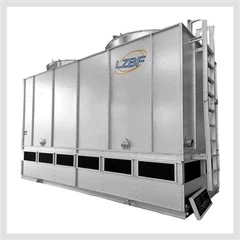
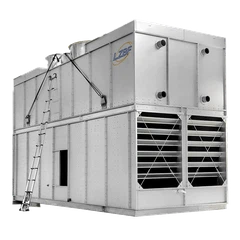
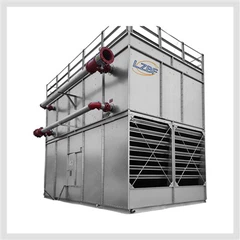
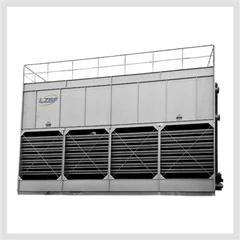
 Closed cooling towers adopt a closed coil heat exchange structure, where internal medium does not come into contact with external dust and microorganisms, greatly lowering risks of corrosion and scaling.
A standard closed cooling tower with 304 stainless steel coils boasts an overall service life of 20 to 25 years. Those equipped with 316L stainless steel are suitable for chemical and coastal applications, and can operate steadily for 25 to 30 years with standardized maintenance.
The internal circulating pipelines remain clean long-term, and only the external spray fill needs regular cleaning and replacement, resulting in a far longer major maintenance cycle than open towers.
cooling tower
 Material is the core factor that determines the upper limit of a cooling tower's service life. FRP fiberglass shells resist acid and alkali and are rust-proof, capable of serving 15 to 20 years under ordinary outdoor conditions.
 Nevertheless, long-term exposure to intense ultraviolet radiation will cause chalking and cracking; shells without anti-aging coatings may crack and leak after around 10 years. Pultruded anti-corrosion fiberglass delivers superior weather resistance, with high-quality models offering a service life of over 30 years.
 Hot-dip galvanized carbon steel comes at a lower cost, lasting 10 to 15 years in ordinary factories with pure circulating water, yet its service life will be halved directly under poor water quality with excessive chloride ions.
 304 stainless steel fits general industrial scenarios with a 20–25 year service life, while 316L stainless steel stands out in salt spray and chemical corrosion resistance, enabling stable operation for more than 20 years even under harsh working conditions.
 Large concrete frames for industrial cooling towers have the highest durability with a designed service life of 30 to 50 years, only requiring regular replacement and maintenance of internal fill and metal pipelines. Fan motors, bearings and gaskets are general wearing parts.
 Even if the tower body remains intact, motors need inspection or replacement every 8 to 10 years, and bearings must be filled with lubricant every 3 years; otherwise, abnormal noise and vibration will occur and accelerate overall equipment wear.
cooling tower
Operating conditions directly shorten or extend the service life of equipment. Factories with long-term high-temperature inlet water, untreated hard circulating water, heavy dust, salt spray and chemical waste gas witness doubled rates of corrosion and scaling.
 Long-term operation with hard water forms thick limescale on coils and fills, which reduces heat exchange efficiency and triggers local stress corrosion. Chloride ions from chemical waste gas and coastal sea wind continuously erode metal components.
Cooling towers without water chemical dosing and side filtration systems will lose one-third of their overall service life. On the contrary, indoor facilities or ordinary factories with stable water quality, moderate inlet water temperature and clean surroundings see significantly slowed equipment wear, and most units can reach or even exceed their designed service life.
cooling tower
Daily maintenance is essential to achieve the designed service life, and insufficient upkeep will lead to premature scrapping of equipment. Standardized maintenance consists of four modules: water quality control, regular cleaning, structural anti-corrosion and seasonal protection.

Water pH value and hardness shall be monitored monthly, scale and corrosion inhibitors shall be dosed, and blowdown shall be performed regularly to reduce concentration ratio. Fills shall be flushed, sludge in water basins removed and spray nozzles unclogged every quarter.
Steel structures shall be inspected for rust removal and repainting, and cracks on fiberglass shells repaired annually. Residual water shall be drained and antifreeze added in winter to prevent pipeline cracking.
Long-term lack of cleaning will cause fill blockage, motor overload and frame corrosion perforation. Fiberglass open towers with an original 15-year design life may need full replacement within 8 years under severe working conditions.
cooling tower
Based on industrial engineering practices, the standard service life of standard configurations in general factories is as follows: properly maintained fiberglass open cooling towers can serve 12 to 18 years, and hot-dip galvanized steel open towers 8 to 15 years; closed cooling towers with 304 stainless steel coils run stably for 20 to 25 years, while anti-corrosion closed towers adopting 316L stainless steel achieve a service life of 25 to 30 years.

When making procurement decisions, buyers should not only focus on initial purchase cost. Materials matching the service environment shall be selected together with standardized maintenance plans. This can not only prolong the service cycle of equipment, but also cut comprehensive costs arising from frequent equipment replacement and shutdown maintenance.
Send Inquiry