


How Low Can Cooling Tower Outlet Water Temperature Drop?
Jul 13, 2026
Leave a message

 The ultimate cooling limit of a cooling tower is determined by the local outdoor wet-bulb temperature, and infinite cooling is impossible. The core industry consensus is as follows: the minimum outlet water temperature of a standard open cooling tower can only approach the outdoor wet-bulb temperature plus 3 to 5°C.
Restricted by its heat exchange structure, a closed cooling tower will have its ultimate temperature raised by an additional 2 to 4°C. Chillers, ice thermal storage systems or other refrigeration equipment must be deployed if lower water temperatures are required.
Products Description
 Outdoor wet-bulb temperature is a critical parameter for measuring air moisture content and heat dissipation capacity, distinct from the dry-bulb temperature people normally perceive.
 In sweltering summer days with high air humidity, the wet-bulb temperature approximates the ambient temperature, drastically weakening the cooling tower's heat rejection performance.
 In dry and well-ventilated areas with low wet-bulb temperatures, heat dissipation efficiency improves remarkably. Taking summer operating conditions in North China as an example: with a dry-bulb temperature of 35°C and wet-bulb temperature of 27°C, the theoretical minimum outlet temperature of a conventional open cooling tower ranges from 30°C to 32°C.
 In arid Northwest China where the dry-bulb temperature hits 38°C while the wet-bulb temperature is merely 22°C, the outlet water can cool down to 25°C–27°C, presenting an obvious temperature difference.
Products Description
 Open counter-flow and cross-flow cooling towers are the most widely adopted models. They rely on direct contact evaporation between water and air for heat dissipation, delivering the highest heat exchange efficiency and optimal cooling limit.
 Under ideal full-load conditions with clean fills, fans running at full speed and uniform water spraying, the theoretical cooling limit is 3°C above the wet-bulb temperature.
 In practical engineering applications, factors including scaling on fills, reduced fan air volume, uneven water distribution and air short-circuiting inside the tower create performance losses.
 Thus, reserving a 5°C temperature margin is a safer design practice. Many factories mistakenly believe water can be cooled to 20°C at an ambient temperature of 30°C while ignoring wet-bulb constraints.
This leads to excessive operating temperatures and overheating alarms on high-temperature equipment such as air compressors, injection molding machines and medium-frequency furnaces.
Products Description

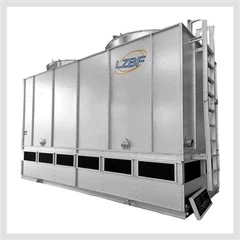
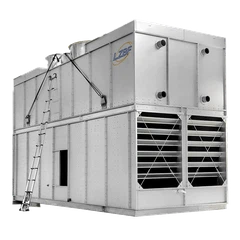
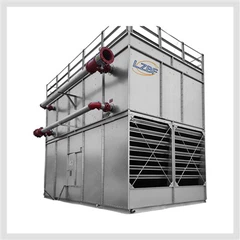
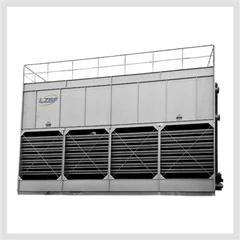
Closed cooling towers adopt sealed coil heat exchange, so circulating cooling water never makes direct contact with air, maintaining clean, impurity-free water quality. They suit scenarios with strict water quality requirements including photovoltaic energy storage, precision machine tools and chemical reactors.

However, an extra thermal resistance from metal coil walls reduces their cooling capacity compared to open towers. Under identical wet-bulb conditions, the outlet temperature of a closed tower is 2–4°C higher than that of an open tower.
In an environment with a 27°C wet-bulb temperature, a standard closed cooling tower can only achieve a minimum outlet temperature of 32°C–34°C. Adding auxiliary spray cooling and increasing fan airflow can narrow the temperature gap by roughly 1°C, yet it still cannot match the cooling limit of open cooling towers.
Products Description
 Numerous users demand low-temperature cooling water, for instance 15°C to 20°C in winter, which cannot be achieved by cooling towers alone.
Although ambient temperatures drop in winter, air still has a fundamental wet-bulb temperature threshold, and evaporation cooling alone can hardly cool water below this threshold.
Two feasible solutions are available: first, install plate heat exchangers paired with chillers for secondary refrigeration to lower water temperature; second, deploy air-cooled chillers independently for small-scale low-temperature processes without relying on cooling towers.
Products Description
 Routine maintenance directly determines the actual cooling limit of cooling towers. Fill clogging caused by limescale, slipping fan belts, blocked spray pipelines and ventilation obstruction by surrounding barriers can push the actual outlet temperature 4°C to 8°C higher than the theoretical value.
Regular cleaning and replacement of fills, fan inspections and removal of sludge at the tower bottom restore the equipment's original heat dissipation capacity, bringing operating temperatures close to the designed cooling limit.

In summary, cooling towers are essentially evaporative heat dissipation devices whose maximum cooling capacity is capped by local wet-bulb temperature. The optimal outlet temperature for open towers equals wet-bulb temperature plus 3–5°C, while that for closed towers equals wet-bulb temperature plus 5–9°C.

If process specifications demand water temperatures below this range, cooling towers alone are insufficient, and mechanical refrigeration equipment must be added. Consistent daily maintenance and cleaning allow cooling towers to steadily reach their maximum cooling performance and ensure uninterrupted stable operation of industrial equipment.
Send Inquiry