


What Is the Most Efficient Type of Cooling Tower?
Jan 06, 2026
Leave a message

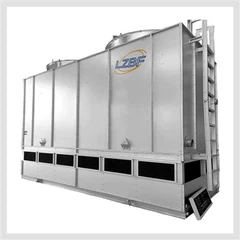
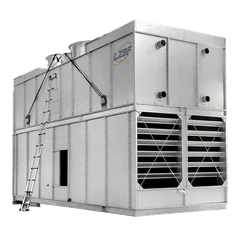
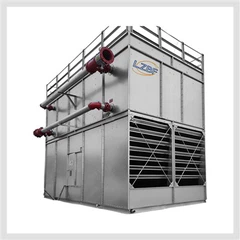
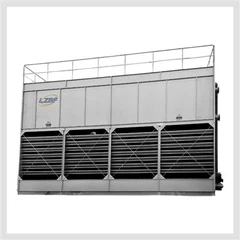
cross-flow closed-circuit cooling tower
In industrial cooling systems, thecross-flow closed-circuit cooling toweris currently the most efficient type in terms of overall performance. It far surpasses traditional models such as open-circuit cooling towers and counter-flow cooling towers in heat exchange efficiency, energy consumption control, operation and maintenance (O&M) costs, and environmental adaptability. This type is particularly suitable for scenarios with stringent requirements for cooling stability and energy efficiency, including precision manufacturing, data centers, and new energy industries.
From the perspective of core heat exchange principles, the cross-flow closed-circuit cooling tower adopts a "cross-air flow + closed-circuit circulation" design: cooling water flows inside sealed coil pipes without direct contact with the outside air, while external air passes horizontally through the coil pipes and the spray water layer, forming a three-phase heat exchange system (gas-liquid-solid). This structure increases the heat exchange area utilization rate by more than 30%, and the cooling temperature difference can be stably controlled within 5–8℃, which is significantly better than the 8–12℃ of open-circuit cooling towers. Meanwhile, the closed-circuit circulation completely solves the problems of scaling, corrosion, and water quality pollution associated with open-circuit towers. The cleaning cycle of the coil pipes is extended to 12 months, with a heat exchange efficiency attenuation rate of less than 5%. In contrast, open-circuit towers may experience a heat exchange efficiency attenuation of up to 20% within six months due to scaling.

In terms of energy efficiency, the cross-flow closed-circuit cooling tower has particularly prominent advantages. Its cross-flow design greatly reduces the static pressure loss of the fan, and the supporting high-efficiency variable-frequency fan saves 25%–30% more energy than the fans of traditional counter-flow cooling towers. In addition, this model can automatically adjust the fan speed and the start/stop of the spray pump according to the actual cooling load. The coefficient of performance (COP) under partial load conditions can reach more than 4.5, while the COP of open-circuit cooling towers is usually only 2.8–3.2. For a cooling water flow rate of 1,000 m³/h, the cross-flow closed-circuit cooling tower can save more than 100,000 yuan in electricity costs annually, fully complying with the energy conservation and consumption reduction requirements in the industrial sector.

From the perspective of O&M and service life, the cross-flow closed-circuit cooling tower features a lower overall cost. The closed-circuit circulation reduces the consumption of water quality treatment chemicals, with the chemical cost only accounting for 1/3 of that of open-circuit towers. At the same time, the sealed coil pipes have no risk of blockage, reducing the O&M workload by 60%. The designed service life of the equipment can reach 20 years, which is 8–10 years longer than that of open-circuit towers. In addition, its cross-flow structure results in a lower tower height, reducing the installation space requirement by 25%, making it more suitable for compact layouts inside workshops or on rooftops.

It should be noted that the initial investment cost of cross-flow closed-circuit cooling towers is 15%–20% higher than that of open-circuit towers. However, through the savings in energy costs and O&M costs, the investment can usually be recovered within 2–3 years. For simple industrial scenarios with low load and high dust concentration, open-circuit towers still have certain cost-effective advantages. Nevertheless, from the perspective of long-term operation and the core demand for high-efficiency cooling, the cross-flow closed-circuit cooling tower is currently the optimal choice in the industrial field.
Send Inquiry