


Closed Cooling Towers vs. Open Cooling Towers
Oct 30, 2025
Leave a message

Open cooling towers achieve cooling by spraying circulating water onto fill material. Fans drive air circulation inside the tower, enabling heat exchange through direct contact between water and air. The cooled circulating water exits at the bottom of the tower.
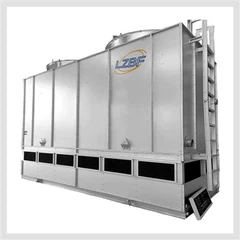
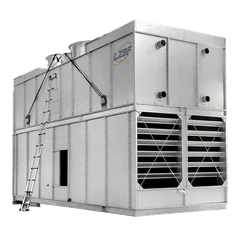
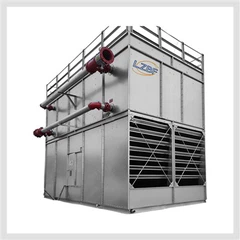
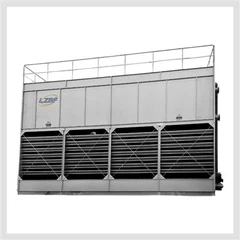
Closed cooling towers feature two circulation loops: an internal loop and an external loop. Their core component is a copper tube surface cooler, with no fill material.
(1) Internal Loop
It connects to the cooled equipment, forming a closed circulation system (usually using demineralized water as the circulating medium). It transfers heat from the equipment to the cooling tower. The internal circulating water flows through heat exchange coils, transferring heat to the atmosphere via these coils.
(2) External Loop
Composed of circulating pumps, spray systems, water collection pans, and pipelines, the external circulating water does not come into direct contact with the internal circulating water. It absorbs heat from the internal loop solely through the heat exchanger inside the tower, then dissipates the heat via direct contact with air. During autumn and winter when ambient temperatures are low, the external loop can be shut down if air-to-coil heat exchange alone meets cooling requirements.
Heat Dissipation Methods for External Loops
Both rely on water evaporation heat transfer and conductive heat transfer, with evaporation being the primary method. In summer, when water temperature is lower than air temperature, heat from the air transfers to the water, hindering heat dissipation. Conductive heat transfer only becomes effective gradually as outdoor temperatures drop, but its contribution remains minimal.
Water Quality of Cooled Circuits
Open cooling towers suffer from poor water quality, which easily causes scaling in the cooled heat exchangers. Their water treatment methods are complex and costly. Closed cooling towers maintain better water quality for the cooled circuits, with simpler and more cost-effective water treatment processes.
Water Consumption
Closed and open cooling towers have similar water consumption in summer. In cold seasons, the spray evaporation cooling can be turned off, significantly reducing water consumption for closed towers.
Anti-Freezing Requirements for Winter Operation
Equipment requiring year-round cooling may need the cooling tower to operate throughout the year. For cooling towers installed outdoors in cold or extremely cold regions, effective technical measures must be implemented to prevent freezing. The adoption of appropriate anti-freezing measures and ensuring safe winter operation of the cooling tower are critical to the success of the cold source system.
Specific Technical Measures
Based on cooling tower operation experience, the outlet water temperature should not be lower than 6℃ to avoid freezing risks. For extremely cold regions, it is recommended to set the design outlet water temperature to around 10℃-this meets the needs of computer room air conditioners and exceeds the minimum anti-freezing operating temperature specified by the equipment.
Equip the cooling tower with variable frequency fans. Under cold weather conditions, reducing fan speed can maintain the outlet water temperature within the controlled range, achieving energy savings, reducing circulating water drift, and preventing freezing.
Install bypass pipes and electric control valves on the cooling water supply and return pipelines. If the water temperature remains below the design value after the cooling tower fan stops, fully divert the cooling water back to the water collection pan or reservoir by opening the bypass. Restart the cooling tower only after the water temperature rises (note the process and steps for the bypass scheme).
Operate the cooling water pump at a constant flow rate to maintain the design flow consistently, preventing freezing caused by insufficient water flow in the cooling tower.

It is advisable to install a cooling tower water tank instead of the built-in water collection pan. Water from inactive cooling towers will be fully collected in the tank, which is located inside the refrigeration station. The favorable indoor environment prevents freezing. Additionally, winter operation of cooling towers requires higher standards for maintenance personnel and equipment quality. It is essential to select equipment suppliers with high product quality, advanced technology, and rich experience in anti-freezing solutions.
Send Inquiry