


Working Principle Of Evaporative Condenser
Nov 13, 2025
Leave a message
Working Principle of Evaporative Condenser
The evaporative condenser achieves highly efficient condensation by combining water evaporation heat absorption with forced air convection. Its working process can be divided into four key stages:
First,
high-temperature and high-pressure refrigerant gas enters the serpentine coil, where the temperature is typically maintained between 60-80°C. Simultaneously, the spray system evenly distributes circulating water over the coil surface, forming a continuous water film.
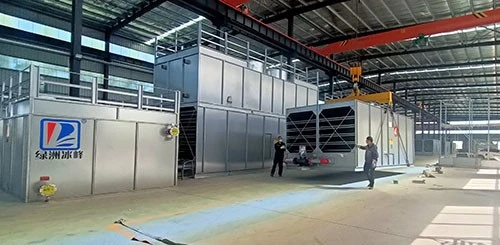
Subsequently,
under the forced airflow generated by the fan, approximately 15-20% of the spray water rapidly evaporates. This phase change process absorbs a significant amount of heat, with each kilogram of water evaporation removing about 2450 kJ of thermal energy. The refrigerant within the coil begins to undergo phase change as heat is carried away.
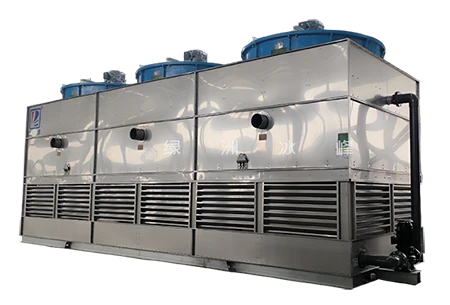
Meanwhile,
the fan continuously draws in ambient air, not only accelerating water film evaporation but also promptly discharging unevaporated water mist and humid air. The drift loss rate can typically be controlled within 0.001% of the circulating water volume, effectively reducing water resource waste.
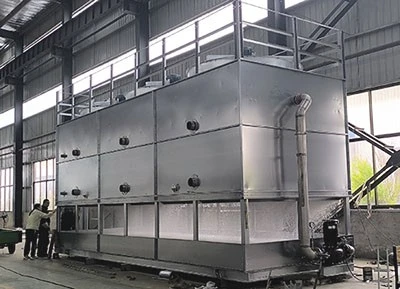
Finally,
the refrigerant that has completed heat exchange gradually condenses into a liquid state, with the temperature dropping to 5-8°C above the ambient wet-bulb temperature. The circulating water is recovered through the collection tank and transported back to the spray system by the pump for reuse, while the automatic water replenishment valve适时 (shìshí - timely) supplements fresh water according to water level changes.
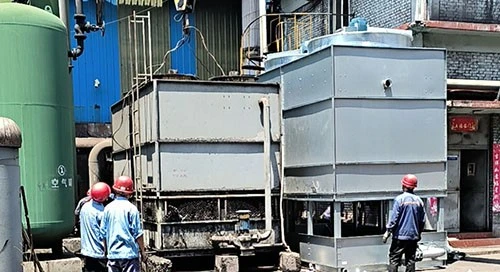
This design, which organically integrates heat transfer and mass transfer processes, enables the evaporative condenser to save about 40% more energy than traditional air-cooled models and approximately 70% more water than water-cooled models. It is particularly suitable for industrial scenarios with limited water resources and high energy efficiency requirements.
Send Inquiry