


Which Is Better, Open-Loop Or Closed-Loop Cooling Tower?
Jun 15, 2026
Leave a message
Which Is Better, Open-Loop or Closed-Loop Cooling Tower?
In the field of industrial cooling, "which is better, open or closed?" is a question that comes up frequently. Many users struggle with this choice when selecting a cooling tower.But the question itself is flawed. "Which is better" depends on your specific operating conditions, budget, operational requirements, and long-term goals. There is no absolute "better" - only "more suitable."Below we compare open and closed-circuit cooling towers from multiple dimensions to help you make a more informed decision.I. Fundamental Difference in Working Principle
Open Cooling Tower:
Circulating water is directly exposed to the air. It is pumped to the top of the tower and evenly distributed over the fill material. A fan draws external air in from the bottom. The air comes into contact with the water, and a portion of the water evaporates, carrying away heat. The cooled water falls back into the basin at the bottom and is recirculated.Core characteristic: Water is in direct contact with air. Water evaporates, and it becomes dirty.Closed-Circuit Cooling Tower:
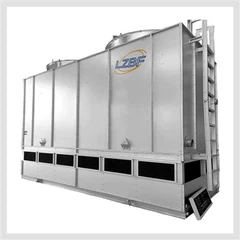
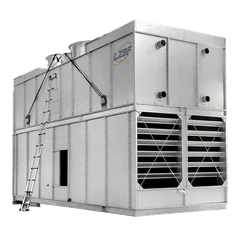
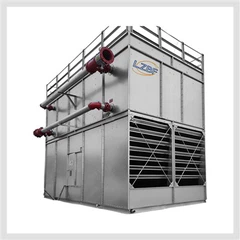
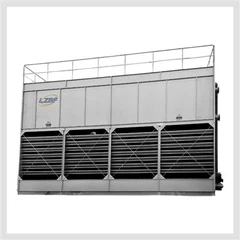
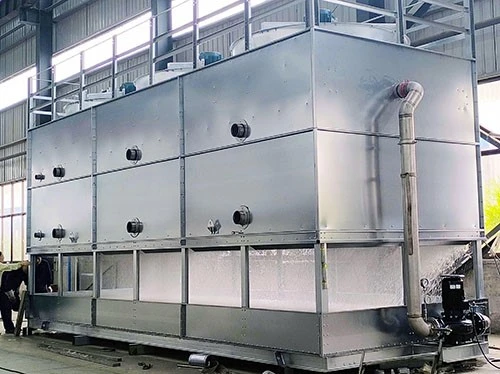
The circulating water is completely sealed inside heat exchange coils. An independent spray water system is contained within the tower. The spray water evaporates on the external surface of the coils, carrying away heat from the circulating water inside the coils. The circulating water inside the coils is completely isolated from the spray water and the air.Core characteristic: The internal circulating water never contacts the air. It does not evaporate, is not consumed, and is not contaminated.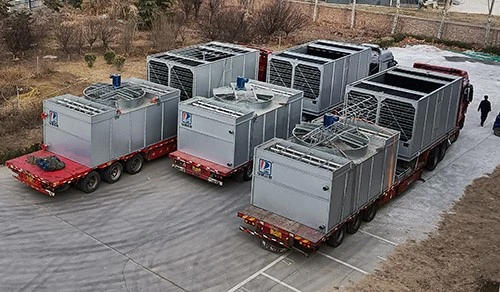
II. Multi-Dimensional Comparison
Aspect Open Cooling Tower Closed-Circuit Cooling Tower
Initial Investment Lower (about 50%-70% of closed type for same capacity) Higher (coil cost is high, more complex structure)
Operating Cost (Water) High. Evaporation loss about 1%-3%, requires continuous makeup water Extremely low. Internal loop consumes no water, spray water is recirculated
Operating Cost (Electricity) Lower (low air resistance, lower fan energy) Slightly higher (higher air resistance, additional spray pump energy)
Water Quality Dirty. Leaves, dust, insects easily enter Clean. Internal loop fully sealed, impurities cannot enter
Scaling Risk High. Water evaporation concentrates minerals, leading to scale precipitation Extremely low. Internal loop does not concentrate, no scale inside coils
Equipment Life Shorter. Corrosion and scaling cause premature aging Longer. Clean internal loop, coil life can reach 10-15 years
Maintenance Frequency High. Requires frequent cleaning of fill, basin, nozzles Low. Internal loop is maintenance-free; spray system needs periodic cleaning
Winter Freeze Protection Easier. Natural draining after shutdown Requires additional measures (heat tracing, draining, antifreeze)
Noise Higher (noticeable falling water noise) Lower (water film heat exchange, less falling water noise)
Footprint Larger Smaller (more compact structure)
Applications Situations not sensitive to water quality, strong maintenance capability, tight budget Situations sensitive to water quality, high equipment life requirements, water-scarce areas.
III. When Should You Choose an Open Cooling Tower?
An open cooling tower is still a reasonable choice, especially in the following situations:Very tight budget:
The initial investment of an open tower is significantly lower. If project funds are limited, an open tower is a more realistic choice.Not sensitive to water quality:
If the equipment being cooled has low requirements for water quality (e.g., certain rough industrial processes), the "dirty water" issue of an open tower is not a major concern.Strong maintenance capability:
Open towers require frequent fill cleaning, regular blowdown, and water treatment chemicals. If the factory has a dedicated maintenance team, these are not problems.Temporary projects:
If the project only needs to run for one or two years, the low initial investment of an open tower is a clear advantage.The core issues with open towers: dirty water, scaling, high water consumption. If you can accept these three points, an open tower is an economical choice.
IV. When Should You Choose a Closed-Circuit Cooling Tower?
The advantages of a closed-circuit cooling tower are especially prominent in the following scenarios:
Industries with high water quality requirements:
Data centers, pharmaceutical manufacturing, food processing, precision manufacturing. For these industries, equipment fouling or clogging can cause huge losses. The clean circulating water of a closed-circuit tower is the best guarantee.Water-scarce regions:
The annual water evaporation from an open tower is significant. In areas with high water prices or water extraction limits, the water savings of a closed-circuit tower quickly cover the initial investment difference.Long equipment life requirements:
The coil life of a closed-circuit tower can reach 10-15 years or more, while an open tower may develop serious corrosion or scaling problems within 5-8 years.
Limited maintenance capability:
A closed-circuit tower requires almost no daily maintenance - just periodic checks of the spray system. For factories without dedicated maintenance personnel, a closed-circuit tower is more worry-free.Limited installation space: Closed-circuit towers have a compact structure and small footprint, suitable for installations with limited rooftop space.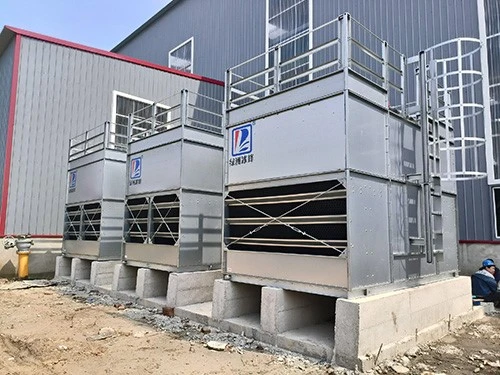
V. An Often Overlooked Dimension: Lifecycle Cost
Many users only compare initial investment and ignore long-term operating costs. Let's do some math.
Assume a cooling tower with a capacity of 100 tons per hour, operating for 10 years:
Cost Item Open Tower Closed-Circuit Tower
Initial Investment 100,000 180,000
Water Cost (10 years) Approx. 300,000 (annual consumption 16,000 tons, at 2 RMB/ton) Approx. 30,000 (annual consumption 1,600 tons)
Electricity Cost (10 years) Approx. 200,000 Approx. 220,000
Maintenance Cost (10 years) Approx. 150,000 (cleaning, repairs, fill replacement) Approx. 50,000
Total 10-Year Cost Approx. 750,000 Approx. 480,000
Although the closed-circuit tower costs 80,000 more upfront, its total cost over a 10-year operating cycle is 270,000 lower than the open tower.
VI. Conclusion: There Is No "Better," Only "More Suitable"
Open and closed-circuit cooling towers each have their advantages and disadvantages.
The advantages of an open tower are lower initial investment. Its disadvantages are dirty water, scaling, high water consumption, and shorter life.The advantages of a closed-circuit tower are clean water, water conservation, and longer life. Its disadvantages are higher initial investment and additional freeze protection needs.
Your choice should be based on three questions:
How sensitive is your equipment to cooling water quality?
Is your project short-term (1-3 years) or long-term (10+ years)?
What are the water prices and water extraction policies in your region?
If your answers lean toward "water quality sensitive, long-term operation, high water prices," a closed-circuit cooling tower is the better choice. If your answers are "water quality not sensitive, short-term project, tight budget," an open cooling tower is still a reasonable choice.
Oasis Bingfeng - 24 years focused on the R&D and manufacturing of closed-circuit cooling towers. We do not disparage open towers, nor do we mythologize closed towers. We do one thing: help users make the most suitable choice based on their real operating conditions.Send Inquiry