


The Two Main Types Of Cooling Tower Configurations: Open And Closed
Jun 17, 2026
Leave a message
The Two Main Types of Cooling Tower Configurations: Open and Closed
In the field of industrial cooling, cooling towers are mainly divided into two types based on whether the circulating water system is in direct contact with the atmosphere: open cooling towers andclosed-circuit cooling towers. These two configurations each have their own advantages and disadvantages, suitable for different operating conditions and scenarios. Below we explain in detail the core differences, characteristics, and applications of each.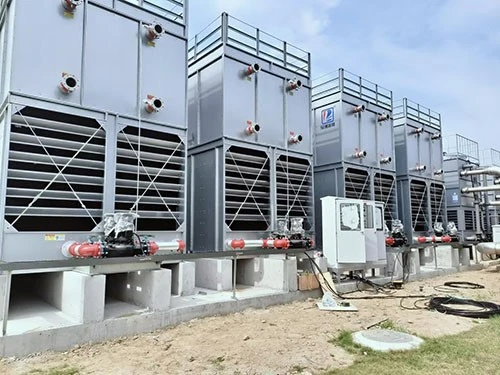
I. Open Cooling Tower
Definition and Working Principle:
The open cooling tower is the most traditional and common form. Its working principle is: circulating water, after absorbing heat from the system (such as a chiller or industrial equipment), is pumped to the top of the tower and evenly distributed over the fill material through a water distribution system. A fan at the top continuously draws external air in from the bottom and expels it from the top. As the air passes through the wetted fill, it picks up heat from the water, and a portion of the water evaporates, achieving cooling. The cooled water falls back into the basin and is pumped back to the equipment needing cooling, repeating the cycle.Core characteristic:
Circulating water is in direct contact with air, cooling through both evaporative and convective heat transfer.Advantages:
- Lower initial investment: simple structure, no complex heat exchange coil system, lower manufacturing cost
- High heat exchange efficiency: direct contact between water and air enables efficient evaporative cooling
- Lighter weight: simple structure, lower requirements for installation foundations
- Easy winter freeze protection: water can be naturally drained after shutdown, low risk of freeze damage
Disadvantages:
- Poor water quality: circulating water is directly exposed to air, allowing leaves, dust, insects, and other impurities to enter
- Severe scaling: water concentrates due to evaporation, causing calcium and magnesium ions to accumulate and form scale on equipment surfaces
- High water consumption: evaporation and drift losses require significant makeup water
- Shorter equipment life: corrosion and scaling cause premature aging
- Frequent maintenance: requires regular cleaning of fill, basin, nozzles, and chemical treatment
- Higher noise: noticeable falling water impact noise
Applications:
- Rough industrial cooling with low water quality requirements
- Short-term projects with tight budgets
- Factories with strong maintenance capabilities
- Equipment cooling that is not sensitive to water quality

II. Closed-Circuit Cooling Tower
Definition and Working Principle:
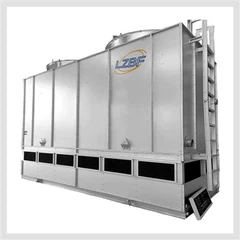
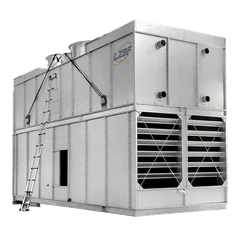
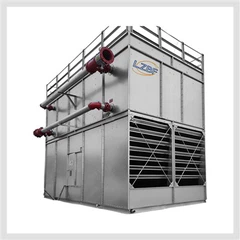
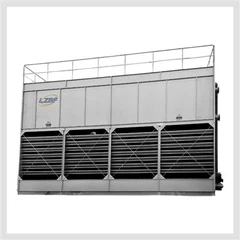
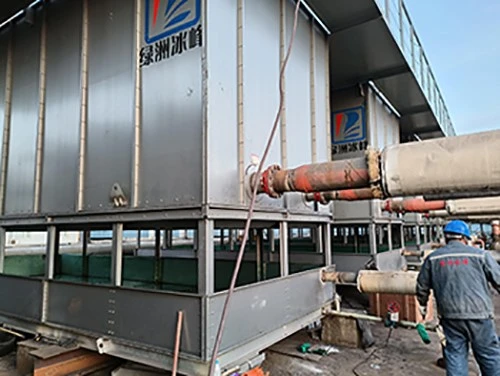
Closed-circuit cooling towersuse a completely different design approach. The circulating water to be cooled is sealed inside heat exchange coils, with an independent spray water system outside the coils. The process works as follows:Internal circuit (process side):
Hot circulating water from the chiller or industrial equipment flows inside the sealed heat exchange coils. This water is completely isolated from the outside air.External circuit (cooling side):
A spray pump draws water from the basin at the bottom and distributes it above the coils, where nozzles evenly spray it onto the external surface of the coils, forming a thin water film.Forced air flow:
A fan draws air in from the bottom of the tower, flowing upward across the external surface of the coils, accelerating evaporation of the water film and carrying away heat from the circulating water inside the coils.Heat transfer path:
Heat from the internal circulating water → coil wall → external water film → carried away by evaporation into the air.
Core characteristic:
The internal circulating water is completely isolated from the air - no evaporation, no loss, no contamination. The external spray water operates independently as a cooling medium.Advantages:
- Clean water quality: internal circulating water is fully sealed, impurities cannot enter, remains pure
- No scaling: internal water does not evaporate or concentrate, so no scale forms on the internal coil surfaces
- Significant water savings: internal loop consumes no water, spray water is recirculated, annual water savings can exceed 90%
- Long equipment life: coils do not corrode or scale, service life can reach 10-15 years or more
- Low maintenance cost: internal loop is maintenance-free, only the spray system needs periodic cleaning
- Stable operation: heat exchange efficiency remains consistent over time, not degraded by scaling
- Lower noise: water film heat exchange on coil surfaces results in less falling water noise
- Flexible installation: compact structure, small footprint
Disadvantages:
- Higher initial investment: heat exchange coils are expensive, structure is more complex
- Heavier weight: coils and structural components add overall weight
- Winter freeze protection required: external spray water is at risk of freezing in low temperatures
- More complex maintenance: coil leaks are relatively difficult to repair
- External loop needs periodic maintenance: spray water still requires periodic blowdown and cleaning
Applications:
- Industries with high water quality requirements (data centers, pharmaceuticals, food, precision manufacturing)
- Water-scarce regions or areas with high water prices
- Equipment requiring long-term stable operation
- Factories with limited maintenance capability or wanting to reduce maintenance burden
- Sites with limited installation space
III. Key Comparison of the Two Configurations
| Aspect | Open Cooling Tower | Closed-Circuit Cooling Tower |
|---|---|---|
| Water Quality | Dirty, contains impurities | Clean, pure water circulation |
| Scaling Risk | High | Extremely low |
| Water Consumption | High (annual loss about 1%-3% of circulation volume) | Very low (over 90% water savings annually) |
| Initial Investment | Low | High (about 1.5-2 times) |
| Operating Cost | High water cost + high maintenance cost | Low water cost + low maintenance cost |
| Equipment Life | 5-8 years | 10-15 years |
| Maintenance Frequency | Frequent | Very low |
| Winter Freeze Protection | Easy | Requires additional measures |
| Noise | Higher | Lower |
| Suitable Water Quality | Average | Even poor water quality can be handled |
| Lifecycle Cost | Higher | Lower |
IV. How to Choose?
Choose an open cooling tower when:
- Budget is very tight
- Equipment is not sensitive to water quality
- Project is short-term or temporary
- Factory has ample maintenance personnel and capability
Choose
a closed-circuit cooling tower
when:
- Equipment is sensitive to water quality (data centers, pharmaceuticals, food, etc.)
- Water resources are scarce or water prices are high
- Project is long-term (10+ years)
- You want to reduce long-term operating costs and maintenance burden
- Installation space is limited
V. Conclusion
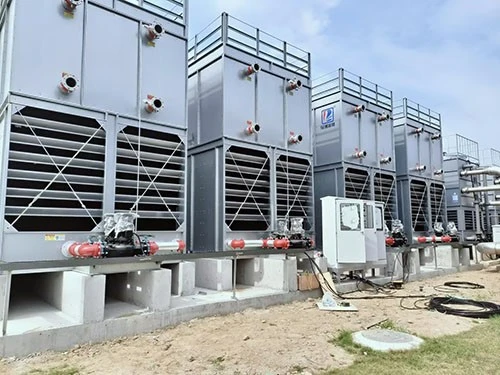
Open andclosed-circuit cooling towersare two distinctly different cooling configurations. There is no absolute "better" or "worse" - only "more suitable" or "less suitable." If your needs are low cost, short cycle, and you don't mind frequent maintenance, an open tower is a reasonable choice. If your needs are long life, stable operation, low maintenance, water savings, and energy efficiency, a closed-circuit tower is the better option.The key is to choose the one that best fits your specific operating conditions, budget, and long-term goals.Oasis Bingfeng - 24 years focused on the R&D and manufacturing ofclosed-circuit cooling towers. We not only provide high-quality closed-circuit cooling towers but also offer professional selection guidance to help you make the most informed decision.
Send Inquiry