


What Are The Three Types Of Cooling Towers?
Jun 13, 2026
Leave a message
What Are the Three Types of Cooling Towers?
In the field of industrial cooling, cooling towers are mainly divided into three types based on the direction of airflow and water flow, as well as structural design: counterflow, crossflow, and hybrid flow. Each type has its own characteristics and is suitable for different operating conditions and scenarios. Below is a detailed explanation.
I. Counterflow Cooling Tower
Structural Features:
The core characteristic of a counterflow cooling tower is that the air and spray water flow in opposite directions. Air enters from the bottom of the tower and moves upward, while spray water is distributed from the top and flows downward over the heat exchange coil surface, forming a countercurrent flow.
Working Principle:
In a counterflow design, the coolest air first contacts the coolest part of the coil (where the circulating water has already been partially cooled), while the warmest air at the top contacts the warmest part of the coil (where the circulating water has just entered). This "gradient matching" maximizes the average temperature difference across the heat exchange process, resulting in the highest heat transfer efficiency.
Advantages:
Highest heat transfer efficiency: Under the same coil area and fan power, counterflow typically achieves 15-25% higher heat exchange than crossflow
Compact structure: Small footprint, suitable for installations with limited space
Lower outlet water temperature: Can get closer to the ambient wet-bulb temperature, meeting demanding cooling requirements
Disadvantages:
Higher air resistance, leading to slightly higher fan energy consumption
Taller tower height compared to crossflow designs
Requires highly uniform water distribution
Applications:
Factories or rooftops with limited space
Industries with strict cooling requirements (e.g., data centers, precision manufacturing)
Process cooling requiring low outlet water temperatures
II. Crossflow Cooling Tower
Structural Features:
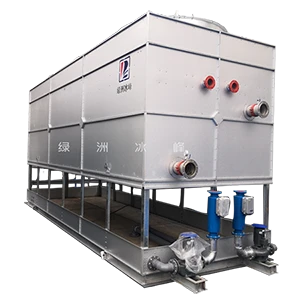
In a crossflow cooling tower, the air and spray water flow in directions perpendicular to each other. Air enters horizontally through louvers on both sides of the tower and flows across the heat exchange coils, while spray water falls vertically from the top down through the coil surfaces.
Working Principle:
In a crossflow design, air moves horizontally across the coils, intersecting with the vertically falling spray water. This structure creates a shorter airflow path and lower air resistance. Coils are typically arranged in multiple rows, with air gradually absorbing heat and moisture as it passes through the coil bundle.
Advantages:
Low air resistance: Smooth airflow, resulting in lower fan energy consumption
Low noise: Gentle airflow pattern, significantly quieter than counterflow designs
Easy maintenance: Coil area is easily accessible, providing ample maintenance space
Simple water distribution: Spray system has a simple structure, less prone to clogging
Disadvantages:
Slightly lower heat transfer efficiency than counterflow
Larger footprint than counterflow designs
Slightly lower coil area utilization for the same tower size
Applications:
Noise-sensitive locations (hospitals, hotels, schools, residential areas)
Installations with limited height but sufficient floor space
Situations requiring frequent inspection and maintenance

III. Hybrid Flow Cooling Tower
Structural Features:
The hybrid flow cooling tower is an innovative fusion of counterflow and crossflow designs. Its typical configuration consists of a heat exchange coil section in the upper part and a fill section in the lower part. Spray water first passes through the fill section for pre-cooling before being sprayed onto the coils above.
Working Principle:
Spray water descends from the top of the tower and first enters the fill section. Inside the fill section, air and spray water undergo thorough heat exchange, significantly lowering the spray water temperature. This pre-cooled spray water is then evenly distributed over the coil surface above to cool the circulating water inside the coils. This "two-stage cooling" design effectively reduces the risk of scaling on the coil surface, since lower water temperatures make it harder for scale to precipitate.
Advantages:
Strong anti-scaling capability: Spray water is pre-cooled in the fill section, reducing scaling on coil surfaces
Suitable for poor-quality water: Ideal for regions with hard water
Stable heat transfer efficiency: Less scaling means slower performance degradation over time
Combines the high efficiency of counterflow with the low air resistance of crossflow
Disadvantages:
More complex structure, slightly higher manufacturing cost
Tallest tower height among the three types
Fill section requires periodic cleaning and maintenance
Applications:
Regions with poor water quality (northern hard water areas, well water applications)
Industries requiring long-term operational stability
Situations where both heat transfer efficiency and maintenance convenience are needed

Summary Comparison of the Three Types
| Aspect | Counterflow | Crossflow | Hybrid Flow |
|---|---|---|---|
| Heat Transfer Efficiency | ★★★★★ | ★★★★ | ★★★★★ |
| Footprint | ★★★★★ (small) | ★★★ (large) | ★★★★ |
| Operating Noise | ★★★ | ★★★★★ (low) | ★★★★ |
| Maintenance Ease | ★★★ | ★★★★★ (easy) | ★★★★ |
| Anti-scaling Ability | ★★★ | ★★★★ | ★★★★★ |
| Manufacturing Cost | Medium | Lower | Higher |
| Suitable Water Quality | Average | Average | Poor |

How to Choose?
Prioritize heat transfer efficiency and small footprint → Choose Counterflow
Prioritize noise control and easy maintenance → Choose Crossflow
Poor water quality and need for long-term stability → Choose Hybrid Flow
Oasis Bingfeng - 24 years focused on the R&D and manufacturing of closed-circuit cooling towers. All three tower types can be customized according to customer operating conditions.

Send Inquiry