

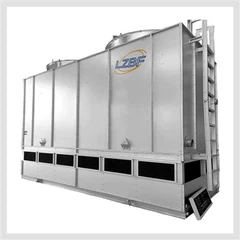
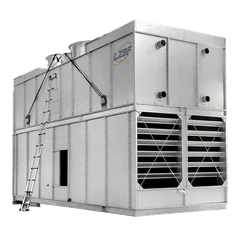
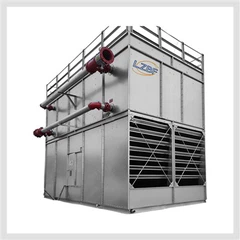
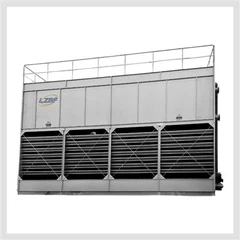

Counterflow Vs. Combined Flow Closed Circuit Cooling Tower Comparison
Jan 23, 2026
Leave a message
The choice between a counterflow and a combined flow closed circuit cooling tower is essentially a trade-off between cooling efficiency, project budget, installation constraints, and energy consumption. In simple terms, the counterflow type is the choice for pursuing ultimate efficiency and compact space, while the combined flow type is more suitable for handling large thermal loads and is better suited for situations with greater sensitivity to initial investment and space constraints.

To help you quickly grasp the key distinctions, I have summarized the crucial comparisons between the two as follows:
Counterflow vs. Combined Flow Closed Circuit Cooling Tower Comparison
| Comparison Dimension | Counterflow Closed Circuit Cooling Tower | Combined Flow Closed Circuit Cooling Tower |
|---|---|---|
| Core Principle | Air and water flow in completely counter-current directions, maximizing the heat transfer temperature difference and driving force. | "Counterflow + Crossflow" hybrid design: Upper counterflow coils provide initial cooling, while lower fill media enables deep cooling and enhanced evaporation. |
| Main Advantages | 1. Highest heat exchange efficiency, achieving lower outlet water temperatures under comparable conditions. 2. Compact structure with a relatively smaller footprint, saving space. |
1. Strong capability in handling large thermal loads, especially suitable for high-temperature or large ΔT conditions. 2. Generally lower initial investment and operational energy consumption for the same cooling capacity. 3. Superior airflow organization, effectively reducing "air blocking" for more stable operation. |
| Main Disadvantages | 1. Higher system resistance, potentially leading to greater fan energy consumption. 2. Higher requirements for water quality and water distribution uniformity. |
1. Typically larger in size, occupying more space. 2. Relatively more complex structure with slightly more maintenance points. |
| Typical Applications | Scenarios pursuing ultimate cooling effect with limited installation space. Examples: Precision manufacturing, chemical reactors, high-frequency power supplies, and other processes with stringent outlet temperature requirements. |
Scenarios with large cooling loads, significant temperature differences, and sensitivity to overall cost. Examples: Large central air conditioning systems, steel smelting, data centers, waste heat recovery systems, etc. |
| Selection Guideline | Choose Counterflow for: Priority on efficiency & limited space. |
Choose Combined Flow for: Priority on large loads & cost-effectiveness.
|

Overall, you can follow this line of thinking when making a choice: "Prioritize efficiency and limited space? Choose counterflow. Prioritize large loads and cost? Choose combined flow." As long as the project's meteorological conditions (such as wet-bulb temperature) and process parameters (flow rate, temperature difference) are met, both types can achieve the design objectives.
Send Inquiry