

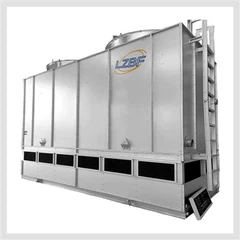
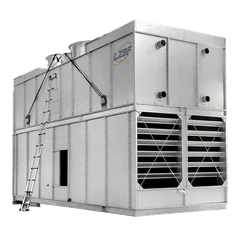
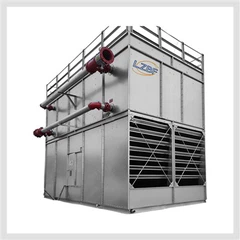
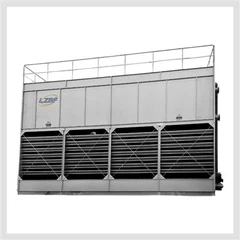

Counterflow Closed-Circuit Cooling Tower Working Process
Jun 23, 2026
Leave a message
Counterflow Closed-Circuit Cooling Tower Working Process
I. What Is a Counterflow Closed-Circuit Cooling Tower
A counterflow closed-circuit cooling tower is a high-efficiency cooling device designed based on the principle of gas-liquid counterflow heat transfer enhancement-. Its name derives from its core design feature: spray water is evenly distributed from top to bottom through the water distribution system, while air is drawn by fans from bottom to top in a high-speed counterflow, and the two undergo sensible and latent heat exchange on the surface of the heat exchange coils, thereby achieving closed-loop cooling of the process fluid. In short: water moves downward, air moves upward - opposite directions, maximum heat exchange efficiency.

II. Core Working Process
The operation of a counterflow closed-circuit cooling tower consists of two independent cycles: the internal circuit and the external circuit-.
1. Internal Circuit (Process Side)
Circulating water, after being heated by heat source equipment (air compressors, medium-frequency furnaces, reactors, etc.), enters the heat exchange coils of the cooling tower. The high-temperature medium flows inside the coils, and heat is transferred through the coil walls to the outside. The cooled circulating water is then returned to the heat source equipment by the pump.
The core feature of the internal circuit: the medium flows entirely within the enclosed coils, with no contact with outside air or spray water-. This means the medium is not contaminated, does not evaporate, and does not scale - this is the core value of closed-circuit cooling towers.
2. External Circuit (Cooling Side)
Spray water is delivered from the collection basin to the spray system and evenly sprayed from above the coils, forming a water film on the outer surface of the coils. The axial fan at the top of the tower continuously operates, drawing air from inside to outside, creating negative pressure-. Cold air enters from the lower part of the tower and flows upward, in the opposite direction to the spray water - this is the origin of the term "counterflow."
The rising air passes over the water film on the coil surfaces, carrying away evaporated water vapor-. Water evaporation absorbs a large amount of latent heat - this is the most efficient part of the entire cooling process-. The warm and humid air is ultimately discharged into the atmosphere through the fans. Spray water that is not evaporated falls back into the collection basin for recirculation, with automatic water make-up when the water level drops.

III. Unique Advantages of Counterflow Design
Why is the counterflow design the most efficient among closed-circuit cooling towers?
The key lies in counterflow between air and spray water. Spray water moves downward while air moves upward - completely opposite directions-. At the top of the coil, the water temperature is highest, while the air has just entered from the bottom at its lowest temperature, creating the maximum temperature difference for heat exchange. At the bottom of the coil, the water temperature has already decreased, while the air has absorbed heat and warmed up, yet the two still maintain a reasonable temperature difference. Throughout the entire heat exchange process, a significant temperature difference is maintained, maximizing the driving force for heat transfer-. Additionally, the counterflow design enhances air movement, creates negative pressure inside the tower, lowers the evaporation temperature of water, and strengthens the cooling effect-.
Furthermore, counterflow towers have a compact structure, occupy less floor space, and can be combined in multiple units.

IV. Oasis Bingfeng Counterflow Closed-Circuit Cooling Towers
Oasis Bingfeng has focused on closed-circuit cooling towers for twenty-four years, accumulating deep experience in the design and manufacturing of counterflow closed-circuit cooling towers.
Technical Advantages:
Holds twenty-three patented technologies, covering heat exchange coil design, intelligent control systems, anti-corrosion processes, and other key areas. The casing uses magnesium-aluminum-zinc coated sheets, offering corrosion resistance more than ten times that of ordinary galvanized sheets, with no perforation for over fifteen years. The coils are standard 304 stainless steel, with a normal service life of more than ten years without leakage. All bolts, nuts, and washers are 304 stainless steel, never rusting.
Quality Assurance:
A production base covering more than forty mu, dedicated exclusively to closed-circuit cooling towers. Every tower undergoes performance testing on the testing platform before leaving the factory - core indicators such as flow rate, temperature difference, and heat exchange capacity are all measured, and only qualified units are shipped.
Market Recognition:
Products are exported to Japan, Vietnam, the UAE, Indonesia, Algeria, and many other countries and regions, with industry-leading customer repurchase rates.

V. Application Scenarios
Counterflow closed-circuit cooling towers are suitable for situations where space is limited and high cooling performance is required. They are widely used in steel metallurgy, petrochemicals, power generation, data centers, photovoltaic manufacturing, heat treatment, and other industrial fields. Their advantages are particularly prominent in water-scarce regions or factories with strict environmental protection requirements.

VI. Conclusion
The counterflow closed-circuit cooling tower, with its counterflow design of "water downward, air upward," achieves the highest heat exchange efficiency. Through two independent internal and external circuits, it efficiently removes heat while ensuring the purity of the medium. Oasis Bingfeng, with twenty-four years of dedication to closed-circuit cooling towers, provides reliable cooling solutions for various industries through mature craftsmanship, solid materials, and rigorous testing.

Send Inquiry