


What Cooling Methods Do Most Data Centers Use?
Jun 22, 2026
Leave a message
What Cooling Methods Do Most Data Centers Use?
Data centers are the physical foundation of the digital economy, and cooling systems are their "lifeline." According to the International Energy Agency (IEA), data centers currently account for about 1% of global electricity consumption, with cooling systems alone representing approximately 30% to 40% of that total-3. So what cooling methods do most data centers actually use? The answer is: air cooling remains the mainstream, liquid cooling is rapidly rising, and hybrid cooling is becoming the norm during this transition.
I. Air Cooling: Still the Absolute Dominant Force
Air cooling is the most traditional and mature cooling method, using fans, heat sinks, and airflow circulation to cool critical components such as processors and memory. According to the Uptime Institute's 2025 Global Data Center Survey, over 70% of data centers still rely on air cooling as their primary cooling method. Another survey shows that 45% of respondents reported using a fully air-cooled system in their primary data center.
The reasons air cooling has long dominated are clear: cost-effectiveness, easy maintenance, and technological maturity. For traditional data centers with rack power densities between 10kW and 15kW, air cooling is entirely sufficient. In small to medium-sized data centers and traditional enterprise server rooms, air cooling remains the absolute mainstream.
However, air cooling's limitations are becoming increasingly apparent. When single-rack power exceeds 30kW, the Coefficient of Performance (COP) of traditional air cooling drops below 1.5-. Facing the high-density deployments driven by AI computing power, air cooling is approaching its physical limits.

II. Liquid Cooling: The Fastest-Growing "New Force"
Liquid cooling technology is expanding rapidly, with a compound annual growth rate of approximately 20%. Currently, liquid cooling mainly falls into three categories: cold plate liquid cooling, single-phase immersion cooling, and two-phase immersion cooling-.
Cold plate liquid cooling is currently the most mainstream liquid cooling method. By installing metal cold plates on chip surfaces, coolant circulates inside the cold plates to carry away heat, with single-rack cooling capacity reaching up to 75kW-. At a single-rack power of 10kW, the total cost of ownership for liquid cooling solutions has already surpassed that of air cooling.
Immersion liquid cooling submerges servers directly in dielectric cooling fluid, offering the highest cooling efficiency. Immersion liquid cooling can reduce Power Usage Effectiveness (PUE) to 1.03, achieving 40% energy savings compared to air cooling-. Immersion cooling is expected to experience explosive growth between 2026 and 2028.
Currently, 42% of data centers have adopted a "air + liquid" hybrid cooling approach, up from 38% in 2024.

III. Closed-Circuit Cooling Towers: The Unsung Hero Behind Liquid Cooling Systems
The efficient operation of liquid cooling systems relies on support from the external heat rejection stage - and this is where closed-circuit cooling towers play a crucial role.
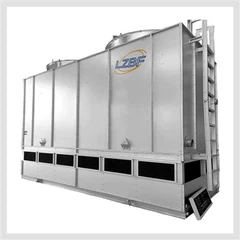
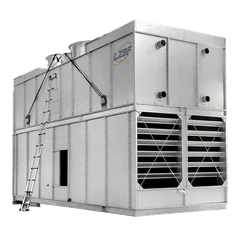
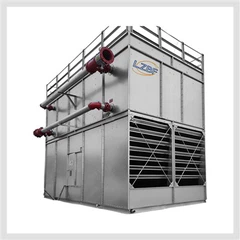
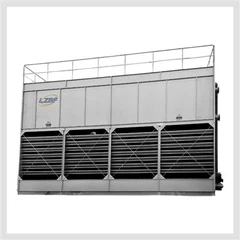
Liquid cooling systems transfer heat from chips to coolant via cold plates. The heated coolant must then be sent to external heat exchange equipment for cooling before being recirculated back to the servers-. Closed-circuit cooling towers are one of the core pieces of equipment in this external heat exchange stage. Using a fully enclosed circulation design, the water in closed-circuit cooling towers runs inside sealed coils without direct contact with air, ensuring clean water quality and resistance to scaling. These characteristics make closed-circuit cooling towers ideal for providing stable and reliable cooling support for liquid cooling systems. For data centers deploying liquid cooling, closed-circuit cooling towers are critical equipment for achieving efficient heat rejection and ensuring long-term system stability.

IV. The Trend: Air Cooling Dominates, Liquid Cooling Accelerates, Hybrid Is the Norm
The current overall landscape of data center cooling is: air cooling still holds the largest share, liquid cooling is rapidly penetrating, and hybrid cooling has become the mainstream choice during this transition-. For new data center construction, cold plate liquid cooling is gradually replacing air cooling as the primary cooling technology-. Looking ahead to 2030, liquid cooling is expected to become the dominant model, accounting for an estimated 61% of total cooling capacity.
Data center cooling is transitioning from "air cooling-dominated" to "liquid cooling-dominated". As an indispensable heat rejection component of liquid cooling systems, closed-circuit cooling towers are playing an increasingly important role in this transformation.

Send Inquiry