


Analysis Of The Appearance Characteristics Of A Closed Cooling Tower
Jun 04, 2025
Leave a message
As a highly efficient heat exchange device, a closed cooling tower's design not only balances functionality but also embodies a blend of aesthetics and practicality. From its overall structure to its detailed features, the appearance of a closed cooling tower directly impacts its heat dissipation efficiency, ease of maintenance, and environmental adaptability.
Overall Structure: Compact and Stable
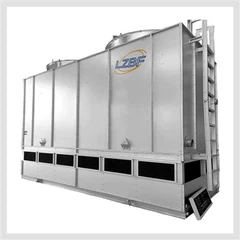
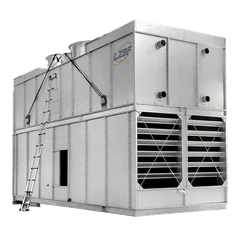
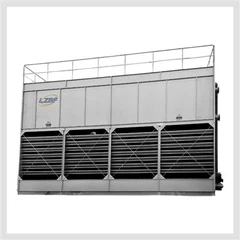
Closed cooling towers typically adopt a rectangular or box-shaped structure, with a regular overall shape to adapt to various installation environments. Their outer shells are often constructed of corrosion-resistant materials such as galvanized steel, stainless steel, or fiberglass, with a smooth surface that enhances durability and reduces the accumulation of dust and impurities. The tower's height and width are determined by its cooling capacity. Large industrial closed cooling towers tend to be larger, while smaller commercial or residential units are more compact.
The tower's top is typically designed with a sloping roof or air deflector to prevent rainwater accumulation and direct airflow for optimal heat dissipation. Some closed-circuit cooling towers also feature a double-layered outer shell with insulation filling the middle to minimize the impact of ambient temperature on internal cooling efficiency.
Heat Dissipation Components: Filling and Fan Area
The core heat dissipation area of a closed-circuit cooling tower is typically located in the middle or upper portion of the tower and consists of the filler layer and the fan system. The filler layer (heat exchange coils or fins) is typically covered by a protective cover and appears to have a regular grid or corrugated structure. The material is typically PVC, stainless steel, or copper alloy to ensure corrosion resistance and efficient heat exchange.
The fan system is typically mounted on the top of the tower and consists of a motor, a speed reducer, and fan blades. These fan blades are typically made of aluminum alloy or engineering plastic and resemble propellers. Their high-speed rotation effectively drives air flow and accelerates heat dissipation from the cooling medium. Some closed-circuit cooling towers use variable-frequency motors, which adjust the fan speed according to cooling requirements, thereby optimizing energy consumption.
Inlet and Outlet Piping and Drain Pan
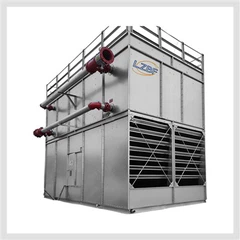
The inlet and outlet piping of a closed cooling tower is typically located on the side or bottom. Pipe connections are designed with flanges or quick-connects for easy installation and maintenance. The inlet typically connects to the circulating medium being cooled, while the outlet discharges the cooled fluid. The piping is typically insulated to minimize heat loss and condensation.
A drain pan (tank) is located at the bottom of the tower to collect spray water or condensate. The pan is typically made of stainless steel or fiberglass, with a flat surface and slightly raised edges to prevent overflow. Some closed cooling towers are also equipped with a water level sight glass or automatic water replenishment system to facilitate monitoring of water levels and maintain stable system operation.
Support and Protective Structure
The bottom support structure of a closed cooling tower is typically a steel frame or concrete foundation to ensure the stability of the equipment during operation. The steel support is typically hot-dip galvanized to prevent rust and appears as a grid or column-like support structure. Some closed-circuit coolers are also equipped with shock-absorbing pads or soundproof enclosures to reduce the impact of operating noise on the surrounding environment.
In addition, many closed-circuit coolers have access doors, observation windows, or ladders on their exteriors to facilitate inspection of internal components (such as fill, fans, and motors). These openings are typically sealed to prevent the ingress of dust and foreign matter while maintaining the overall aesthetics of the equipment.
Color and Finish
Closed-circuit coolers are typically finished in gray, blue, or silver. These hues are not only stain-resistant but also reflect some sunlight, reducing thermal stress on the equipment caused by high temperatures. Some customized cooling towers can be customized with corporate logos or environmentally compatible colors to better blend into industrial plants or architectural landscapes.
Summary
The appearance of a closed-circuit cooler is a comprehensive reflection of its functionality and engineering design. From the overall structure to the detailed features, every design element is designed to enhance heat dissipation efficiency, extend equipment life, and optimize maintenance ease. Whether it is a large industrial cooling tower or a small commercial unit, its exterior design strikes a balance between practicality and aesthetics, making it a key element in modern heat exchange technology.
Send Inquiry