


Working Principle of Closed-Circuit Cooling Towers and Their Application Scenarios in the New Energy Industry
Sep 06, 2025
Leave a message
1. Main Components
Heat Exchange Coil: As the core component, it is composed of metal tubes (commonly copper tubes or stainless steel tubes) arranged closely. The hot process fluid flows inside these fully closed pipes.
Spray Water System: The spray water pump draws out water from the sump. The nozzles spray water evenly onto the outer surface of the heat exchange coil to form a water film.
Sump: Located at the bottom of the tower body, it collects the sprayed water and scattered water droplets.
Fan System: The fan is usually an axial flow fan, which forces or induces air to enter from the bottom or side of the tower, flow upward or horizontally through the coil and spray water area, and then be discharged from the top of the tower.
Water Collector: Located above the coil and below the fan. Its function is to capture water droplets entrained in the air flow, reducing the drift loss of spray water.
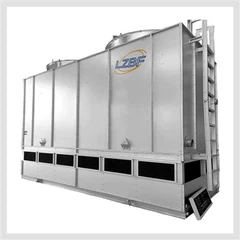
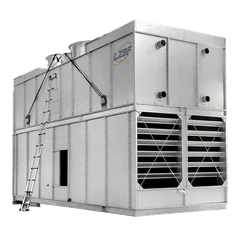
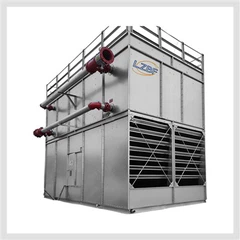
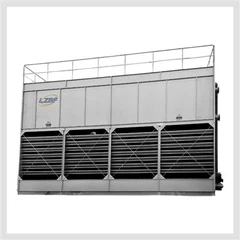
Tower Body: Contains all internal components and guides air flow.
Air Inlet Grille/Louvers: Guide air to enter the tower body evenly, preventing debris from entering and direct sunlight.
Water Treatment System: Used to treat spray water, preventing scaling, corrosion and microbial growth. It includes a blowdown valve, make-up valve, chemical dosing device, etc.
Control System: According to the outlet temperature of the process fluid or other parameters, it controls the fan speed (frequency conversion control) and/or the start-stop of the spray water pump to adjust the cooling capacity and save energy.
2. Working Principle Steps (Detailed Process)
Hot Fluid Circulation: The hot process fluid that needs to be cooled is pumped into the closed heat exchange coil.
Spray Water Wetting the Coil: The spray water pump draws out the cooling water from the sump, and sprays it evenly onto the outer surface of the heat exchange coil through the nozzles to form a continuous flowing water film.
Air Introduction and Flow: The fan starts, forcing ambient air to be drawn into the tower through the air inlet grille/louvers at the bottom of the tower body. The air flows upward (or horizontally) through the area of the heat exchange coil covered with spray water.
First Heat Exchange: The high-temperature process fluid inside the coil transfers heat to the spray water film covering the outer wall of the tube through the metal tube wall. This part of heat transfer mainly relies on conduction (through the tube wall) and convection (between the tube wall and the spray water film), resulting in an increase in the temperature of the spray water.
Second Heat Exchange: The heated spray water film is in direct contact with the upwardly flowing forced air flow on the outer surface of the coil. The air flow has a relatively low wet-bulb temperature. A part of the water molecules on the surface of the spray water film absorb enough heat to evaporate into water vapor. The evaporation of water requires absorbing a large amount of latent heat of vaporization, which is directly taken away from the spray water film. At the same time, there is also sensible heat transfer between the air flow and the spray water: the spray water with higher temperature transfers part of the sensible heat to the air flow with lower temperature through convection, increasing the air temperature.
Air Discharge: The saturated or nearly saturated humid and hot air that has absorbed water vapor (increased humidity) and sensible heat (increased temperature) flows upward under the action of the fan, passes through the water collector, and is finally discharged from the top of the tower to the atmosphere.
3. Advantages of Closed Cooling Towers
Water Saving
The cooling tower adopts an efficient water collector to reduce water drift loss.
Refined anti-splashing design reduces water splashing loss.
The amount of make-up water and blowdown water for circulating water should be adjusted according to the season to reduce the total amount of make-up water.
The spray water of the closed cooling tower uses ordinary tap water, saving water.
Environmental Protection
Tower body materials such as fillers, water collectors, and water distribution pipes are all flame-retardant, with a flame-retardant oxygen index ≥ 30.
Fully enclosed space, the cooling medium is not affected by the external environment and will not pollute the environment.
It can cool media such as brine, oil, alcohol, quenching fluid, brine and chemical fluids. The composition of the medium has no impact, there is no loss of the medium, and no leakage will occur.
High Efficiency
The closed cooling tower is fully enclosed, so no dust will enter the cooling pipeline and control system, causing pipeline blockage.
Automatic digital control system with high degree of automation, energy saving and environmental protection, high efficiency, high operation accuracy, convenience and stable operation.
The closed cooling tower adopts dual cooling methods of air cooling and evaporative heat absorption, resulting in higher cooling efficiency and more energy saving.
Fully closed circulation, no impurities entering, no medium evaporation, no pollution, soft water closed circulation, no scaling, no blockage, no loss.
Extended Service Life
To extend the service life of the equipment, the connecting bolts are made of 304 stainless steel plate material, the coil is made of 304 stainless steel tube, and the outer guard plate is made of 304 stainless steel plate material, maximizing the service life of the equipment.
Others
The closed cooling tower adopts a soft water circulation system, which makes it difficult to form scale, thus preventing the pipeline from being damaged due to overheating.
Small floor area, convenient site selection, installation, movement and layout, compact structure, no need to excavate a water storage tank, improving the plant utilization rate and saving space.
4.Application Scenarios of Closed-Circuit Cooling Towers in the New Energy Industry!
Closed-circuit cooling towers have extensive and important application scenarios in the new energy industry, mainly reflected in the following aspects:
Solar Power Generation
In the field of solar power generation, closed-circuit cooling towers are mainly used for cooling solar panels. The operating efficiency of solar panels will decrease significantly in high-temperature environments, so an effective cooling system is crucial. Through its closed circulation system, the closed-circuit cooling tower can effectively remove the heat generated by solar panels and dissipate the heat through air or water coolants in the tower, ensuring that the panels can still operate efficiently under high-temperature conditions. This not only improves the efficiency of solar power generation but also extends the service life of the panels.
Wind Power Generation
Closed-circuit cooling towers also play an important role in wind power generation. Wind turbines generate a lot of heat during operation. If the heat is not dissipated in time, it may cause the equipment to overheat, affecting power generation efficiency and equipment life. Closed-circuit cooling towers are used in the heat dissipation system of wind turbines. With their efficient heat exchange performance, they can quickly take away the heat generated by the generator, ensuring that the generator operates at the optimal temperature. This not only improves the efficiency and stability of wind power generation but also reduces the maintenance cost of the equipment.
Electric Vehicles
With the popularization of electric vehicles, the battery cooling system of electric vehicles has become an emerging application field for closed-circuit cooling towers. The batteries of electric vehicles generate a lot of heat during charging and discharging. If the heat cannot be dissipated in time, it may lead to a decline in battery performance or even damage. Through its closed circulation system and efficient heat exchange performance, the closed-circuit cooling tower can provide a stable and reliable cooling effect for the batteries of electric vehicles, ensuring that the batteries can still maintain good performance and safety in high-temperature environments.
Energy Storage Systems
In addition to the above application scenarios, closed-circuit cooling towers also have application potential in new energy storage systems. With the continuous development of energy storage technology, energy storage systems are becoming increasingly important in the new energy field. Energy storage systems also generate heat during charging and discharging. Closed-circuit cooling towers can provide a stable heat dissipation solution for energy storage systems through their efficient cooling capacity, ensuring the safe and efficient operation of energy storage systems.
Summary
With advantages such as efficient heat exchange performance, water and electricity saving, and prevention of water pollution, closed-circuit cooling towers play an important role in the new energy industry. They not only improve the operating efficiency and stability of new energy equipment but also extend the service life of the equipment and reduce maintenance costs. With the continuous development of the new energy industry, the application prospects of closed-circuit cooling towers will be broader.
Send Inquiry