

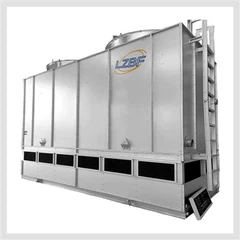
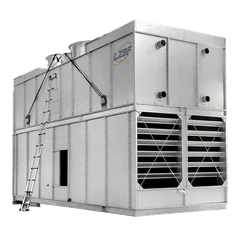
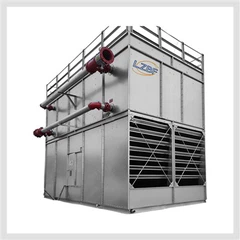
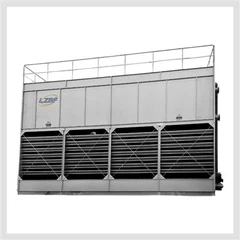

Cross-Flow Closed-Circuit Cooling Towers: Efficient and Energy-Saving Industrial Cooling Solutions
Sep 07, 2025
Leave a message
1.Working Principle of Cross-Flow Closed-Circuit Cooling Towers
The working principle of cross-flow closed-circuit cooling towers is based on the principle of heat and mass exchange, achieving cooling effects through the coordinated operation of an internal circulating water system and an external circulating water system.
Internal circulating water system: The cooled circulating water in the coil flows out of the tower body and is sent to the heat source (cooled equipment) by the system's circulating water pump. The circulating water, which has been heated through heat exchange, then re-enters the coil for cooling.
External circulating water system: The external spray water exchanges heat with the coil and filler through contact, and after cooling the circulating water inside the coil, it falls into the lower water tank and is sent back to the spray water tank by the spray pump for recirculation.
Cross-flow closed-circuit cooling towers adopt an advanced cross-flow design combined with a closed circulation system. The medium to be cooled is delivered to the top of the tower by a water pump, forming a uniform water film.
2.Advantages of Cross-Flow Closed-Circuit Cooling Towers
Cross-flow closed-circuit cooling towers exhibit the following significant advantages in the field of industrial cooling:
High efficiency and energy saving: Efficient cooling is achieved through direct contact between air and water. Meanwhile, the fully enclosed circulation design reduces the entry of impurities and evaporation loss, significantly improving energy utilization efficiency.
Easy maintenance: The simple structure and optimized layout make maintenance and cleaning operations quick and easy, effectively reducing maintenance costs.
Strong adaptability: It can ensure stable operation and excellent cooling effects regardless of climate conditions or environmental requirements.
Low noise and reliability: The use of high-quality materials results in low operating noise and high reliability of the equipment, with little impact on the surrounding environment and low failure rates.
Small footprint: The compact design allows cross-flow closed-circuit cooling towers to occupy a small area, and multiple units assembled side by side save more space, making them suitable for space-constrained occasions.
Environmental protection and energy saving: The closed design effectively prevents water quality from being polluted by the outside world, reducing the risk of water waste and environmental pollution. Through optimized design and efficient operation, energy consumption and carbon emissions are reduced, meeting the requirements of green development in modern industry.
3.Practical Applications of Cross-Flow Closed-Circuit Cooling Towers
Cross-flow closed-circuit cooling towers are widely used in multiple industrial fields. For example, in the steel industry, they are used to cool various fluids in the steel manufacturing process; in the plastic industry, they cool fluids used in various plastic processing equipment; in the papermaking industry, they cool various liquids used in the papermaking process. In addition, cross-flow closed-circuit cooling towers can also be found in industries such as petrochemicals, electric power, textiles, and food processing.
In specific application cases, many large enterprises have successfully used spring isolators in their cooling towers. For instance, in the renovation project of a closed cross-flow cooling tower in a petrochemical enterprise, after the installation of spring isolators, equipment vibration was reduced by 40%, and cooling efficiency was increased by 20%. After the project was implemented, the enterprise not only saved a large amount of maintenance costs but also effectively reduced equipment energy consumption, achieving significant economic and environmental benefits.
4.Differences Between Cross-Flow Towers and Counter-Flow Towers
① Structural differences
Cross-flow closed-circuit cooling towers: Adopt a cross-flow design, with radiators and fans arranged on one side, and a hot water pan on the other side. Their structure is relatively simple, facilitating maintenance.
Counter-flow closed-circuit cooling towers: Equipped with a fan at the top, a hot water pan at the bottom, and radiators in the middle. This design results in higher heat exchange efficiency but has a relatively complex structure and higher maintenance costs.
② Differences in working principles
Cross-flow closed-circuit cooling towers: Fans blow air towards the radiators to exchange heat with the hot water in the radiators. Hot water flows into the hot water pan from one side, and after being cooled by the radiators, flows out from the other side.
Counter-flow closed-circuit cooling towers: Hot water flows into the radiators from the top, exchanges heat with air, and then flows out from the bottom. The function of the fan is to accelerate air flow and improve heat exchange efficiency.
③ Application differences
Cross-flow closed-circuit cooling towers: Due to their simple structure and low noise level, they are more suitable for occasions with high noise requirements, such as residential areas and hospitals. At the same time, they are also widely used in some industrial fields such as the automotive and electronics industries.
Counter-flow closed-circuit cooling towers: Due to their high heat exchange efficiency, they are widely used in industrial fields such as chemical industry and steel industry. However, it should be noted that due to their complex structure and high maintenance costs, careful consideration is required when using them in occasions with high cost requirements.
④ Advantage comparison
Cross-flow closed-circuit cooling towers:
Low noise: The design of the lower part of the filler allows water flow to directly fall into the water tank, reducing noise levels.
Convenient maintenance: Equipped with special access doors and internal space.
Low energy consumption: The inlet air velocity is low, corresponding to reduced motor energy consumption, making long-term operation more economical.
Counter-flow closed-circuit cooling towers:
High heat exchange efficiency: Adopt a unique heat exchange design to achieve optimal heat exchange efficiency.
Compact structure: Although the overall tower height is relatively large, the model is small and can be placed in the workshop.
Strong corrosion resistance: The radiators are made of copper tubes or stainless steel, with good corrosion resistance.
Cross-flow closed-circuit cooling towers and counter-flow closed-circuit cooling towers each have their unique advantages and applicable occasions. When choosing, comprehensive consideration should be given according to actual needs and occasions to select the most suitable type of cooling tower.
In summary, the working principle of closed-circuit cooling towers is to achieve efficient, stable, and environmentally friendly cooling of industrial heat sources through the heat exchange between circulating water and cooling water, gas-water separation, air flow, and the role of the control system. It plays an important role in modern industrial production, making significant contributions to improving production efficiency, reducing energy consumption, and protecting the environment.
Send Inquiry