


Two Main Configuration Types Of Cooling Towers
Jun 29, 2026
Leave a message

 Cooling towers are core evaporative heat dissipation equipment widely used in new energy storage, chemical pharmacy, data centers, machinery manufacturing and power industries.
According to the structural isolation mode of circulating cooling medium, cooling towers are divided into two core mainstream configurations: open cooling tower and closed cooling tower.
The two types differ fundamentally in medium circulation structure, heat exchange logic, applicable working conditions and full-cycle operating cost, each with targeted application scenarios and distinct performance advantages. A clear grasp of their configuration characteristics is the premise of accurate engineering selection.

The first mainstream configuration is the open cooling tower, also known as open-circuit cooling tower, the earliest and most widely used basic cooling tower form. Its core structural feature lies in the fully open circulation loop of the cooling medium.
 The production process water directly flows into the tower interior and makes full contact with atmospheric air on the surface of PVC or PP packing. The circulating water forms a water film on the packing layer; forced air convection generated by top fans accelerates water evaporation, and latent heat evaporation takes away the waste heat of the process medium to realize temperature reduction.
The overall configuration consists of water distribution pipes, filler heat exchange layers, water collecting sink, axial flow fan, water pump and water replenishing pipeline, with simple composition and low one-time procurement cost.

In terms of operating characteristics, open cooling towers have prominent short-term heat exchange advantages under clean, low-dust and constant ambient conditions.
The packing has a large specific heat exchange area, and the medium directly contacts air without intermediate heat transfer coil resistance.
When the equipment is newly put into use and the packing is clean, the heat exchange efficiency is high, and the unit cooling capacity investment cost is the lowest among all cooling tower products.
It is suitable for general industrial scenarios with low requirements for water quality, such as ordinary construction air conditioning, small machinery injection molding and simple civil cooling circulation. However, the open configuration has inherent structural defects. Process water is completely exposed to the outside air, so dust, industrial suspended particles, algae and bacteria in the air continuously enter the circulating pipeline.

Within one to three months of continuous operation, scaling, mud accumulation and packing blockage will occur, resulting in a 20%–40% drop in heat dissipation efficiency. Enterprises need regular shutdowns for packing cleaning, pipeline descaling and water quality dosing treatment, bringing hidden costs of production suspension loss and high water treatment consumption. In addition, open towers suffer severe wind drift loss, with water loss rate up to 1%–3% every day, and winter anti-freezing requires large-scale drainage of circulating water, which is not friendly to water-deficient areas.
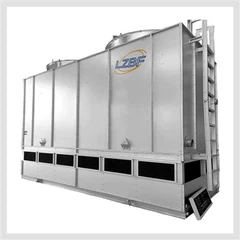
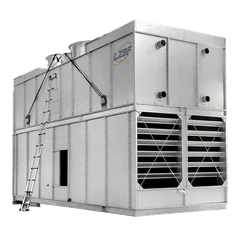
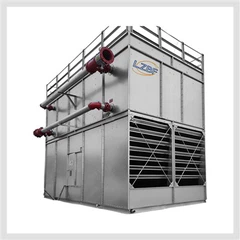
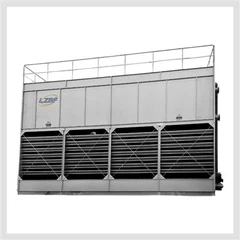
 The second core configuration is the closed cooling tower, or closed-loop cooling tower, a high-end optimized configuration developed to solve the pain points of open towers such as medium pollution and unstable heat dissipation.
Its core configuration innovation is to separate the internal process circulation medium and the external spray cooling water through fully closed metal heat exchange coils, forming two independent non-interconnected circulating loops.
The inner closed loop transports clean process water, antifreeze or special coolant, which only flows inside stainless steel coils and never contacts the outside air; the outer open auxiliary loop sprays water evenly on the outer wall of the coils to form a thin water film, and the fan drives air flow to complete evaporative heat exchange on the coil surface. The complete set of configuration adds closed heat exchange coils, independent internal circulation pumps and spray water filtering components on the basis of the basic tower frame, with higher initial equipment investment than open towers.

The closed configuration perfectly makes up for all the structural shortcomings of open towers. Since the process medium is completely isolated from the atmosphere, dust, corrosive gas and algae cannot contaminate the inner circulation pipeline.

The coil heat exchange area remains stable for a long time, and the heat dissipation attenuation after one year of operation is controlled within 5%, eliminating frequent shutdown cleaning and descaling work. The wind drift loss of spray water outside the tower is lower than 0.3%, which greatly saves water resources.
In winter, antifreeze can be added to the internal closed medium, and the external spray water can be emptied or equipped with heating devices to avoid pipeline icing and cracking, adapting to low-temperature northern regions, high-salt fog coastal areas and high-corrosion chemical parks.
 For precision manufacturing industries such as lithium battery production, medical reagents, data center constant temperature cooling and fine chemical crystallization, which have strict standards for cooling medium cleanliness, closed cooling towers are the only reliable configuration choice.
Its disadvantage is the slightly higher power consumption of dual-circulation pumps and higher one-time purchase price, but the saved water treatment fee, downtime loss and pipeline maintenance cost within two years can offset the price difference with open towers, showing outstanding comprehensive economic benefits in long-term continuous production projects.

To sum up, open cooling tower and closed cooling tower are the two primary configuration types of cooling towers, distinguished by whether the process medium is in open contact with air.
 The open type features low initial cost and simple structure for low-standard water quality scenarios; the closed type relies on double-loop coil isolation to realize stable heat dissipation, medium protection and low maintenance, matching high-precision, harsh environment and long-cycle production projects.
Engineering designers need to select the matching tower configuration according to on-site dust concentration, medium cleanliness requirements, annual running time and local water resource conditions to balance initial investment and long-term operating cost.
Send Inquiry