


Do All Data Centers Use Closed Loop Cooling?
Jun 26, 2026
Leave a message

Not all data centers adopt closed loop cooling systems.
The cooling solution selected by a data center depends on its scale, geographical climate, construction budget, power density of servers, local water resource policies and long-term operation and maintenance demands.
Closed loop cooling represented by closed cooling towers has obvious advantages in constant temperature, water saving and anti-pollution, yet open cooling systems, air cooling and hybrid cooling schemes still occupy a large market share in many data center projects.


Small and edge micro data centers rarely deploy closed loop cooling. Such facilities are usually built in office buildings, shopping malls and community service stations, with small cabinet quantities and low single-cabinet heat load. Most operators choose direct air-cooled air conditioners as the main heat dissipation equipment.
 Air cooling units have simple structures, low one-time investment, no supporting water circulation pipelines and water treatment equipment, and can be put into use quickly.
Since the equipment scale is small, the energy consumption gap between air cooling and closed loop cooling is not prominent in the short term.
There is no need to invest extra funds in closed cooling towers, water pumps and water quality maintenance systems, so air cooling becomes the most cost-effective choice for edge data centers.
Medium-sized traditional data centers built in early years mostly adopt open cooling loop systems matched with open cooling towers. A decade ago, server power density was relatively low, and there were no strict regional restrictions on water consumption and wastewater discharge.
 Open cooling towers have ultra-low procurement costs and simple construction processes.
Circulating water is directly contacted with air for heat exchange to meet basic heat dissipation demands.
However, this solution has inherent defects: dust, pollen and microorganisms in the air mix into the cooling water, easily causing scaling and blockage of heat exchange pipelines, requiring regular dosing, water replacement and pipeline cleaning.
In recent years, many old data centers have begun to transform to closed loops, but limited by reconstruction funds and site conditions, a large number of open cooling systems are still in normal operation.
 Large-scale new high-density computing data centers prefer closed loop cooling, but not all of them use it alone. Large cloud computing base stations, AI computing centers and supercomputing rooms feature high power density servers, and the cooling water system must maintain stable water quality and precise temperature control to avoid server downtime caused by pipeline scaling and temperature fluctuations.
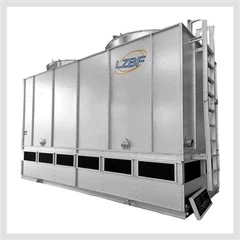
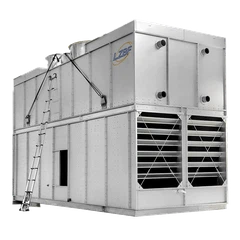
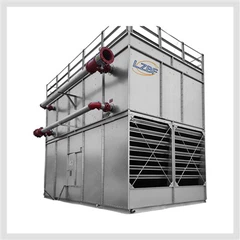
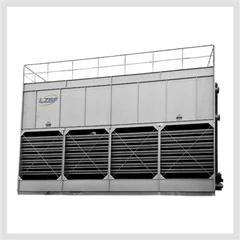
Closed loop cooling completely isolates the internal process water from the external air, fundamentally preventing impurity pollution, greatly extending the cleaning cycle of heat exchangers and reducing the risk of equipment failure.
In water-scarce northern regions and areas with strict water-saving policies, closed cooling towers have extremely low water drift loss, which can meet local water consumption assessment standards.
Even so, many large data centers adopt hybrid cooling: closed loop serves as the main body, and natural air cooling is used for auxiliary heat dissipation in low-temperature seasons to further cut energy consumption, instead of relying solely on a single closed loop system.

In addition, data centers in extremely dry northern cold regions also widely deploy dry air cooling systems without any water circulation loops.
The local annual average temperature is low and air humidity is extremely low. Dry coolers can rely entirely on air convection to dissipate heat without spraying water for evaporation cooling.
 This type of zero-water-consumption cooling solution completely avoids water resource waste and the risk of pipeline freezing, which is more suitable than closed loop cooling.
For such projects, closed loop equipment with water spraying function will instead increase unnecessary water consumption and maintenance links, so investors will directly abandon closed loop design.
In conclusion, closed loop cooling is an excellent high-performance cooling scheme, but it cannot cover all data center scenarios. Edge small stations tend to use air cooling, old medium-sized parks retain open cooling towers, arid cold regions adopt dry air coolers, and only high-density large computing hubs generally take closed loop cooling as the core heat dissipation system. Data center designers will comprehensively weigh cost, climate, water resources and heat load to select targeted cooling modes, rather than uniformly applying closed loop cooling.
Send Inquiry