


Core Advantages of Evaporative Condensers
Jun 25, 2026
Leave a message

 Evaporative condensers are mainstream heat exchange equipment in refrigeration, cold chain and chemical temperature control industries. Based on the spray evaporation heat exchange principle, they combine the dual heat dissipation merits of air cooling and water cooling, showing prominent comprehensive advantages over shell-and-tube water-cooled condensers and air-cooled condensers.
Widely applied in cold storage, cold chain logistics, chemical refrigeration, industrial chilled water units and supermarket refrigeration, they possess irreplaceable practical value in energy conservation, floor space, operation & maintenance and running stability.
Energy saving and consumption reduction stand as the primary advantage of evaporative condensers. Traditional water-cooled condensers must be equipped with cooling towers and circulating water pumps to deliver cooling water continuously, and the water circulation system consumes massive electric power over long-term operation.
 Conventional air-cooled condensers rely on forced convection by fans, whose heat exchange efficiency drops sharply under high ambient temperatures. Evaporative condensers remove heat through the latent heat of water evaporation with a larger heat exchange temperature difference.
Under equal refrigeration loads, fan power consumption is lower, and no extra cooling water circulation pipelines and supporting pumps are required, eliminating persistent energy consumption of the water circulation system.
Under high-temperature summer conditions, the unit achieves cooling via evaporation, with the heat exchange side temperature far lower than the ambient dry-bulb temperature.
The operating pressure of compressors is markedly reduced to cut power consumption of main units. Long-term operation can lower the overall energy consumption of the whole refrigeration system by 15%~30%, bringing remarkable power-saving benefits for cold storage and industrial refrigeration units running nonstop all year round.
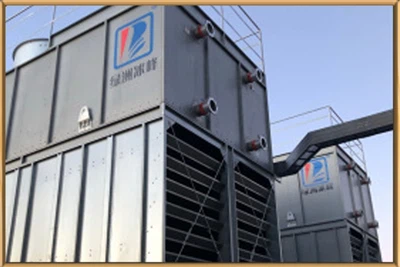 The equipment features high integration and greatly saves floor space. A traditional water-cooled refrigeration system consists of four separate components: condenser, cooling tower, cooling water pump and water tank, which occupy large factory space with complicated pipeline layout.
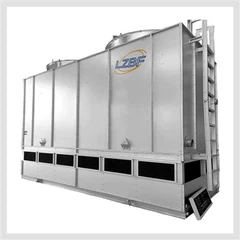
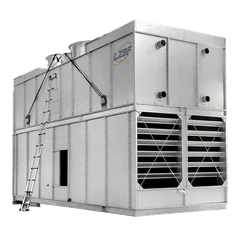
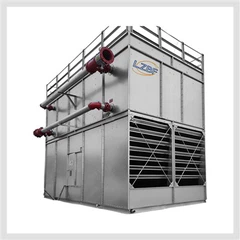
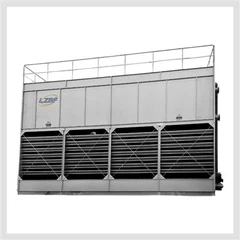
Evaporative condensers integrate heat exchange coils, spray systems, water capture fillers, induced draft fans and water collecting troughs into one unit fully assembled before delivery. On-site installation only requires connection of refrigeration pipelines and electrical circuits, with no need for independent cooling pools or circulating water piping.

Small and medium-sized cold storages and workshop refrigeration units can be directly installed on rooftops or outdoor platforms to make full use of idle overhead space and free up indoor production and storage areas, lowering land costs.
They are especially suitable for newly built factories with limited space and renovation projects of small and medium cold chain warehouses.
They maintain stable operating conditions and boast strong adaptability to high temperatures. When the temperature exceeds 35℃ in summer, air-cooled condensers suffer a sharp rise in condensing temperature, frequently triggering high-pressure alarms and automatic shutdown protection that severely disrupt continuous production.

Evaporative heat transfer extracts heat via water evaporation, keeping the heat exchange medium close to the outdoor wet-bulb temperature. Even under extreme heat, the condensing temperature stays within a reasonable range to stabilize unit high pressure and avoid frequent start-stop cycles.
 The equipment runs steadily in hot northern summers and humid southern rainy seasons. Equipped with anti-freezing structures, it can drain spray water in cold winters and operate purely in air cooling mode without disassembly all year round. Adaptable to all climates across northern and southern China, its heat exchange efficiency will not drop drastically with seasonal changes.
Evaporative condensers save abundant water with high water utilization rates, ideal for water-deficient regions. Fitted with high-efficiency water capture fillers and water baffles inside, water vapor generated by spray water absorbing heat is intercepted by fillers and flows back to the bottom water trough.
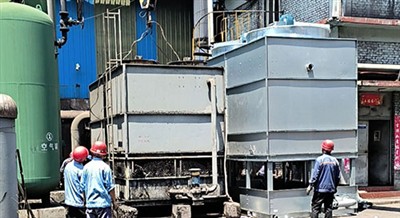
Water loss is limited to evaporation volume with an extremely low drift rate, cutting water consumption by over 60% compared with traditional open cooling towers.
The compact water collecting trough only needs a small amount of make-up water daily to compensate evaporation loss instead of continuous large water supply, granting them obvious strengths in water-shortage northwest factories and industrial parks with strict water usage control.
Meanwhile, the semi-closed water circulation reduces dust and debris entering the trough, inhibits algae growth and lowers the dosage of water treatment chemicals.
 Operation and maintenance are convenient with lower long-term costs. The unit features a simple structure with external spray cooling on heat exchange coils.
External dirt on coils can be easily flushed with high-pressure water guns during shutdown without disassembling complex pipelines. Eliminating auxiliary equipment such as cooling water pumps and external cooling towers reduces the number of rotating parts and fault points, extending the replacement cycle of wearing components including bearings and fans.
 The whole unit undergoes anti-corrosion treatment: coils are made of hot-dip galvanized steel or stainless steel, and the shell's anti-corrosion coating resists water vapor corrosion to prevent rust and damage under long-term outdoor placement.
Compared with complete water-cooled systems, annual maintenance work including pump inspection, pipeline descaling and pool cleaning is greatly reduced, slashing expenditures on labor and spare parts.

Furthermore, the equipment enjoys wide compatibility, matching various refrigeration devices such as screw units, piston units, low-temperature quick-freezing units and chemical process cooling units. Multiple units can be connected in parallel for capacity expansion to satisfy refrigeration loads of all sizes.
 Equipped with low-noise fans, the unit operates with well-controlled noise and will not cause sound disturbance to workshops or factory living quarters when installed outdoors.
Boasting combined advantages in energy efficiency, space occupation, climate adaptability and easy maintenance, evaporative condensers have gradually replaced traditional combined water and air cooling systems to become the preferred heat exchange equipment for industrial refrigeration and cold chain storage projects.
Send Inquiry