


Comprehensive Guide to Cooling Tower Selection
Sep 19, 2025
Leave a message
Guide to Cooling Tower Selection
Selection of Cooling Tower Flow Rate
Flow rate (unit: tons per hour, T/H) is one of the key parameters for cooling tower selection, determining the cooling tower's handling capacity. Below are selection recommendations for common flow rate requirements:
- 50T: Suitable for small-scale industrial applications or commercial buildings.
- 100T: Suitable for medium-sized factories or data centers.
- 150T: Applicable to large-scale industrial production or commercial complexes.
- 250T: Suitable for large industrial projects or district cooling systems.
- 500T: Applicable to extra-large industrial facilities or centralized cooling for multiple buildings.
- 800T/1000T: Suitable for ultra-large industrial projects, such as chemical plants and oil refineries.
Selection of Cooling Tower Type
The type of cooling tower affects its performance, installation, and maintenance. Below are the characteristics of several common types:
- Cross-flow cooling towers: Air and water flow in perpendicular directions. They feature a simple structure and easy maintenance, making them suitable for small to medium-sized applications.
- Counter-flow cooling towers: Air and water flow in opposite directions. They offer high cooling efficiency and are applicable to large-scale industrial applications.
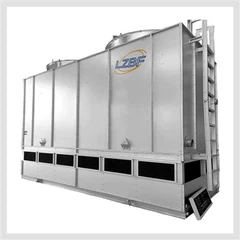
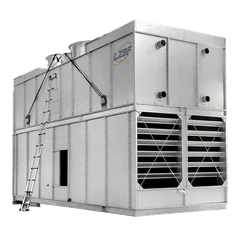
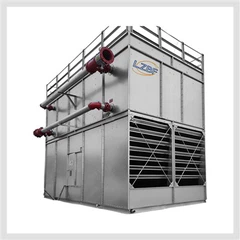
- Closed-circuit cooling towers: Adopt a closed-loop circulation system to prevent water quality contamination, making them suitable for scenarios with high water quality requirements.
Selection of Cooling Tower Shape
The shape of a cooling tower also influences its performance and applicability:
- Circular cooling towers: Compact structure with a small footprint, suitable for locations with limited space.
- Square cooling towers: Regular appearance, easy to integrate with the building environment, suitable for commercial and industrial applications.
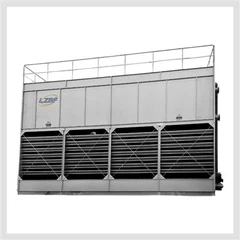
- Rectangular cooling towers: High flexibility, with customizable dimensions based on site conditions, suitable for large-scale industrial applications.
Selection of Cooling Tower Inlet/Outlet Water Temperatures
Inlet and outlet water temperatures are important parameters for measuring the cooling effect of a cooling tower. Below are different categories of cooling towers and their applicable inlet/outlet water temperature ranges:
- High-temperature cooling towers: 60°C - 35°C, suitable for high-temperature cooling needs, such as in the chemical and steel industries.
- Medium-temperature cooling towers: 43°C - 33°C, suitable for general industrial applications, providing moderate cooling effects.
- Standard cooling towers: 37°C - 32°C, suitable for most commercial and industrial applications, providing basic cooling effects.
Matching Flow Rate with Type
To select the appropriate flow rate and type, the following factors should be considered:
- Site conditions: Installation space and surrounding environment for the cooling tower.
- Cooling requirements: The cooling capacity required by the system.
- Maintenance convenience: Maintenance requirements of different types of cooling towers.
- Aesthetic requirements: Whether the appearance of the cooling tower coordinates with the surrounding environment.
How to Select a Closed-Circuit Cooling Tower
Closed-circuit cooling towers are common cooling equipment in industrial production. Their function is to absorb heat through circulating water and dissipate it into the surrounding air, thereby cooling industrial equipment. Only by gaining an in-depth understanding of actual needs and relevant factors can you select a suitable closed-circuit cooling tower. You can make your selection through the following five methods:
Check the Appearance
- ✅ A high-quality closed-circuit cooling tower features a more aesthetically pleasing design with neat edges and corners.
- ❌ Inferior closed-circuit cooling towers have a rough surface and irregular edges and corners.
During assembly, details such as:
- Edge alignment accuracy and fastener material
- Handling of plate joints and potential water leakage points
- Installation firmness and appearance quality of water pumps and fans
- Whether pipelines are installed horizontally and vertically
- Whether components and wiring inside the control cabinet are neat, aesthetically pleasing, and up to standard
- Whether the cable routing and arrangement are reasonable and neat
These details better reflect the standardization of the manufacturer's quality control and the extent of their manufacturing experience.
Check the Installation
Check the Installation Environment
The installation environment of the cooling tower must comply with national regulations. During installation, the cooling tower should not be placed near heat sources. Ensure good ventilation around it to prevent hot air recirculation, which would affect heat dissipation.
Check the Installation Method
Closed-circuit cooling towers are connected in a closed manner to heat-generating production equipment, with pipelines used for connection. A closed water tank is adopted for water replenishment, without open water pools or large water tanks.
Check the Installation Height
Closed-circuit cooling towers can be installed on the ground or rooftops. Pay attention to the convenience of air discharge and water replenishment in the pipeline system, especially air discharge. Install automatic air release valves at the highest points of the system and local high points to ensure that air in the system can be quickly discharged during initial operation.
Check the Operating Noise
The noise of closed-circuit cooling towers should not exceed 60 decibels. When installed in residential areas, low-noise fans or sound insulation walls should be used to reduce noise.
Check the Fan
- ✅ Check the fan: A high-quality fan has a large air volume, low rotation speed, low noise, and a long service life.
- ✅ Check the fan blades: High-quality blades have a smooth surface, no dust accumulation, and are lightweight.
- ✅ Check the bearings: High-quality bearings have a long service life, typically requiring replacement every 4-6 years.
Check the Water Pump
The performance of the water pump has a significant impact on the performance of the closed-circuit cooling tower. Generally, pipeline centrifugal pumps are used to provide power for closed-circuit cooling towers. It is recommended to select products from well-known brands and large-scale manufacturers, as they can provide relatively mature water pressure curves. The performance curve of the water pump should be tested to ensure ideal operation under specified working conditions and to extend its service life as much as possible.
Check the Noise
Closed-circuit cooling towers generate noise when the motor drives the blades to rotate, so attention should be paid to the noise issue. For the same cooling effect, the lower the noise, the higher the efficiency.
Send Inquiry