

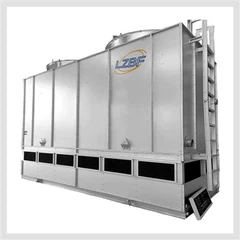
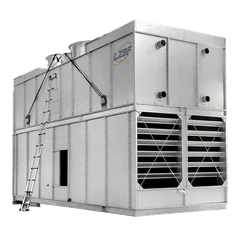
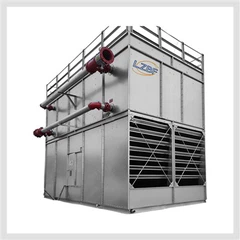
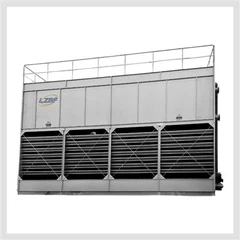

Closed Cooling Tower Structure Analysis: Core Equipment in the Industrial Cooling Field
Jul 01, 2025
Leave a message
In modern industrial production, closed cooling towers, as efficient heat exchange equipment, are widely used in energy, chemical, and manufacturing industries. Their unique structural design not only improves cooling efficiency but also extends equipment life, making them a key option for many companies optimizing production processes.
The core structure of a closed cooling tower consists of a heat exchanger, a spray system, a fan, a water collection tray, and a casing. The heat exchanger, typically made of copper or stainless steel tubes, circulates the medium to be cooled, while water sprays the outside of the heat exchanger for heat exchange with the air. This closed design effectively prevents direct contact between the medium and the external environment, reducing the risk of contamination and scaling, making it particularly suitable for applications requiring high water quality.
The spray system is another key component of a closed cooling tower. It uses evenly distributed nozzles to spray circulating water onto the heat exchange tubes, creating a water film that enhances heat transfer efficiency. Simultaneously, the fan drives outside air through the moistened heat exchange tube bundle, removing heat through the principle of evaporative cooling. The synergistic effect of air and water enables closed-circuit cooling towers to achieve efficient cooling with low energy consumption, significantly improving water conservation compared to traditional open-circuit cooling towers.
A water collection tray, located at the base of the unit, collects unevaporated circulating water after spraying. A filtration and water replenishment system maintains a stable water level. Some advanced designs also incorporate water quality monitoring modules, enabling real-time adjustment of water treatment agent dosage to ensure long-term, reliable system operation. The outer shell is typically constructed of galvanized steel or composite materials, offering both corrosion resistance and thermal insulation, making it suitable for complex outdoor climates.
With increasing demands for energy efficiency and environmental protection in the industrial sector, closed-circuit cooling tower construction technology continues to improve. For example, variable-frequency control of fan speed and the use of high-efficiency filler materials further reduce operating energy consumption. These innovations enable closed-circuit cooling towers to meet stringent cooling requirements while becoming essential equipment for promoting green manufacturing.
Understanding the internal structure of closed-circuit cooling towers helps companies select the appropriate model for their specific operating conditions, balancing production costs and equipment performance. This technology, with its stable performance, provides reliable support for the sustainable development of the global industrial system.
Send Inquiry