


Can evaporative coolers really refrigerate?
Dec 10, 2025
Leave a message
Clear Conclusion: Evaporative Closed Towers Deliver Stable Refrigeration Performance, with Closed-Tower Structure as the Core Advantage
.

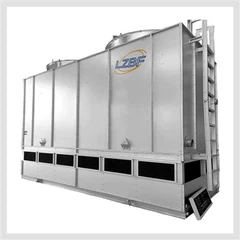
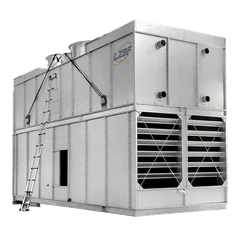
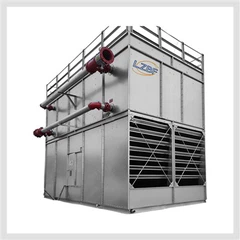
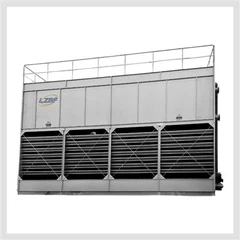
Many users question the refrigeration function of evaporative coolers, especially closed-tower models. This confusion essentially arises from conflating "refrigeration forms" with "application scenarios" - while it cannot achieve deep low temperatures like compression refrigeration equipment, as a "closed-circuit cooling tower" (referred to as a closed tower), its closed-loop structural design enables more efficient and cleaner refrigeration.
It serves as a core solution for industrial cooling, precision equipment temperature control, and other scenarios. This refrigeration capability has been verified across multiple industries, and the closed tower's unique "zero-medium-contact" design endows it with irreplaceable value in clean refrigeration needs, though it is not suitable for all cooling scenarios.
Principle Analysis: The "Physical Refrigeration Logic" Behind Closed-Tower Structure
The refrigeration mechanism of evaporative closed towers is based on the physical principle of water evaporation absorbing heat. The closed-loop design makes the refrigeration process more controllable and efficient, with no chemical substances involved throughout, ensuring environmental friendliness and safety. The core process consists of three links.

01
Energy Conversion Core
02
Closed-Tower Structural Coordination
03
Refrigeration Process Implementation

Energy Conversion Core
When liquid water turns into gaseous water vapor, it must absorb a large amount of thermal energy (known as the "latent heat of vaporization effect"). Data shows that each kilogram of liquid water absorbs approximately 2,260 kilojoules of heat when fully evaporated, equivalent to the energy required to lower the temperature of 1 cubic meter of air by about 10℃. This is the core source of refrigeration for closed towers, and compared with open-type equipment, closed towers improve energy utilization efficiency through structural optimization.

Closed-Tower Structural Coordination
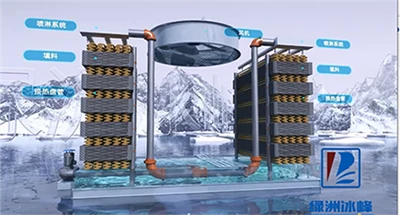
The core components include "hermetic heat exchange coils," "wet curtain media," "powerful fans," "circulating water supply systems," and a "water collection tank." Unlike open-type equipment, the process medium to be cooled (such as industrial circulating water or hydraulic oil) flows inside the hermetic coils without direct contact with external air. A spray water pump delivers clean water to the top water distribution device, moistening the wet curtain to form a water film. The fan forces air through the wet curtain to conduct heat exchange with the outer wall of the coils.

Refrigeration Process Implementation
When air contacts the wet curtain's water film, the water film absorbs heat and promotes evaporation. The medium inside the coils transfers heat through the tube wall, resulting in temperature reduction. The evaporated water vapor is carried away by the air flow, keeping the medium inside the coils clean at all times. This achieves the dual effects of "closed-loop circulation + efficient refrigeration," avoiding medium contamination and scaling issues in open-type equipment.
Empirical Support: Multi-Scenario Data Verifying Refrigeration Effectiveness
The refrigeration effect of evaporative closed towers is not merely theoretical but supported by numerous industrial measurement data. The closed-tower characteristics further endow it with advantages of "cleanliness, stability, and low maintenance"

In the cooling system of chemical reactors, under outdoor conditions of 39℃ and 48% relative humidity, the closed tower reduced the temperature of process circulating water from 45℃ to 27℃ (a cooling range of 18℃), with a refrigeration efficiency of 82%.
Compared with traditional open cooling towers, the scaling rate decreased by 90%, and the maintenance cycle extended from 3 months to 12 months.

In the temperature control of precision equipment in electronic factories, the closed tower provides constant-temperature chilled water for servers, stabilizing the medium temperature at 18-20℃ (fluctuation ±0.5℃).
Its energy consumption is only 35% of that of air-cooled machines with the same power, saving over 80,000 yuan in annual electricity costs and reducing equipment failure rate by 75%.

In the temperature control of sterile workshops in the food industry, the closed tower ensures no secondary contamination of the medium through closed-loop circulation.
Under outdoor conditions of 36℃, it reduced the temperature of the coolant from 32℃ to 22℃ at a rate of 0.33℃ per minute, with a refrigeration efficiency exceeding 78%, meeting the strict requirements of sterile production.
Suitable and Limited Scenarios: The Dual Impact of Closed-Tower Characteristics
The refrigeration efficiency of evaporative closed towers is closely bound to their "closed-tower nature," with clear applicable scenarios and certain limitations
Highly Suitable Scenarios
It is ideal for the electronics, pharmaceutical, and food industries requiring clean refrigeration, as it prevents medium contamination. For continuous industrial production in chemicals, metallurgy, and other fields, its low scaling and low maintenance characteristics ensure production continuity, with a cooling range of 8-18℃, suitable for medium-low temperature needs of 10-28℃.
In dry and hot areas with relative humidity below 60%, it achieves optimal refrigeration efficiency and saves over 30% more water than open-type equipment.

Limited-Effect Scenarios
When ambient relative humidity exceeds 70%, water evaporation is hindered, and refrigeration efficiency drops below 55%.
Its minimum temperature is close to the ambient wet-bulb temperature, unable to achieve deep refrigeration below 0℃, so it cannot replace refrigeration equipment such as freezers. With a complex structure and high initial investment, it is not suitable for low-cost civil scenarios like households or small shops.
Conclusion: Refrigeration Value of Closed-Tower Evaporative Coolers
Evaporative closed towers are by no means "pseudo-refrigeration" equipment but efficient refrigeration tools based on the latent heat of vaporization principle combined with optimized closed-loop structures. Their advantages of "high efficiency, cleanliness, and low maintenance" make them outstanding in industrial production, precision equipment temperature control, and other scenarios, with irreplaceable values of energy conservation, water conservation, and environmental friendliness.
Judging whether it "can refrigerate" lies in clarifying the scenario and needs - it is an ideal choice for medium-low temperature clean refrigeration in dry environments or for those pursuing long-term stability and low maintenance. However, caution should be exercised in high-humidity environments, for deep refrigeration needs, or low-cost civil scenarios. Overall, evaporative closed towers fill the gap of traditional refrigeration equipment in the field of "clean and efficient cooling" and serve as a core solution in the industrial refrigeration system.
Send Inquiry