


Working Process Of A Hybrid Flow Dual Inlet Closed Circuit Cooling Tower
Sep 11, 2025
Leave a message
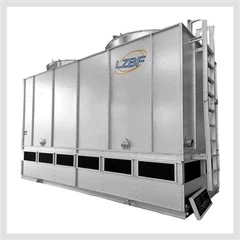
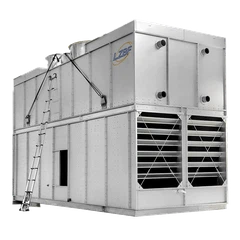
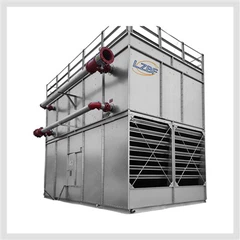
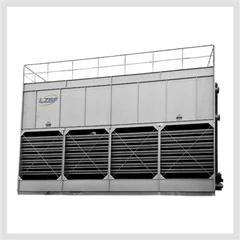
A hybrid flow dual inlet closed circuit cooling tower is a highly efficient and energy-saving cooling equipment. The term "hybrid flow" refers to the mixed state of oblique cross-flow and partial counter-flow between air and spray water on the inclined coil surface, while "dual inlet" indicates that cooling air enters synchronously from both sides of the tower unit. Its working process perfectly integrates the principles of sensible heat conduction and evaporative latent heat exchange. The specific process is as follows:
1. High-Temperature Process Fluid Circulation
The high-temperature process fluid requiring cooling (such as softened water, oil, glycol solution, etc.) circulates within the sealed coil. After absorbing heat from production line equipment (e.g., medium-frequency furnaces, air compressors, hydraulic systems), this fluid is delivered to the closed coil of the cooling tower by the system's circulation pump, providing the heat source for the cooling process.

2. Dual Side Synchronous Air Intake and Airflow Organization
A powerful axial fan located at the top of the tower creates suction, drawing ambient air into the tower through the air inlet louvers on both sides of the tower body simultaneously. The dual-inlet design doubles the air intake area, ensuring sufficient air supply. After entering the tower, the air is guided by specially designed air guides or the inclined coil itself, and its flow direction gradually changes from horizontal to obliquely upward.

3. Spray Water System Operation
The spray water in the sump at the bottom of the tower is drawn and pressurized by a clog-resistant spray pump. It is then transported via pipes to the distribution system above the coil. Water is atomized or formed into an even water curtain through precision nozzles, sprayed vertically downward, completely covering the external surface of the coil and forming a continuously renewing water film.

4. Core Hybrid Flow Heat Exchange
This is the core stage of the entire process, whose heat exchange efficiency is far superior to pure cross-flow design:
Sensible Heat Transfer:
Heat from the high-temperature fluid inside the coil is transferred through the metal tube wall (typically carbon steel tube with coating or stainless steel) to the external water film, raising its temperature.
Latent Heat Transfer (Primary Cooling Effect):
The heated water film comes into full contact with the air stream drawn from both sides and flowing obliquely upward. Because the air stream forms a "hybrid flow" state of oblique cross-flow and local counter-flow with the falling water film, the contact method and time are significantly optimized. A portion of water molecules evaporates rapidly, absorbing a large amount of vaporization latent heat, thereby efficiently removing heat from the water film and the coil itself. This flow field design reduces thermal resistance and enables more sufficient heat exchange.

5. Cooling Completion and Fluid Output
After efficient heat and mass exchange, the process fluid inside the coil is fully cooled, its temperature drops to the set requirement, and it flows out from the coil outlet, returning to the main equipment to continue the production cycle, forming a clean, closed-loop system without consumption.

6. Moist Air Exhaust
The air, having completed the heat absorption and moisture absorption process, becomes saturated moist air and continues moving upward under the fan's suction. Before being discharged from the tower, it passes through an efficient drift eliminator. Its internal labyrinth channels intercept the vast majority of water droplets entrained in the air, which drip back into the sump, effectively controlling water drift loss. Finally, the nearly dry, moist air is discharged from the tower by the fan.

7. Spray Water Recirculation and Intelligent Make-up
The sprayed water falls and collects in the sump. Due to evaporation and minimal drift, the water level decreases. An automatic makeup valve, controlled by a float valve or electronic level sensor, opens promptly to replenish softened or deionized water. Simultaneously, an automatic blow-down valve works intermittently to discharge concentrated water and maintain water quality, preventing scaling from clogging the nozzles and coil. The water in the sump is then recirculated by the pump back to the spray system, forming a continuous spray cycle.
Summary of Features:
The hybrid flow dual inlet closed circuit cooling tower, through its unique flow field design and dual-side air intake system, combines the advantages of low air resistance and low fan energy consumption, while significantly improving heat transfer efficiency by creating local counter-flow. The dual-side air intake ensures greater air volume and more uniform airflow distribution, enabling it to achieve higher cooling efficiency while maintaining a compact structure, making it an ideal choice for large-scale industrial applications.
开启新对话
Send Inquiry