


Which is better, a cross-flow or counter-flow cooling tower?
Sep 27, 2025
Leave a message
The main differences between cross-flow and counter-flow cooling towers lie in their structural design, dimensions, water distribution density, packing height, and design flexibility.
Cross-flow tower: Water flows perpendicular to the airflow. It has a simpler air duct layout, lower cooling efficiency, but also lower construction costs. Theoretically, its packing height can be infinitely high.
Counter-flow tower: Water flows in the opposite direction to the airflow. It offers higher cooling efficiency but is taller and requires greater water pressure. Its packing height is limited.
In terms of maintenance, cross-flow towers are more convenient, allowing inspection and upkeep without shutdown. Conversely, most components of a counter-flow tower are enclosed within the casing, making maintenance more difficult.
Structural Differences
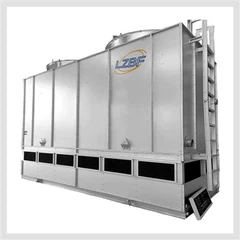
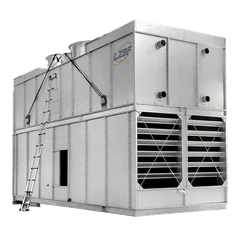
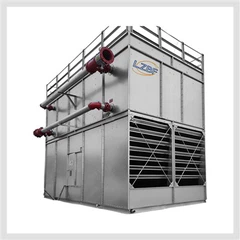
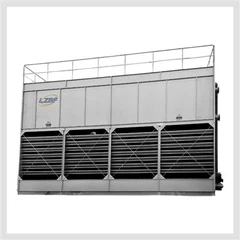
Cross-flow closed cooling tower: Features a cross-flow design with the heat exchanger and fan on one side, and the hot water basin on the other. Its structure is relatively simple, facilitating easier maintenance.
Counter-flow closed cooling tower: Equipped with a fan at the top, a hot water basin at the bottom, and the heat exchanger in the middle. This design achieves higher heat transfer efficiency but is more complex and costly to maintain.
Working Principle Differences
Cross-flow: The fan blows air across the heat exchanger, exchanging heat with the hot water inside. Hot water enters the basin from one side, is cooled as it passes through the exchanger, and exits from the other side.
Counter-flow: Hot water flows into the heat exchanger from the top, exchanges heat with the air, and exits from the bottom. The fan accelerates airflow to enhance heat transfer efficiency.
Application Differences
Cross-flow: Ideal for noise-sensitive areas like residential neighborhoods and hospitals due to its simple structure and low noise level. Also widely used in industries such as automotive and electronics.
Counter-flow: More prevalent in industrial sectors like chemical and steel production where high cooling efficiency is paramount. However, its complex structure and higher maintenance costs make it less suitable for cost-sensitive applications.
Advantage Comparison
Cross-flow closed cooling tower advantages:
Low noise: Water directly falls into the basin below the packing, significantly reducing noise.
Easy maintenance: Features dedicated access doors and ample internal space.
Low energy consumption: Lower inlet air velocity reduces motor energy usage, making long-term operation more economical.
Counter-flow closed cooling tower advantages:
High heat transfer efficiency: Unique design optimizes heat exchange performance.
Compact structure: Despite its greater height, its smaller footprint allows installation within workshops.
Strong corrosion resistance: Heat exchangers made from copper tubes or stainless steel offer excellent durability.
Both types have unique advantages and specific applications. The choice between them should be based on a comprehensive evaluation of actual requirements and operating conditions to select the most suitable cooling tower type.
Send Inquiry