


Definition and Classification of Cooling Towers
Sep 28, 2025
Leave a message
Background of Cooling Towers
As a crucial heat exchange equipment, cooling towers are widely used in industrial, commercial, and environmental protection fields. By reducing water temperature, providing stable cold sources, and handling waste heat, they offer strong support for the normal operation of various facilities and environmental protection. Serving as the core component of industrial cooling systems, the efficient operation of cooling towers is vital to ensuring the continuity and stability of production processes. The penetration of Internet technology has brought profound changes to the design, production, operation, maintenance, and service modes of cooling towers, further promoting the transformation and upgrading of the cooling tower industry.
Working Principle of Cooling Towers
The working principle of cooling towers is based on the heat absorption of water during evaporation. Typically, cooling towers are used in systems that require heat dissipation in industrial and commercial processes, such as air conditioners, chillers, and power stations. They are usually made of concrete or steel, with basic structures including a water tank, a packing layer, and a fan.
During operation:
1.Water enters the water tank from the system and is pumped to the packing layer.
2.In the packing layer, the water is sprayed and evenly distributed over a large surface area through a distributor at the bottom, which accelerates water evaporation and maximizes its surface area.
3.The fan blows air into the tower, enabling contact between air and water. During this process, water evaporates and releases heat into the air, while the air absorbs part of the moisture and heat.
4.The cool, dry air is then pushed out of the tower and enters the system for heat dissipation, allowing the water to circulate and continuously reduce heat.
The penetration of Internet technology has brought unprecedented development opportunities to the cooling tower industry. The integrated application of cutting-edge technologies such as the Internet of Things (IoT), big data, cloud computing, and artificial intelligence (AI) is gradually transforming the design, production, operation, maintenance, and service modes of cooling towers. Through big data analysis, the cooling tower industry can accurately predict market demand, optimize inventory management, and reduce operating costs. The application of AI technology enables cooling towers to achieve intelligent control, automatically adjusting operating parameters according to actual needs for precise control and reduced unnecessary energy consumption. Meanwhile, the Internet provides a more convenient information exchange platform for the cooling tower industry, promoting knowledge sharing and technological progress within the industry.
Classification of Cooling Towers
Cooling towers come in various types and can be categorized into multiple common types based on different classification criteria. The main classifications and common types are as follows:
Classification by Heat Exchange Method (Direct Contact with Air or Not)
Open-Circuit Cooling Towers
Working Principle: Circulating water directly contacts air for heat exchange. Hot water is sprayed onto the surface of the packing through a spray system to increase the contact area between water and air. As air flows through the packing, part of the water evaporates and takes away a large amount of latent heat, thereby cooling the remaining water.
Advantages: Simple structure; low initial investment cost.
Disadvantages: Direct contact between water and air leads to easy contamination, scale and algae growth, requiring frequent water treatment; continuous water consumption occurs due to evaporation and drift.
Common Applications: General air conditioning systems and industrial cooling where water quality requirements are not high.
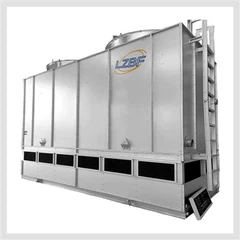
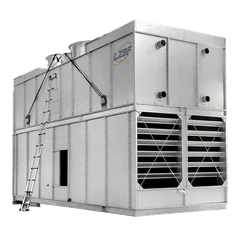
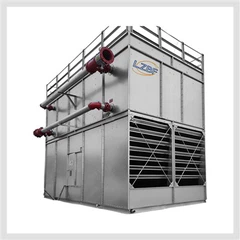
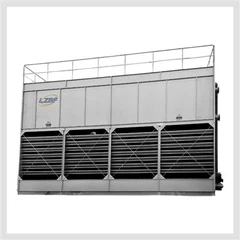
Closed-Circuit Cooling Towers
Working Principle: The core component is a coil (tubular heat exchanger). The process fluid circulates in a closed coil, without any contact with the outside air. The outer wall of the coil is sprayed with water, while the fan drives air flow. Heat transfer relies on:
① Sensible heat exchange between the tube wall and the spray water;
② Latent heat removal by the evaporation of spray water.
Advantages: Ensures the fluid inside the coil is clean, free from contamination and loss; low water treatment cost and better water conservation; flexible operation mode (can operate in dry mode).
Disadvantages: High initial investment cost; one additional heat exchange process results in slightly lower heat exchange efficiency.
Common Applications: Occasions with high water quality requirements, such as cooling for precision instruments, intermediate frequency furnaces, reaction kettles, data centers, and hydraulic systems.
Classification by Ventilation Method
Mechanical Draft Cooling Towers
Features: Use fans for forced air induction or supply. The air volume is stable, and the cooling effect is not affected by natural wind, making it the most widely used type.
Forced Draft: The fan is located at the bottom of the tower, blowing air into the tower. The fan motor is less susceptible to corrosion by humid and hot air, but the air distribution may be uneven.
Induced Draft: The fan is located at the top of the tower, drawing air out of the tower. It features uniform air distribution and high efficiency, making it the most mainstream type currently. However, the fan motor is in a high-temperature and high-humidity environment.
Natural Draft Cooling Towers
Features: Do not use fans; air flow is driven by the suction force formed by the density difference between the air inside and outside the tower (hot air is lighter). They usually have extremely tall hyperbolic towers (commonly seen in thermal power plants and nuclear power plants).
Advantages: Extremely low operating costs (no fan energy consumption); high reliability.
Disadvantages: Huge initial investment; large size; cooling efficiency is affected by environmental and meteorological conditions.
Classification by Air and Water Flow Directions (Mainly for Open-Circuit Towers and Coil Sections of Closed-Circuit Towers)
Counterflow Cooling Towers
Features: Air flows upward, while water is sprayed downward, with the two flows in opposite directions.
Advantages: Counter-contact between air and water results in a large average temperature difference and high heat exchange efficiency; relatively small floor space.
Disadvantages: Slightly higher system resistance; slightly higher requirements for water pump head.
Crossflow Cooling Towers
Features: Air flows horizontally through the packing, while water is sprayed vertically downward, with the two flows perpendicular to each other. The packing is usually placed at an incline or vertically, and the side of the tower is equipped with large air inlet louvers.
Advantages: Low ventilation resistance and low fan power consumption; low water pressure requirements and small water pump head.
Disadvantages: Large floor space; generally lower efficiency than counterflow towers under the same conditions.
Send Inquiry