


Principle of Correlation Between Cooling Capacity of Closed-Circuit Cooling Towers and Wet-Bulb Temperature
Jul 31, 2026
Leave a message

Core Overview: Wet-Bulb Temperature Determines the Cooling Limit of Closed-Circuit Cooling Towers
 In industrial cooling systems, the cooling performance of closed-circuit cooling towers is not determined by the ambient dry-bulb temperature perceived by humans, but strictly restricted by the ambient wet-bulb temperature. This is the core reason why the cooling effect on cloudy and rainy days is far better than that on sweltering sunny days under the same air temperature.
Different from open cooling towers, closed-circuit cooling towers adopt a closed circulation of internal medium and realize cooling through evaporative heat transfer of spray water, with evaporative heat dissipation as the core heat exchange method. As a core index for measuring the evaporative heat dissipation capacity of air, wet-bulb temperature directly determines the cooling limit and actual cooling capacity of cooling towers.
Parameter Differentiation: Essential Differences Between Dry-Bulb and Wet-Bulb Temperature
 It is necessary to clarify the core differences between dry-bulb temperature and wet-bulb temperature. The dry-bulb temperature refers to the air temperature directly measured by ordinary thermometers, which only reflects the sensible heat of air and the cold and hot state of the air, but cannot characterize the water vapor carrying capacity of air.
The wet-bulb temperature is the limit temperature of air under adiabatic saturation, representing the minimum temperature that can be achieved by water evaporation and cooling under the current air environment. The lower the air humidity, the more intense the water evaporation, the larger the difference between wet-bulb and dry-bulb temperature, and the stronger the cooling potential. When the air is humid and water vapor approaches saturation, the evaporation almost stagnates, the wet-bulb temperature is close to the dry-bulb temperature, and the cooling capacity decreases significantly. This feature is highly consistent with the heat exchange logic of closed-circuit cooling towers.
Heat Transfer Mechanism: Evaporative Heat Dissipation as the Core and Wet-Bulb Temperature as the Cooling Limit
 The heat transfer process of closed-circuit cooling towers includes two stages, and all core heat transfer relies on evaporation. During equipment operation, spray water evenly covers the outer wall of heat exchange coils, and flowing air sweeps across the wetted coil surface.
The spray water absorbs heat from the high-temperature medium inside the coils and evaporates rapidly. Water evaporation is the only core way to take away system heat and realize cooling, and the air's moisture absorption and evaporation capacity directly determines the heat exchange capacity. Physically, the wet-bulb temperature is the theoretical limit temperature of water evaporation cooling under working conditions.
That is to say, the outlet water temperature of closed-circuit cooling towers can only infinitely approach the ambient wet-bulb temperature but never be lower than it, which makes the wet-bulb temperature a rigid upper limit for the cooling capacity of cooling towers.
Quantitative Law: Dynamic Influence of Dry-Wet Bulb Temperature Difference on Cooling Power
 From the perspective of quantitative cooling capacity, the rated cooling capacity of cooling towers is essentially the heat exchange result driven by the temperature difference between the medium water temperature and the wet-bulb temperature.
A larger working temperature difference accelerates the evaporative heat transfer rate, removes more heat per unit time, and delivers stronger cooling capacity. When the dry-bulb temperature remains constant and the wet-bulb temperature rises, the air humidity increases, water evaporation becomes difficult, and the efficiency of evaporative heat dissipation drops sharply.
The actual cooling power of the cooling tower will be significantly reduced even at a high ambient temperature. On the contrary, dry environments with a relatively high dry-bulb temperature but low wet-bulb temperature can achieve better cooling effects. This explains the insufficient cooling performance of equipment in sweltering summer weather and stable operation in dry weather.
Engineering Application: Wet-Bulb Temperature as the Core Benchmark for Equipment Selection and Operation
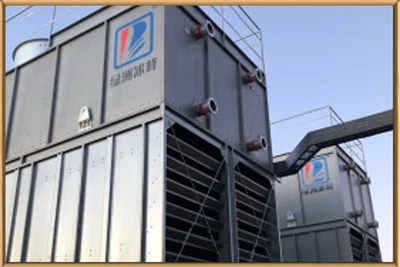 In addition, wet-bulb temperature serves as the sole benchmark for the selection and working condition calibration of closed-circuit cooling towers. All rated cooling parameters of industrial closed-circuit cooling towers are tested based on the standard wet-bulb temperature rather than dry-bulb temperature.
If equipment selection is only based on ambient air temperature without considering wet-bulb temperature, it will lead to insufficient cooling margin and excessive system water temperature under high-temperature and high-humidity working conditions. Meanwhile, the adjustment of equipment floating charge, spray water flow and fan air volume during operation is mainly adapted to the dynamically changing wet-bulb temperature to match the evaporative heat transfer demand under variable working conditions.
Conclusion: Core Logic of Wet-Bulb Temperature Dominating Cooling Capacity

In summary, closed-circuit cooling towers take evaporative heat dissipation as the core heat exchange method, and the wet-bulb temperature is the exclusive quantitative index of air evaporative cooling capacity, which determines the equipment's cooling limit, heat transfer temperature difference and actual cooling power. As an auxiliary environmental parameter, dry-bulb temperature cannot reflect the restriction of air humidity on evaporation, which is the fundamental reason why wet-bulb temperature dominates the cooling capacity of closed-circuit cooling towers.
Send Inquiry