


Precise Control Logic and Energy Efficiency Optimization of Fan and Spray Systems in Closed-Circuit Cooling Towers
Dec 02, 2025
Leave a message
Precise Control Logic and Energy Efficiency Optimization of Fan and Spray Systems in Closed-Circuit Cooling Towers
In the operation system of industrial cooling systems, the control of fans and spray systems in closed-circuit cooling towers can be called the "intelligent core". It is not a simple equipment start-stop operation, but a dynamic balance system built around the outlet temperature of process fluid, which needs to find the optimal solution among cooling efficiency, energy consumption and water resource consumption. Its core logic is to take the set outlet temperature of the process fluid as the benchmark, and intelligently adjust the proportion of sensible heat exchange and latent heat exchange by real-time monitoring of environmental parameters (such as wet-bulb temperature, dry-bulb temperature, wind speed) and system load (inlet temperature and flow rate of process fluid), and finally achieve the operation purpose of "reaching the cooling target with the minimum energy consumption cost".
Products Description
From the perspective of heat exchange principle, the cooling process of closed-circuit cooling towers is the synergy of sensible heat exchange and latent heat exchange.
The process fluid circulates in the closed coil, and heat is transferred to the outside through the coil wall; the cooperation between the spray system and the fan is to adjust the proportion of the two heat exchange methods by changing the heat exchange conditions outside the coil.
When the ambient wet-bulb temperature is low (such as at night, in winter or on rainy days) and the cooling load is in the light range, the control system will give priority to starting the low-energy consumption mode - at this time, there is no need to turn on the fan, only the spray pump is started. A small amount of spray water is evenly sprayed on the surface of the coil to form a thin and uniform water film.
After the water film comes into contact with air, natural evaporation occurs, and a large amount of heat in the coil is taken away through latent heat exchange. This combination of "evaporative cooling + natural ventilation" only consumes the operating power of the spray pump (usually only 1/5 to 1/3 of the fan power), which is equivalent to realizing "free cooling" and greatly reducing the operating cost during the light load period.
At the same time, to avoid water flow loss caused by excessively thick water film, the system will real-time monitor the spray water volume through a flow sensor and control it in the optimal range of "just covering the coil without excess dripping", further reducing water resource waste.

Products Description
When the environmental conditions deteriorate (such as high temperature in summer, dry and hot weather) or the process load increases (such as full-load operation of production equipment and increased inlet temperature of process fluid), the natural evaporation of spray water alone can no longer meet the cooling demand.
At this time, the control system will start the synergistic enhancement mode - first gradually increase the speed of the spray pump to increase the spray water volume. If the outlet temperature is still higher than the set value, the fan will be started decisively. The intervention of the fan can be called a "qualitative change switch" for cooling capacity: through forced convection, it introduces a large amount of ambient air into the tower, which quickly passes over the surface of the coil covered by the water film.
The increase in air flow speed not only accelerates the evaporation rate of the water film (latent heat exchange efficiency increases by 3-5 times) but also enhances the temperature difference between the air and the coil wall (sensible heat exchange efficiency increases by 1-2 times). Under the dual effect, the heat dissipation capacity of the system increases by an order of magnitude.
At this time, the fan and the spray pump enter the coordinated operation state. However, the subtlety of the modern control system lies in that it does not allow both to work at full load all the time, but realizes "stepless adjustment" through frequency conversion technology. Taking the fan as an example, the control system will real-time adjust the fan speed through the frequency converter according to the deviation between the actual outlet temperature of the process fluid and the set value: if the outlet temperature is only slightly higher than the set value, the fan will operate at a low speed of 30%-50%; if the deviation increases, the speed will be gradually increased to full load.
The energy-saving effect of this adjustment method is extremely significant - since the power consumption of the fan is proportional to the cube of its speed, when the speed decreases from 100% to 70%, the power consumption can be reduced by about 65%, which greatly reduces energy waste under partial load.


The refined control of the spray system is also inseparable from frequency conversion technology and multi-pump combination strategy. For large-scale closed-circuit cooling towers, 2-3 spray pumps are usually equipped. The control system will adopt a dual method of "number adjustment + speed adjustment" according to the load change: only one pump is started and operated at low speed under low load; one full-speed pump or two low-speed pumps are started under medium load; all pumps are started and operated at full speed only under high load.
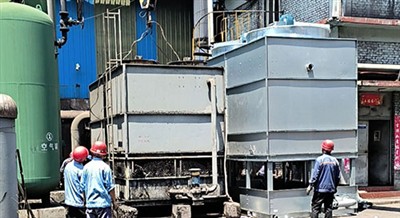
This combined adjustment not only avoids the energy consumption problem of "a large horse pulling a small cart" for a single large pump but also improves the system reliability through multi-pump redundancy. At the same time, some advanced systems will also set up a bypass regulating valve in the spray pipeline.When the ambient humidity is extremely high (such as in the plum rain season) and the evaporation efficiency of the water film decreases, the bypass valve will open automatically, directing part of the spray water back to the water tank to reduce the invalid spray volume.This not only reduces the energy consumption of the water pump but also prevents the formation of scale on the coil surface by excess water (scale will increase thermal resistance and reduce cooling efficiency by 10%-20%).
Products Description
 In addition to the adjustment strategy under normal load, the control system also needs to deal with extreme working conditions and fault scenarios to ensure operation stability. For example, when the ambient temperature drops sharply (such as the temperature below 0℃ at night in winter), to prevent equipment damage caused by the freezing of the water film outside the coil, the control system will automatically stop the spray pump, start the fan and turn on the "anti-freezing heating device" at the same time. Through forced air flow and local heating, the surface temperature of the coil is maintained above 5℃; if the fan fails (such as motor overload, blade jamming), the system will immediately send an alarm signal, increase the spray water volume at the same time, and open the "emergency bypass pipeline" to introduce part of the process fluid into the standby cooling circuit to avoid excessive process temperature. In addition, the system will also real-time monitor the water quality of the spray water (such as conductivity, pH value), and automatically start the "sewage discharge and water supplement device" when the water quality deteriorates to ensure the evaporation efficiency of the water film and the service life of the equipment.
Products Description
 From the perspective of long-term operation benefits, the precise control of fans and spray systems in closed-circuit cooling towers can not only reduce energy consumption and water resource consumption but also extend the service life of equipment and reduce maintenance costs. According to industrial data statistics, compared with the traditional "fixed-speed start-stop" mode, the fan and spray system with frequency conversion control can reduce annual power consumption by 30%-40% and water resource consumption by 25%-35%. At the same time, the cleaning cycle of the coil is extended by 2-3 times, and the equipment failure rate is reduced by more than 50%. This "energy-saving, water-saving and consumption-reducing" operation mode not only meets the "green and low-carbon" development needs of modern industry but also brings significant economic benefits to enterprises, becoming one of the core directions for the upgrading of industrial cooling systems.
Send Inquiry