

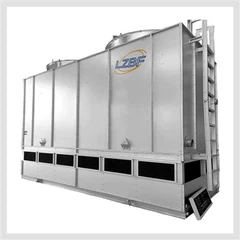
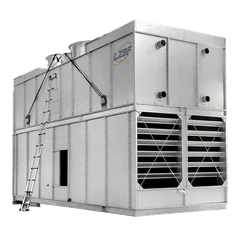
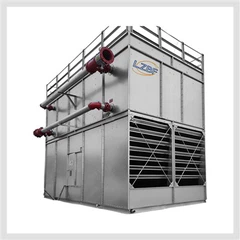
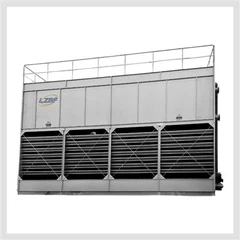

Introduction to Closed-Circuit Cooling Towers
Sep 15, 2025
Leave a message
A complete set of closed-circuit cooling tower equipment consists of a main unit, a water tank, a circulating water pump, and an electric control cabinet. The main unit is composed of components such as a shell, a heat exchanger, a fan, a spray water pump, a water collector, a water tank, and pipeline valves. During the operation of the closed-circuit cooling tower, the cooling medium (soft water, oil, or other liquids) is driven by the main circulating pump to circulate between the heat exchanger and the equipment that needs cooling. The spray water is evenly sprayed on the heat exchanger, forming a uniform water film on the outer surface of the heat exchanger. Cold air enters the tower through the air inlet at the bottom of the tower and flows countercurrently with the spray water over the surface of the heat exchanger. In this process, there are two heat exchange methods: heat conduction between cold air and the cooling medium, and heat exchange through evaporation and heat absorption of the spray water. The saturated hot and humid air after absorbing heat is discharged into the atmosphere by the fan, and the remaining spray water flows into the water tank at the lower part of the tower, which is then transported back to the spray system by the pump. This cycle continues, and the cooling medium in the heat exchanger is cooled down. Closed-circuit cooling towers have two operating modes: air cooling, and air cooling + spray. The switching between the two modes is automatically performed by the electronic control system according to working condition requirements to achieve energy saving and consumption reduction.
1. Working Principle
The main principle of a closed-circuit cooling tower is that the spray water evaporates on the outer wall of the coil to cool the cooling water flowing through the tube, and at the same time, a fan is used to timely remove the generated water vapor. A small part of the spray water evaporates, and the rest is collected by the chassis for recirculation. The higher-temperature cooling water from the condenser is pressurized by the cooling water pump and delivered to the cooling coil of the closed-circuit cooling tower. On the other hand, a pipeline pump is used to pump the water in the cooling tower chassis into the spray coil, which is sprayed on the outer surface of the cooling coil to vaporize and absorb the heat of the cooling water in the coil, thereby reducing the temperature of the cooling water. At the same time, relying on the suction effect of the fan installed on the water baffle, air flows from bottom to top through the cooling coil, exchanging sensible heat and latent heat with the spray water. This not only strengthens the heat release on the outer surface of the cooling coil but also timely removes the water vapor formed by evaporation, accelerates water evaporation, and improves the cooling effect.
2. Application Fields
1. Induction heating and metal smelting equipment, such as cooling for high and medium frequency quenching equipment, medium frequency power supplies and electric furnaces, induction heat penetration furnaces, holding furnaces, etc.
2. Cooling of circulating water for various reactors and condensers in the chemical industry.
3. Cooling of large motors, diesel engines, rectifying equipment, electric welding equipment, hydraulic stations, continuous casting equipment, etc.
4. Cooling of large molds such as metal die-casting molds and injection molds.
5. Cooling of industrial solutions, such as quenching fluids, electroplating fluids, etc.
3. Advantages
1. The cooling medium circulates in a fully closed loop, which can prevent debris from entering the cooling pipeline system and avoid evaporation loss of the cooling medium.
2. Using soft water as the cooling medium prevents scaling, pipeline blockage, and reduces faults.
3. Adopting dual cooling methods of air cooling and spray water evaporation heat absorption, resulting in high cooling efficiency.
4. The device is small in size, occupies little space, is convenient to move and place, and does not require the construction of a water pool.
5. Equipped with automatic intelligent control, it can automatically switch cooling modes according to working condition requirements, with simple and reliable operation.
6. Wide range of uses, can directly cool quenching fluids, oils, alcohols and other media that have no corrosive effect on the heat exchanger, with no medium loss and stable composition.
4. Characteristics of Lvshou Bingfeng Closed-Circuit Cooling Towers
1. Strong heat dissipation capacity:
① The design meteorological conditions are designed with reference to the national standards for open cooling towers, and necessary allowances are considered in the design and equipment selection process. High standards and strict requirements result in good heat dissipation capacity, adapting to more stringent meteorological environments and working condition requirements.
② Adopting advanced design methods and optimized heat exchange models, high-efficiency and low-resistance heat exchangers, and an excellent circulating spray system, the heat exchange efficiency is greatly improved, the floor area is reduced, and the tower weight is reduced.
2. Simple operation: A speed-regulating motor can be selected as needed to achieve energy saving, and it can be integrated into the automatic control system for easy management.
3. Good environmental protection:
① Comprehensive management measures make indicators such as vibration, noise, and water drift more in line with environmental protection requirements.
② Special low-noise fans, motors, and reducers are used, with high efficiency and low noise. The optimally designed steel frame structure of the tower is simple, stable, and reliable, and the operating vibration is controlled within an extremely low range. The high-efficiency water collector ensures that the water drift loss is minimized under the premise of meeting large air volume, fully complying with environmental protection requirements. If a speed-regulating motor is selected, the noise can be further reduced by 3-5 dB(A) when running at low speed at night.
4. Aesthetic and durable: Scientific structural design, excellent production, small footprint, and beautiful appearance, especially suitable for various modern enterprise buildings. Structural materials are all high-grade stainless steel or hot-dip galvanized steel plates, with a flat and beautiful appearance, and a warranty of more than 15 years.
5. Quality materials: Equipment and spare parts are strictly selected and meticulously manufactured.
6. High-quality service: A complete customer service procedure provides full guarantee for you to get the best service.
5. Other Basic Knowledge of Cooling Towers
1) Classification of Cooling Towers
There are many types of cooling towers. Classified by ventilation method, there are natural ventilation type and forced ventilation type, etc.; classified by water spray method, there are spray type, drip type, film type, and drip-film type, etc.; classified by the flow direction of water and air, there are cocurrent, countercurrent, and cross-flow types, etc.
2) Working Principle of Cooling Towers
The cooling effect of cooling towers is due to the heat exchange between water and air (in the form of sensible heat) and water evaporation heat dissipation (in the form of latent heat), and these two heat dissipation processes occur simultaneously.
3) Precautions for Selecting and Sizing Cooling Towers
a. The type and cooling water volume of the cooling equipment should be determined according to local natural conditions such as water volume, water quality, water temperature of the water source, and outdoor calculated wet bulb temperature, with reference to the manufacturer's selection chart, the cooling water parameters and technical and economic factors of the unit.
b. In principle, the selection and configuration of cooling towers should correspond one-to-one with the main unit and cooling pump. One main unit can also correspond to multiple cooling towers with interlocking control.
c. The make-up water volume of the circulating water supply system includes evaporation loss, drift loss, blowdown loss, and drainage loss. Cooling towers with low energy consumption and small drift water volume should be selected to control the make-up water volume of air-conditioning cooling water within 1.2% to 1.5% of the total circulating water volume of the system. Take the lower value when the water quality is good; take the higher value when the water quality is poor.
d. In areas with severe air pollution, it is better to use closed cooling towers, because they adopt a heat exchange method where water and air exchange heat through heat transfer tubes, which can avoid corrosion to the tower body, cooling water pump, pipeline, etc. caused by contact between the cooled water or pollutants in the atmosphere. However, compared with open type, closed type has lower efficiency, larger volume, and higher price.
e. When selecting a cooling tower, the impact of its noise on the surrounding environment should also be considered, and low-noise and ultra-low-noise types should be used as much as possible to reduce noise pollution.
4) Factors Affecting the Cooling Effect of Cooling Towers
a. The average pressure difference between the water vapor partial pressure in the air and the saturation pressure corresponding to the water temperature in the cooling tower.
b. The size and duration of the water droplet surface area in contact with the air.
c. The speed of air flowing through the cooling tower. The relative flow direction of air and water (cocurrent, cross-flow, or countercurrent).
5) Determination of Cooling Tower Capacity
a. The cooling tower capacity should be suitable for the cooling water volume required by the unit. The size of the cooling tower is selected according to the maximum cooling water flow on the sample with a certain allowance (1.05-1.20 times).
b. The relative humidity of the air at the place of use should be considered.
c. The outlet water temperature and temperature difference of the cooling tower should be considered.
d. The size of the cooling tower should be considered according to the adverse conditions of high temperature in summer. Broad air conditioning units recommend the use of medium-temperature counterflow cooling towers.
6) Cooling Range
In the cooling tower, if the inlet water temperature is higher than the ambient air temperature, the water temperature starts to drop due to contact heat dissipation and evaporation heat dissipation until it equals the air temperature. If the water vapor in the air is not saturated at this time, the evaporation continues. Theoretically, it can be equal to the wet bulb temperature, but in practice, it cannot reach that. The water temperature leaving the tower is usually about 4-6°C higher than the wet bulb temperature. This temperature difference is also called the cooling range, which reflects the approximation degree between the outlet water temperature of the cooling tower and the wet bulb temperature. The smaller the cooling range, the higher the thermal performance of the cooling tower, and vice versa.
7) Arrangement of Cooling Towers
Cooling towers should be arranged in well-ventilated places, avoiding places with more dust, acid gases, high-temperature gases, and water vapor as much as possible. They are generally arranged on the ground, machine room, or the roof of the podium building.
Send Inquiry