


How does a closed-circuit cooling tower work?
Dec 16, 2025
Leave a message
How Does a Closed-Circuit Cooling Tower Work?
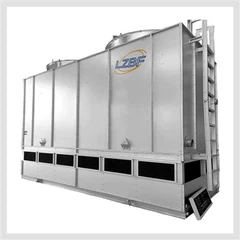
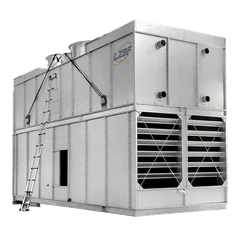
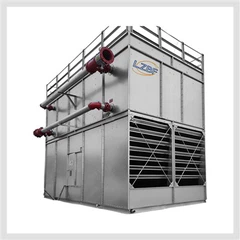
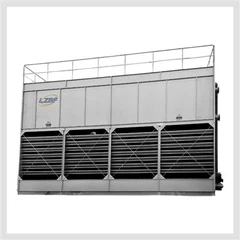
A closed-circuit cooling tower (referred to as a closed cooling tower for short) is a high-efficiency cooling device that integrates a tubular heat exchanger with a cooling tower. Its core lies in achieving heat transfer through a combination of "closed medium circulation" and "open spray heat exchange"-it not only prevents the cooling medium from being contaminated but also dissipates heat efficiently, making it widely used in industrial refrigeration, precision equipment cooling, central air conditioning, and other fields. Its working process can be broken down into three core links: internal medium circulation, external spray heat exchange, and air volume regulation assistance, with the overall operation logic centered around "indirect heat exchange and evaporative heat dissipation".

Internal Closed Medium Circulation: Conveyance of the Core Heat Carrier
The core characteristic of a closed cooling tower is that the cooling medium (usually soft water, ethylene glycol solution, or special heat transfer fluid) circulates in a sealed coil loop, without direct contact with external air or spray water-which is the essence of being "closed".
During operation, the hot medium to be cooled (e.g., high-temperature medium from chillers or industrial reactors) is delivered to the heat exchange coils of the closed cooling tower by a circulation pump. The medium flows continuously inside the coils, transferring the heat it carries to the coil walls.
The coils are typically made of stainless steel, titanium alloy, or copper alloy, which have excellent thermal conductivity and corrosion resistance, enabling rapid heat conduction from the medium to the coil walls. After heat transfer, the low-temperature medium returns to the cooled equipment through the coil outlet to continue absorbing heat, forming a continuous closed circulation.
The key to this link is maintaining the tightness of the loop to prevent medium leakage or air infiltration, which could cause medium deterioration and pipeline corrosion. Therefore, the system is usually equipped with an expansion tank (to balance pressure fluctuations), a make-up pump (to supplement medium loss), and a precision filter (to remove impurities).
External Spray and Evaporative Heat Exchange: Heat Transfer to the Atmosphere
The exterior of a closed cooling tower adopts an open structure, dissipating heat from the coils through spray water evaporation and air convection-this is the core heat dissipation link, divided into two steps: "spray water circulation" and "evaporation + convection heat exchange".
Spray Water Circulation
A sump is installed at the bottom of the tower. A spray pump pressurizes the cooling water in the sump and sprays it evenly onto the outer surface of the heat exchange coils through the top spray device, forming a uniform water film. The spray water fully contacts the outer walls of the coils, absorbs the heat transferred by the walls, and then falls back into the sump after temperature rise, completing the internal circulation of the spray water. The sump is usually equipped with a water quality stabilizer dosing device to prevent scaling and microbial growth in the spray water, which could otherwise affect heat exchange efficiency.
Evaporation + Convection Heat Exchange
An axial flow fan is installed at the bottom or side of the closed cooling tower. When the fan operates, it draws in ambient temperature air from outside the tower, and the air passes upward through the gap between the coils and the water film. Two types of heat exchange occur at this time: first, sensible heat exchange-air directly contacts the high-temperature water film, transferring heat through temperature difference; second, latent heat exchange-part of the spray water evaporates under air flow, absorbing a large amount of latent heat of vaporization (accounting for 70%-80% of total heat dissipation), which rapidly reduces the temperature of the coil outer walls.
The heated and humidified air is discharged from the top of the tower, taking away most of the heat, while the unevaporated spray water falls back to the sump for recycling. A small amount of evaporation loss is compensated by supplementing fresh water.


Air Volume Regulation and Auxiliary Systems: Optimization of Operational Efficiency
To adapt to different loads and environmental conditions, closed cooling towers are equipped with air volume regulation and auxiliary systems to ensure operational stability and energy efficiency:
Variable frequency fan control: Automatically adjusts fan speed (or number of operating fans) based on the temperature of the medium at the outlet of the heat exchange coils. When the cooling load is low, the fan speed is reduced to save energy; when the ambient temperature is too high (e.g., in summer), the speed is increased to enhance air volume and ensure heat dissipation effect.
Anti-freezing devices: In cold regions or during low-load operation in winter, the medium inside the coils may freeze due to low temperature. The system is equipped with electric tracing, steam tracing, or a circulation bypass device to maintain the medium temperature above freezing point; meanwhile, the spray system can switch to "dry operation" (stopping spraying, relying only on air convection for heat exchange) to avoid damage to the tower caused by frozen spray water.
Demister design: A demister is installed at the top of the tower, which can capture tiny water droplets in the spray water (with a capture rate of over 99%). This not only reduces water waste but also prevents water droplets from being discharged with air, which could cause humidity or corrosion in the surrounding environment.
Summary of the Overall Working Process
The operation of a closed-circuit cooling tower can be summarized as: hot medium enters coils → heat conduction through coil walls → spray water absorbs heat → air evaporates and carries heat away → cooled medium returns.
The hot medium flows in sealed coils, and heat is transferred through the coil walls to the external spray water film; air introduced by the fan contacts the water film, carrying heat out of the tower through evaporation and convection; the cooled medium returns to the equipment for recycling, while the spray water circulates repeatedly inside the tower with only a small amount of evaporation loss supplemented.
This design retains the advantage of high-efficiency evaporative heat dissipation of open cooling towers while avoiding contamination and scaling issues caused by direct contact between the cooling medium and the outside world, achieving the dual goals of "high-efficiency heat dissipation + medium protection".

Send Inquiry