

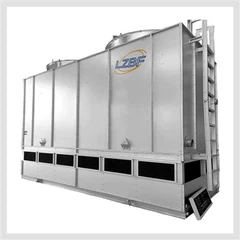
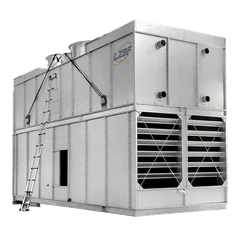
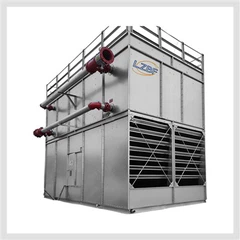
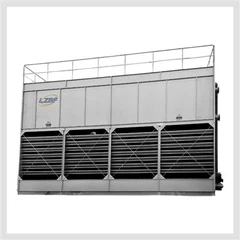

Horizontal closed cooling towers
Sep 25, 2025
Leave a message
Closed cooling towers are widely used in industrial cooling. In terms of cooling structure, closed cooling tows are divided into three forms, which are reverse flow, horizontal flow and composite flow. Today, follow the continent to focus on horizontal closed cooling towers:
How it works
· Flowing closed cooling towers with sprinkler water crossing the direction of the wind horizontally.
· The cooling tower is divided into two side wind, with sprinkler water sprayed from top to bottom, and the water temperature is reduced layer by layer through filling.
· The dry cold wind enters from both sides of the tower, fully fuses with the filling and disc pipes, and wraps the heat exchange pipe all over. Due to the humidity and temperature difference method with the sprinkler water coverage area, the heat exchange effect is better.
· The sprinkler water is heated by layer-by-layer disc pipe, and cooled by filling, so it is repeated many times, and it has passed many cold and heat transitions, increasing the internal and external temperature difference and enhancing the heat exchange effect.
· The characteristics are that the import and export temperature difference is large, the system resistance is small, and the maintenance is convenient and quick.
Scope of application
Horizontal closed cooling towers are suitable for cooling needs in a variety of industrial and commercial applications. They are commonly used to cool hot water or cooling medium in large facilities such as factories, power plants, chemical plants, oil refineries, steel mills, etc. Horizontal closed cooling towers are particularly suitable for medium to large scale cooling needs and are especially suitable in applications where water quality needs to be kept clean.
advantages
Highly energy efficient: The horizontal closed cooling towers use a completely closed design, and the cooling water is not easily evaporated and dissipated during the cycle, thereby avoiding the energy loss and water waste caused by water evaporation in traditional open cooling tows. This design significantly improves the energy efficiency ratio and cooling efficiency.
Easy maintenance: The structure of the horizontal closed cooling towers is relatively simple, so its maintenance is relativeLY easy. Generally, it is only necessary to regularly check the operation of the equipment, replace the water, and replace some fragile parts, which greatly reduces the maintenance cost.
Highly adaptable: Flowing closed cooling towers can adapt to different climatic conditions and environmental requirements. Whether in a high temperature, low temperature, dry or humid environment, the equipment can be ensured for normal operation, so that it can perform well in various environments.
Low noise: Because the horizontal closed cooling towers have a closed design, they produce a low amount of noise during operation and have a small impact on the surrounding environment.
High reliability: The components of the horizontal closed cooling towers are made of high quality materials, ensuring their stability and reliability during use. At the same time, due to its simple maintenance, it also further reduces the probability of equipment failure.
Notes
Although horizontal closed cooling towers have many advantages, there are also some issues that need to be taken into account during use. For example, horizontal closed cooling towers have high water quality requirements, and if the water quality is poor, it is easy to cause problems such as blockage and corrosion of the equipment, affecting the normal operation and service life of the equipment.
practical applications
Horizontal closed cooling towers are widely used in many industrial fields. For example, in the steel industry, it is used to cool various fluids during the steel manufacturing process; In the plastics industry, it is used to cool the fluids used in various plastic processing equipment; In the paper industry, it is used to cool various liquids used in the papermaking process. In addition, horizontal closed cooling towers can also be seen in petrochemical, electricity, textile, food processing and other industries.
In specific application cases, many large enterprises have already successfully used spring shock absorbers in their cooling towers. For example, in the closed horizontal flow cooling towers renovation project of a petrochemical enterprise, the installation of spring shock absorbers reduced the equipment vibration by 40% and improved the cooling efficiency by 20%. After the implementation of the project, the enterprise not only saved a large amount of maintenance costs, but also effectively reduced the energy consumption of the equipment, realizing significant economic and environmental benefits.
Send Inquiry