

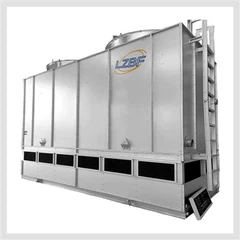
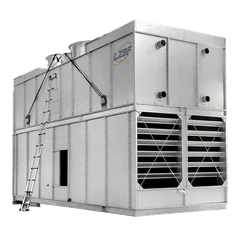
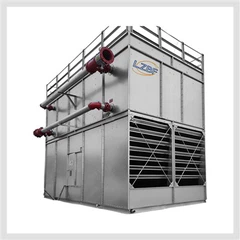
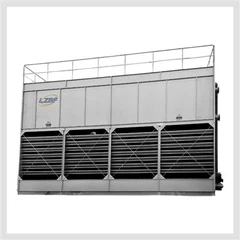

Evaporative cold and closed cooling towers
Sep 24, 2025
Leave a message
Evaporative condenser (also known as evaporative cooling), is a kind of water-cooled and air-cooled, heat and mass transfer process into one and both the advantages of energy-saving cooling equipment.
How it works:
The working principle of evaporative cooling is to pass high temperature and high pressure refrigerated steam that needs condensation through the condensation discharge pipe, spray water outside the pipe and force ventilation to evaporate the water film on the bound surface of the pipe, and the heat from the refrigerated steam inside the pipe is transmitted to the water film outside the pipe, where it evaporates into the atmosphere.
Components:
Evaporative cooling mainly consists of pipe groups, sprinkler systems, water retention boards, axial fans, sinks, pumps, and boxes. It uses the heat of absorption to condense the refrigerant vapor in the tube.Evaporative cooling consumes very little water, which is 1 / 5 to 1 / 10 of the water consumption of a conventional water-cooled condenser under equivalent conditions, and its operating cost is only 1 / 4 to 1 ⁄ 5 of the average water-cooling condenser.
The characteristics of evaporative cold:
1.Efficient energy conservation
The evaporative condenser removes heat through the evaporated latent heat of the water, making the condensation temperature close to the designed wet ball temperature, thereby reducing the power consumption of the compressor and improving the overall energy efficiency of the system.
The use of highly efficient water circulation systems and water-saving designs, such as PVC water retention and dewatering materials and components, can effectively control water consumption and have higher water saving performance compared to traditional cooling systems.
2. Small footprint and easy operation The evaporative condenser is compact and occupies a relatively small footprint, which allows it to provide greater heat exchange capacity in a limited space and reduces installation costs. In addition, the use of an automated control system can realize automatic shutdown, automatic adjustment and other functions, reducing the workload of manual operations and maintenance.
3. Environmentally friendly, non-polluting, easy to maintain
The evaporative condenser produces very little noise, exhaust gases and other pollutants during operation, and meets environmental protection requirements and has no adverse impact on the surrounding environment.
The structure is reasonably designed to facilitate daily maintenance and overhaul, reducing downtime and maintenance costs.
Applications such as evaporated cold air conditioning
It is an air conditioning device that combines the principles of evaporating cooling and circulating refrigeration. Here is a detailed description of e vaporized air conditioning:
1. Work principle The working principle of evacuated air conditioning is mainly based on the following two aspects:
Evaporative cooling principle: Evaporative air conditioning utilizes the principle of evaporation of heat from water to reduce the air temperature. When water is sprayed onto a moist cooling medium, such as a water curtain or wet curtain, water molecules absorb heat from the air during evaporation, which reduces the air temperature. This process is similar to the evaporation and cooling phenomenon in nature, and can effectively remove the heat from the surrounding environment to achieve the cooling effect.
The principle of circulating refrigeration: The circulating refrigerating process includes four steps: compressor work, condenser heat exchange, expansion valve throttle flow and evaporator evaporation. The compressor compresses the refrigerant into a high temperature and high pressure gas, increasing the temperature and pressure of the refrigerant. The high-temperature and high-pressure refrigerants then exchange heat through external air or water in the condenser, releasing heat into the environment while condensing itself into a liquid. Then, as the refrigerant passes through the expansion valve, the pressure decreases and becomes a low-temperature, low-pressure liquid in preparation for entry into the evaporator. Finally, the refrigerant at low temperature and low pressure evaporates in an evaporator, absorbing the heat in the air and reducing the air temperature. The refrigerant that evaporates is absorbed again by the compressor to begin the next refrigeration cycle.
2, Energy efficiency advantages Evaporative cold air conditioning can save more than 35% compared to wind-cooled air conditioning systems;Compared with water-cooled air conditioning systems, it can save more than 15%. This is mainly due to its highly efficient heat exchange system and circulating cooling technology, which allows for a significant improvement in the energy efficiency ratio.
3 suitable scenarios Evaporative cooling air conditioners are used in industrial manufacturing, thanks to their excellent energy efficiency ratio, wide range of applications and excellent cooling effect. Commercial and public service facilities, data centres and high-tech parks, agricultural greenhouses and planting sites, and outdoor recreation and entertainment facilities show extraordinary application potential. For example, in industrial manufacturing, evaporative air conditioning is ideal for many high temperature and high humidity environments, creating a cooler and more comfortable working environment for workers. In commercial and public service facilities, evaporative cooling and air conditioning have become the ideal choice for large shopping centers, office buildings, hotels and other places due to their high efficiency and energy saving characteristics. In data centers and high-tech parks, evaporative air conditioning can quickly remove heat generated by equipment such as servers, ensuring the stable operation of data centers.
Send Inquiry