


Evaporative Condensers: The Working Principle and Application of High-Efficiency Cooling Technology
Jul 08, 2025
Leave a message
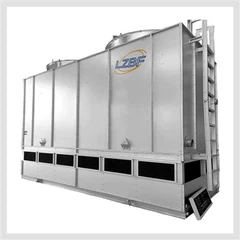
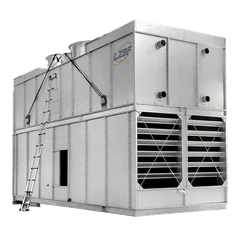
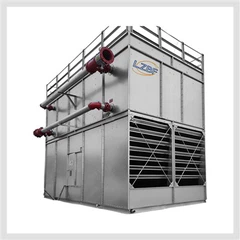
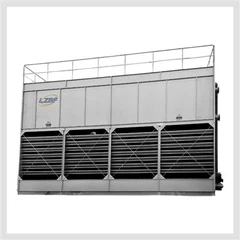
Evaporative condensers are devices that utilize the heat absorption of water evaporation to achieve efficient cooling. They play a vital role in industrial refrigeration, air conditioning systems, and the energy sector. Compared to traditional air- or water-cooled condensers, evaporative condensers combine cooling water with air, removing significant heat through the evaporation process. This significantly improves condensation efficiency and reduces energy consumption.
Working Principle
The core principle of an evaporative condenser is evaporative cooling. When hot refrigerant gas (such as Freon or ammonia) enters the condenser coil, circulating water is sprayed over the coil surface, while a fan drives outside air through the coil. As the water evaporates from the coil surface, it absorbs a significant amount of latent heat, rapidly cooling the refrigerant gas and condensing it into a liquid. The unevaporated water is returned to the tank for recycling, while the air, carrying the water vapor, exits the system.
The key to this process lies in the latent heat of evaporation-the large amount of heat required to transform water from liquid to gas (approximately 540 kcal/kg). Therefore, evaporative condensers offer far greater heat dissipation efficiency than traditional cooling methods that rely solely on air or water.
Structural Components
An evaporative condenser primarily consists of the following components:
Coil assembly: Typically made of copper or stainless steel tubing, it carries the high-temperature refrigerant gas to be condensed.
Spray system: Nozzles spray water evenly across the coil surface, ensuring efficient heat exchange.
Fan: Drives air flow, accelerating water evaporation and removing heat.
Water tank and circulating water pump: Stores and recycles unevaporated water, reducing water waste.
Water collector: Prevents water mist from being lost in the airflow, improving water utilization.
Advantages and Applications
1. High Efficiency and Energy Saving
Evaporative condensers offer 30%-50% higher cooling efficiency than air-cooled condensers and approximately 15%-20% higher energy savings than traditional water-cooled condensers, significantly reducing operating costs.
2. Water-saving and environmentally friendly
Compared to traditional water-cooling systems, evaporative condensers reduce water consumption by recycling water (saving approximately 90%), making them suitable for areas with water shortages.
3. Compact design
Because evaporative condensers integrate cooling, condensing, and water-saving functions, they typically occupy a smaller footprint than traditional cooling systems, making them suitable for space-constrained industrial environments.
4. Widespread applications
Air conditioning and refrigeration industries: Used in large central air conditioning, cold storage, and industrial refrigeration systems.
Power and chemical industries: Play a key role in high-temperature processes such as generator set cooling and chemical reactor condensation.
Food and pharmaceutical industries: Ensure stable operation in low-temperature environments and meet hygiene standards.
Challenges and optimization directions
Despite their significant advantages, evaporative condensers are significantly affected by ambient temperature, humidity, and water quality. They are more efficient in high-temperature, low-humidity areas, while evaporation efficiency is reduced in high-humidity environments. Furthermore, scaling and corrosion can affect coil life, necessitating regular maintenance and the use of anti-corrosion coatings or stainless steel.
Modern technology is further optimizing the performance of evaporative condensers through intelligent control (such as variable-frequency fans and automatic water replenishment) and environmentally friendly cooling media, making them a more sustainable cooling solution while striving for carbon neutrality.
Conclusion
Due to their high efficiency, energy-saving, and environmentally friendly characteristics, evaporative condensers have become a key development direction in modern cooling technology. With the growing demand for industrial refrigeration and technological advancements, evaporative condensers will demonstrate their value in even more areas, contributing to global energy conservation and emission reduction.
Send Inquiry