

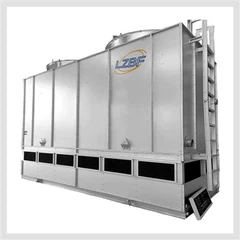
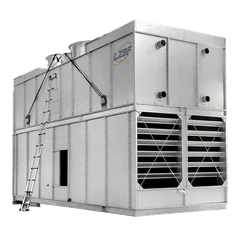
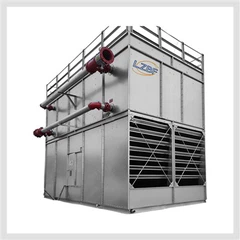
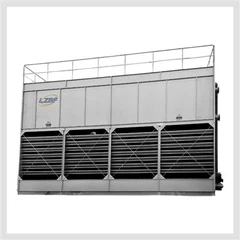

Evaporative Condenser
Oct 11, 2025
Leave a message
An evaporative condenser, also known as an evaporative cooler, is a device used in refrigeration systems. It works by having the spray water outside the coils partially evaporate, which absorbs heat from the high-temperature gaseous refrigerant inside the coils. This process gradually cools and condenses the refrigerant from a gaseous state to a liquid state.
1. Components of an Evaporative Condenser
An evaporative condenser consists of a cooling coil assembly, water supply equipment, ventilator (fan), water baffle, and casing (enclosure), among other parts:
The cooling coil assembly is a set of serpentine coils made from seamless steel pipes, housed in a rectangular casing fabricated from thin steel plates.
Ventilators are installed on either side or the top of the casing.
The bottom of the casing also serves as a water tank for the circulating cooling water.
2. Working Principle of an Evaporative Condenser
High-temperature vapor that needs to be condensed is fed into the cooling coils through the inlet at the upper part of the heat exchange coils.
Inside the coils, the high-temperature vapor releases heat, cools down, and undergoes a phase change to condense into a liquid.
Outside the heat exchange coils, circulating spray water acts as the cooling medium. This spray water forms a uniform water film on the outer surface of the coils.
The water film absorbs the heat released by the hot vapor inside the coils and evaporates.
A fan then draws or blows the water vapor out of the evaporative condenser, effectively removing the heat from inside the coils.
3. Characteristics
Low water consumption: The circulating water volume is much smaller than that of water-cooled condensers (only 5%–10% of water-cooled condensers), and the make-up water requirement is also low (only 1/50–1/25 of water-cooled condensers). This makes it suitable for use in water-scarce and arid regions.
Low fan airflow: The fan airflow is less than 50% of that required by air-cooled condensers.
Humidity-dependent heat exchange: Heat exchange efficiency is significantly affected by the wet-bulb temperature- the drier the climate, the better the cooling effect.
Induced-draft vs. forced-draft types: Induced-draft evaporative condensers allow air to flow evenly through the condensing coils, resulting in better heat transfer performance than forced-draft types. However, the fan operates in a high-temperature, high-humidity environment, increasing the risk of malfunctions.
Energy efficiency and cost: The water pump consumes less power, reducing operating costs, but the initial investment cost is relatively high.
Scale formation risk: Since cooling water is recycled continuously, scale builds up quickly. Therefore, water treated by softening processes is required.
4. Practical Application Issues of Evaporative Condensers
Nozzle clogging: Clogged nozzles prevent the condensing coil assembly from being evenly wetted, leading to increased condensing pressure. Regular cleaning is necessary.
Coil scaling: To address this, advanced electronic water descaling devices should be installed. Additionally, controlling the service life of circulating water and discharging wastewater can help reduce the accumulation of impurities.
Proper water distribution: Ensuring uniform water distribution across the coils is a key challenge.
Corrosion: Corrosion of components (e.g., coils, casing) is a common issue that requires preventive measures.
Wet-bulb temperature of inlet air: The wet-bulb temperature (ts1) of the inlet air is related to local meteorological conditions and directly affects cooling efficiency.
Airflow configuration: Airflow requirements are linked to ts1- a higher ts1 demands a larger air supply volume, which increases energy consumption for ventilation. Thus, airflow configuration should balance energy efficiency and performance requirements.
Water supply configuration: The water supply volume should be sufficient to wet the entire heat exchange surface. Arbitrarily increasing the water supply volume will raise water pump energy consumption, increase water drift loss, and drive up operating costs.
5. Classification
The heat exchange of an evaporative condenser mainly relies on the evaporation of cooling water in air to absorb latent heat of vaporization. It can be classified by airflow direction into induced-draft and forced-draft types. Below are common structural classifications:
Coil-type Evaporative Condenser
Cooling water is sprayed onto the outer surface of the coils to form a water film. After exchanging heat with the medium inside the coils, the water directly contacts the fast-flowing air outside the coils, undergoing heat and mass transfer to complete the heat exchange process. The air carries away heat and water vapor. Airflow not only accelerates heat exchange but also keeps the air unsaturated throughout the process, maintaining a strong driving force for heat and mass transfer. The coil-type evaporative condenser is currently the most widely used type.
Plate-type Evaporative Condenser
In its structure, water and air flow countercurrently, cocurrently, or cross-currently outside the plates, while the space between the plates serves as the condensation and drainage area. Its characteristics include:
Enhanced condensation heat transfer between the plates, accelerating the drainage of the liquid film.
The enhanced heat transfer structure of the plate surface improves fluid flow, strengthens heat and mass transfer between water and air, and significantly increases heat capacity and heat transfer performance.
Enhanced heat transfer is achieved through its special structure, requiring no additional maintenance.
Vertical Evaporative Condenser
Water and air flow countercurrently or cocurrently inside the tubes, while the large space outside the tubes acts as the condensation and drainage area. Its characteristics include:
The tubes are stainless steel enhanced heat transfer tubes, which not only have strong corrosion resistance but also offer excellent heat exchange performance and accelerate the drainage of the condensed liquid film. They are particularly suitable for steam condensation.
In the power industry, condensers are one of the key auxiliary equipment for steam turbine generator units, and their performance directly affects unit operation. The cooling tubes- the main heat transfer components of the condenser- are its most critical part. Therefore, the selection of material and type for cooling tubes is key to condenser design.
Send Inquiry