


Do All AI Computing Centers Adopt Closed-Loop Liquid Cooling Systems?
Jul 04, 2026
Leave a message

 With the rapid expansion of large language model training, generative AI inference and high-density GPU clusters, traditional air cooling and open evaporative cooling towers can no longer meet the thermal management demands of modern AI computing centers.
At present, mainstream large-scale AI supercomputing hubs, hyperscale cloud vendor AI bases and enterprise self-built GPU clusters all take closed-loop liquid cooling as the standard supporting system, while small-scale lightweight AI computing rooms may still retain air cooling as a transitional scheme. Closed-loop cooling has become the core mandatory infrastructure for high-load AI computing scenarios, and its full-popularization trend is irreversible in the industry.
closed-loop liquid cooling

The fundamental reason why closed-loop systems dominate AI cooling lies in the sharp rise of chip heat load. New-generation AI chips such as NVIDIA Blackwell, AMD MI300X and domestic high-performance GPUs have single-chip thermal power exceeding 700W, and a single standard cabinet can carry thermal loads of 80–150kW, far exceeding the 10–20kW upper limit of air-cooled cabinets.
 Air cooling relies on air convection to transfer heat, with low heat transfer efficiency and huge fan power consumption, which pushes the overall PUE of the data center up to 1.3–1.5.
Closed-loop liquid cooling uses sealed pipelines to circulate coolant directly to cold plates attached to chips, with heat transfer efficiency over 85%, cutting cooling power consumption by 30%–40% and pushing PUE below 1.1, and the latest 45℃ warm closed-loop scheme from NVIDIA can even lower PUE to 1.08.
This energy-saving advantage directly reduces the operating cost of large AI bases: a 50MW super-scale AI computing center can save more than 4 million US dollars in annual electricity bills after switching to closed-loop cooling.
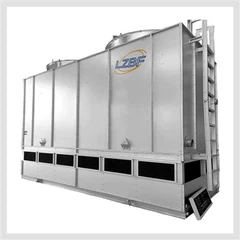
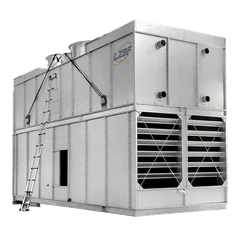
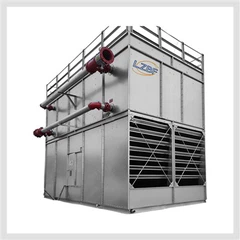
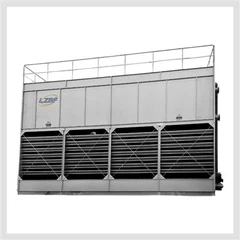
closed cooling tower

Water resource pressure is another key driver for the full adoption of closed-loop systems in AI centers. Open cooling towers rely on water evaporation for heat dissipation, consuming millions of gallons of fresh water every year per megawatt of computing power, triggering strict regulatory restrictions in water-deficient regions.
 Closed-loop cooling forms two independent sealed cycles: the internal circuit connecting server cold plates and closed cooling towers is completely isolated from the external environment, with coolant filled once and recycled for the whole life cycle, almost zero evaporation loss during normal operation.
Industry cases including OpenAI Stargate AI training base and Microsoft new-generation computing park all adopt full closed-loop architecture, cutting annual water consumption to the level of a small restaurant, fundamentally solving the water consumption pain point of "AI water hogs".
Closed cooling towers matched with the system separate internal process water and external spray water through stainless steel coils, so clean circulating water never contacts dust, algae and impurities in the air, avoiding scaling and corrosion of server cold plates, and extending the service life of liquid cooling servers by more than 5 years compared with open systems.
AI computing center

Closed-loop cooling also brings stable operating conditions critical for AI computing. Large model training requires 7×24h uninterrupted stable temperature control; temperature fluctuation will trigger GPU frequency reduction, leading to training interruption and huge computing loss.
 The fully sealed loop of closed-loop systems is equipped with intelligent frequency conversion pumps, temperature sensing modules and automatic bypass control, which can maintain the coolant supply temperature fluctuation within ±0.5℃ all year round.
In spring, autumn and low-temperature nights, the system automatically switches to natural free cooling mode, shutting down chillers to further reduce energy consumption; in high-temperature summer, it cooperates with auxiliary refrigeration to maintain stable heat dissipation without being affected by dust, sand and high humidity in the external environment.
In contrast, open cooling towers are prone to dirt clogging pipelines, requiring regular chemical dosing and water replacement, and the temperature stability is poor, which cannot support long-term uninterrupted AI training tasks.
high-density GPU cluster

However, not all AI-related computing rooms fully deploy closed-loop cooling systems. Small-scale edge AI computing nodes, offline lightweight inference equipment and low-density test rooms with rack power below 20kW still use air cooling or simple open cooling towers to control initial investment.
 Such scenarios have low heat load, short continuous operation time and low sensitivity to water consumption, so closed-loop systems will bring excessive construction and maintenance costs.
But for medium and large-scale AI computing centers with more than 10 GPU cabinets, national industry standards for intelligent computing centers have clearly taken closed-loop liquid cooling as the preferred cold source scheme, and new supercomputing projects are required to configure closed-loop cooling towers as standard supporting equipment.
low PUE

From the perspective of industrial iteration, closed-loop cooling has become the unified design standard of global AI infrastructure. NVIDIA's DSX AI factory reference design, the mainstream architecture of cloud vendors, specifies 100% full closed-loop liquid cooling for all GPU computing platforms, canceling built-in cooling fans of servers completely.
 Domestic east-data-west-computing intelligent computing hubs, new energy AI training bases and pharmaceutical material computing platforms all adopt closed cooling tower matching closed-loop liquid cooling, realizing the dual goals of energy saving, water saving and high-density computing.
With the continuous upgrading of AI chip power, the threshold for mandatory deployment of closed-loop systems will be further lowered, and transitional air cooling schemes will be gradually eliminated in medium and large computing scenarios.
zero water consumption

In summary, small edge AI equipment may temporarily adopt air cooling, but all formal medium and large AI computing centers, super training clusters and hyperscale intelligent computing hubs must use closed-loop liquid cooling systems supported by closed cooling towers.

This solution solves three core pain points of high heat load, excessive water consumption and unstable temperature control of AI computing, and has become the only sustainable thermal management path for the large-scale development of artificial intelligence industry.

Send Inquiry