

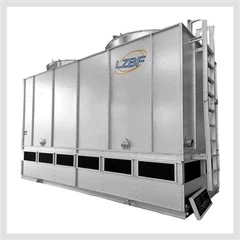
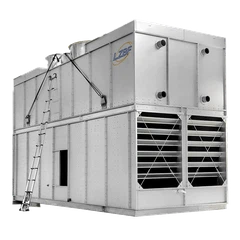
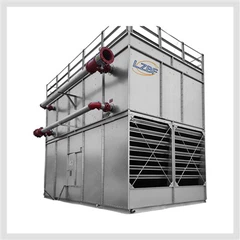
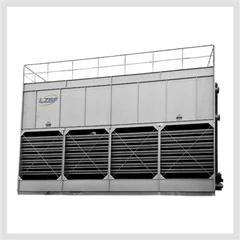

Cooling Tower
Oct 25, 2025
Leave a message
Working Principle of Cooling Tower
Definition of Cooling Tower
A cooling tower is a device that uses water as a circulating coolant. It absorbs heat from the system and discharges it into the atmosphere to lower the water temperature. Its cooling process relies on water evaporation, enabling the cooling water to be recycled and reducing cost waste from an economic perspective.
Cooling Principle
The cooling tower sprays hot water onto the surface of heat dissipation materials, allowing it to come into contact with the passing air. Sensible heat exchange occurs between the hot water and cold air, while part of the hot water evaporates and releases latent heat of evaporation into the air. The cooled water falls into the water tank and is pumped to the heat exchanger to absorb heat again.
Key Factors for Cooling Tower Selection
The following detailed information is required when selecting a cooling tower:
Circulating water flow rate;
Inlet (hot) water temperature of the cooling tower;
Outlet (cold) water temperature of the cooling tower;
Ambient air wet bulb temperature;
Motor voltage and frequency;
Circulating water quality;
Site environmental conditions and available area;
Required tower type.
Characteristics of Cooling Tower
Overview of Counterflow Cooling Tower
Water flows downward naturally by gravity through the heat dissipation materials, while air passes horizontally through the heat dissipation materials, meeting the water flow at a right angle. The cross-flow design reduces air resistance and provides a larger air volume compared to counterflow type.
Characteristics
Cross-flow design reduces air resistance and saves power;
Can be matched with the rectangular design of buildings for an aesthetic structure;
Adopts low-noise design, complying with national standards;
Heat dissipation materials use vacuum forming design, featuring high strength and good heat dissipation effect;
Fan blades adopt wide streamline design, with low rotation speed, high air volume and low noise;
A silencing wind deflector is installed under the fan blade disk to prevent air backflow, increase air volume and reduce wind noise;
Equipped with inspection doors for easy inspection and maintenance;
Can be installed in parallel, offering flexible use and energy saving.
Cooling Tower Selection
Cooling Tower Selection Steps
1.1 First, determine the inlet water temperature of the cooling tower to select a standard-type, medium-temperature-type or high-temperature-type cooling tower.
1.2 Determine the noise requirements based on the equipment in use or on-site conditions, and select either a cross-flow or counterflow cooling tower.
1.3 Select the cooling tower flow rate according to the cooling water flow rate of the chiller or refrigeration machine. Generally, the cooling tower flow rate should be greater than that of the refrigeration machine (usually 1.2–1.25 times).
1.4 When multiple towers are installed in parallel, try to select the same model of cooling tower.
Notes for Cooling Tower Selection
2.1 The tower structure material of the cooling tower should be stable, durable, corrosion-resistant and accurately assembled.
2.2 Uniform water distribution, minimal wall flow, reasonable selection of spray devices that are not prone to clogging.
2.3 The type of cooling tower fill should meet the requirements of water quality and water temperature.
2.4 The fan should be properly matched to ensure long-term normal operation without vibration or abnormal noise. The blades should have good water erosion resistance and sufficient strength. The installation angle of the fan blades is adjustable, but the angles must be consistent, and the motor current should not exceed the rated current.
2.5 Low power consumption and low cost. Small and medium-sized steel frame glass cooling towers should also be lightweight.
2.6 The cooling tower should be avoided as much as possible near heat sources, waste gas and flue gas generation points, chemical storage areas and coal piles.
2.7 The distance between cooling towers or between towers and other buildings should consider not only the ventilation requirements of the towers and the mutual influence between towers and buildings but also the fire and explosion-proof safety distance of buildings and the construction and maintenance requirements of the cooling towers.
2.8 The direction of the inlet pipe of the cooling tower can be rotated by 90°, 180° or 270°.
2.9 The material of the cooling tower can withstand a low temperature of -50℃, but for areas where the average temperature in the coldest month is lower than -10℃, it should be specified when placing an order to take anti-icing measures. The cost of the cooling tower will increase by approximately 3%.
2.10 The turbidity of the circulating water should not exceed 50mg/l, and not exceed 100mg/l in the short term. It should not contain oil stains or mechanical impurities. If necessary, algae removal and water quality stabilization measures should be taken.
2.11 The water distribution system is designed according to the nominal water volume. If the actual water volume differs by more than ±15% from the nominal water volume, it should be specified when placing an order to modify the design.
2.12 During storage and transportation, no heavy objects should be placed on the cooling tower components, and they should not be exposed to direct sunlight. Fire prevention should also be noted. During the installation, transportation and maintenance of the cooling tower, open flames such as electric welding and gas welding should not be used, and firecrackers and fireworks should not be set off nearby.
2.13 For the design of multiple round towers, the net distance between towers should be at least 0.5 times the tower diameter. Cross-flow towers and counterflow square towers can be arranged in parallel.
2.14 The selected water pump should be matched with the cooling tower to ensure process requirements such as flow rate and lift.
2.15 When selecting multiple cooling towers, choose the same model as much as possible.
Maintenance
Most cooling water contains calcium ions, magnesium ions and bicarbonates. When the cooling water flows through the metal surface, carbonate scale is formed. In addition, the oxygen dissolved in the cooling water can also cause metal corrosion and form rust. Due to the formation of rust and scale, the heat exchange efficiency of the cooling tower decreases. In severe cases, it is necessary to spray cooling water outside the shell. Severe scaling can block the pipes and make the heat exchange effect ineffective. Research data shows that scale deposits have a significant impact on heat transfer loss. The increase in deposits will lead to higher energy costs. Even a thin layer of scale can increase the operating cost of the scaled part of the equipment by more than 40%. Keeping the cooling channels free of mineral deposits can effectively improve efficiency, save energy, extend the service life of the equipment, and save production time and costs. For a long time, traditional cleaning methods such as mechanical methods (scraping, brushing), high-pressure water, and chemical cleaning (pickling) have encountered many problems when cleaning equipment: they cannot completely remove scale and other deposits, acid solution corrodes the equipment to form holes, and the residual acid causes secondary corrosion or under-scale corrosion of the material, eventually leading to equipment replacement. In addition, the cleaning waste liquid is toxic and requires a lot of funds for wastewater treatment.
Send Inquiry