

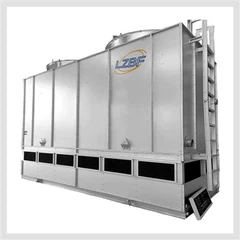
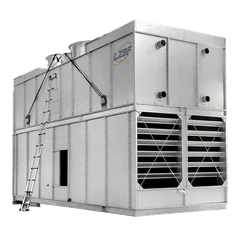
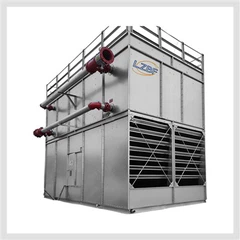
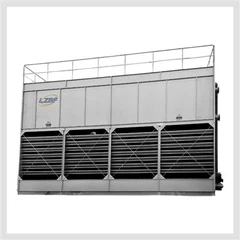

Cooling Capacity of Closed Cooling Towers
Sep 12, 2025
Leave a message
The working principle of a closed cooling tower essentially boils down to heat exchange and heat transfer, involving temperature difference exchanges between air, spray water, and the liquid to be cooled. Therefore, a closed cooling tower is also a heat-dissipating device, with the advantages of reducing energy consumption and enabling cyclic water usage.
The cooling capacity of a closed cooling tower is quite remarkable. It does not involve direct contact between air and the liquid (usually water or an ethylene glycol mixture) being cooled. Unlike open cooling towers, it has two independent fluid circuits. One is the water in the external circuit, which circulates outside the tube bundle (closed coil) in the second circuit connected to the heat flow process, and is cooled and returned in the closed circuit. Air is drawn in through the cascading of circulating water outside the entire heat pipe, providing a similar evaporation effect to open cooling towers. During operation, heat flows from the internal fluid circuit through the coil wall to the external circuit, and then is transferred to the atmosphere through air and water evaporation. Thus, the indirect cooling tower functions much like an open cooling tower, with one exception: the process is controlled by a coolant in a "closed" circuit that is not directly exposed to the atmosphere or the external circulating water. The cooling tower achieves a certain cooling effect, which depends on the heat sink and the air volume of the fan. Additionally, the water consumption, ventilation conditions, and installation location of the cooling tower also have a certain impact on its effectiveness.
Impact of Cooling Tower Heat Sinks and Fan Air Volume on the Cooling System
1. Heat sink: It is a key component of the cooling tower. Small towers generally use PVC sheets made by hot pressing or heat absorption type. Large towers will use wood. The main purpose is to maximize the contact area between air and water without affecting wind resistance, while also maximizing the heat exchange rate. The two parameters that affect the heat transfer effect of the heat sink are mainly its shape and height. It is important to avoid damaging the heat sink to prevent unsmooth water flow within it.
2. Fan capacity: It mainly accelerates the air flow in the tower, speeds up the heat exchange between air and water, and carries away heat. The main factors affecting the air volume of the fan include the shape of the blades (i.e., the width and length of the blades), the deflection angle of the blades themselves, the rotation speed of the blades, the installation angle, the rotation speed, the motor, and the transmission ratio, etc. In addition, under a certain air volume, for cooling towers of the same type, the cooling effect is better with a smaller cooling water flow than with a larger one.
Factors Affecting Cooling Capacity
The cooling capacity of a closed cooling tower is affected by various factors. Its theoretical minimum temperature is closely related to the wet-bulb temperature of the location where it is used, while the actual cooling range needs to be comprehensively evaluated in combination with specific design parameters and operating conditions. The key analyses are as follows:
1. Theoretical cooling limit
The cooling limit of a closed cooling tower mainly depends on the ambient wet-bulb temperature (i.e., the temperature at which water evaporation reaches equilibrium under natural conditions). The theoretical minimum temperature is usually wet-bulb temperature + 3℃. For example, if the wet-bulb temperature in a certain place is 23.6℃, the actual minimum outlet water temperature of the closed cooling tower is approximately 26.6~27℃. Method for measuring wet-bulb temperature: Wrap the temperature-sensing part of a thermometer with a wet gauze, keep the gauze moist and ventilated, and read the temperature after it stabilizes.
2. Range of actual cooling amplitude
Depending on the application scenario, the cooling amplitude of a closed cooling tower is usually between 5~25℃, with specific performances as follows:
- High-temperature medium: If the inlet water temperature is 75℃, it can be reduced to 30℃, with a temperature difference of 45℃;
- Low-temperature medium: If the inlet water temperature is 40℃, it can also be reduced to 30℃, with a temperature difference of 10℃.
The actual cooling effect needs to be adjusted in combination with the following factors:
- Heat load and flow rate: When the heat load is high or the flow rate is insufficient, the cooling amplitude may be limited.
- Environmental conditions: When the temperature difference between dry and wet bulbs is large (such as in sunny weather), the evaporation and heat dissipation efficiency is higher, and the cooling effect is more significant.
- Equipment design and maintenance: Optimized coil structure, high-efficiency fans, and regular cleaning can improve heat exchange efficiency.
3. Key influencing factors
- Wet-bulb temperature: As the core parameter determining the theoretical cooling limit, its value is directly affected by geographical location and seasonal changes.
- Equipment selection and design
- Tower type selection: Counterflow type has high heat exchange efficiency but high noise, while crossflow type is easy to maintain and occupies a small area. Specific selection requires calculation and design by professional engineers.
- Materials and structure: The selection of coil material, as well as the design of coil passes, length, and type, fan energy consumption, and modular design, all affect performance.
- Operation management
- Water quality treatment: Preventing scale can maintain efficient heat exchange.
- Flow control: The flow rate must be ≥ 80% of the designed value to avoid local freezing or efficiency reduction caused by low flow rate.
4. Testing and verification methods
- Comparison of actual operation data: Determine performance by monitoring the deviation between the outlet temperature (T1) and the designed value (T0). If T1 ≤ T0, it is up to standard.
- Characteristic curve evaluation: When the ratio of actual cooling water volume to designed water volume is ≥ 95%, the efficiency is considered qualified.
- Laboratory simulation: Collect data using high-precision sensors in a constant temperature and humidity environment, and optimize the design in combination with CFD analysis.
5. Selection and application suggestions
- Select based on wet-bulb temperature: It is necessary to measure the local wet-bulb temperature in advance to ensure that the designed temperature of the equipment is close to "wet-bulb temperature + 3℃".
- Consider environmental adaptability: In high-temperature and high-humidity areas, it is necessary to increase the heat exchange area or use variable-frequency fans to adjust air volume.
- Choose reliable manufacturers: Priority should be given to manufacturers with rich production experience and patented technologies, such as Oasis Ice Peak.
Send Inquiry