


Complete Air Venting Procedures for Water Cooling Circuits
Jul 02, 2026
Leave a message

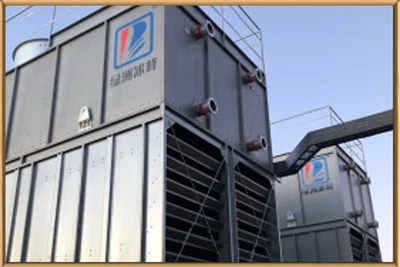 Trapped air inside water cooling circuits creates air locks that block fluid circulation, drastically reduce heat exchanger efficiency, and trigger malfunctions including pump cavitation, pipeline gurgling noise, and equipment overheating shutdown.
Standardized air venting is a core procedure after system commissioning, water replacement and maintenance. Following four core principles-gravity-guided air evacuation, sectional venting, low-speed circulation and repeated rechecks-the full process covers five phases: pre-operation preparation, initial filling & venting, in-operation deep venting via circulation, auxiliary venting for dead zones, and long-term daily anti-air-trapping management.
It applies to all closed-loop water systems such as industrial closed cooling water systems, unit cooling circuits and equipment liquid cooling loops.
Products Description
Pre-operation preparation lays the foundation for complete air removal. Before operation, cut off power to circulation  pumps and heating equipment, and cool down the circuit medium to ambient temperature to avoid backflow of expanded high-temperature steam that draws in new air.
Check liquid levels of expansion tanks and makeup water tanks, and replenish fluid to the standard scale range; excessively low liquid levels will cause negative pressure at pumps to suck in air and continuously generate bubbles.
Fully sort out all vent points on pipelines, and verify intact manual air vents installed at the system's highest points, heat exchanger heads, tops of water distributors and collectors, inflection points of ascending pipelines and equipment cold heads.
 Automatic air vents are permanently mounted at the peak of the main circuit to discharge trace gas precipitated from medium during operation, while manual vents handle bulk air removal in the initial stage; combined use of both improves venting performance.
Meanwhile, inspect pipeline slopes: horizontal pipelines shall maintain a gradient of no less than 5‰ with water flowing gently upward toward vent outlets, enabling bubbles to rise naturally to vent points by buoyancy. Reverse slopes or local sunken dead zones must be eliminated, otherwise bubbles will remain trapped permanently inside pipelines.
Products Description
The initial liquid filling phase adopts the standard process of slow low-point filling and simultaneous high-point venting. Rapid high-flow water injection is strictly prohibited, as fast-flowing water will continuously entrain air to form fine bubbles trapped inside coils and elbows.
 Inject cooling water/antifreeze evenly through the makeup port at the system's lowest point, and open all high-point manual air vents sequentially from remote branches to the main circuit. Prioritize vent outlets on far-end branches before operating main circuit vents.
Air mixed with intermittent water will spurt out of vents at first. Once steady continuous water flow without white foam or intermittent bubbles flows out, keep the vent open for 3 minutes to release residual gas trapped in pipeline interlayers, then slowly close the corresponding vent valve.
Complete venting for one branch before moving to the next to prevent air retention in branches caused by simultaneous closure of multiple vents. After initial venting of all points, top up medium in the expansion tank and restore the closed state of the system.
Products Description
Initial venting can only remove bulk air, while microbubbles remain trapped in pipeline elbows and gaps of heat exchange coils, requiring deep venting via low-speed circulation. Start the circulation pump under no-load condition and adjust operating frequency to 30%–50% of rated speed.
 Low-velocity flow gently scours pipelines, carrying scattered bubbles upward to gather at high-point vent devices for continuous circulation over 10 to 15 minutes.
During circulation, loosen each manual air vent for a second time for 10 to 20 seconds to discharge accumulated rising gas. Replenish medium promptly after venting each point to prevent air intake from falling liquid levels.
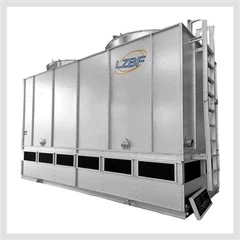
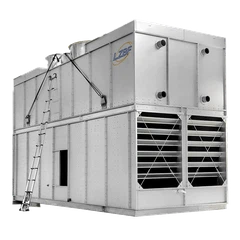
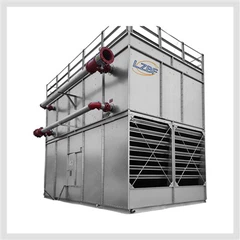
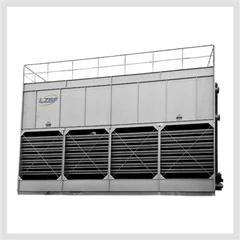
For large industrial closed cooling tower water cooling systems, start and stop the pump repeatedly 3 to 5 times, leaving the system stationary for 5 minutes after each shutdown to allow suspended bubbles to fully rise, then resume low-speed circulation scouring.
Repeat this operation to eliminate air locks inside coil dead zones. During operation, monitor pipelines for gurgling water noise and persistent high unit temperature. Disappearance of abnormal noise and stable constant temperature indicate most air has been discharged.
Products Description
Auxiliary venting measures are adopted for hard-to-vent dead zones that cannot be fully purged by regular circulation, including heat exchanger coils, long ascending branch pipes and built-in equipment cold heads.
 For small liquid cooling equipment, tilt the unit slightly to position pipeline peaks upward and the pump at the lower section; shake the unit to drive internal medium flow and release bubbles stuck in flow channels.
For large industrial water cooling systems, apply slight pressure via the makeup pump within 0.03–0.05 MPa to push bubbles in dead zones toward air vents. If restarting after full medium drainage during shutdown maintenance, attach a thin hose to the air vent to guide drained fluid to the makeup tank and avoid splashing contamination on site; close the vent only when clear bubble-free water flows out of the drainage hose.
For aged circuits with chronic air entrapment and substandard heat exchange performance, isolate pipelines sectionally, fill and vent each segment separately to eliminate hidden air lock risks one by one.
Products Description
Long-term management is required after venting to prevent secondary air ingress and establish a regular maintenance routine. Maintain standard liquid level in the expansion tank during daily operation, conduct periodic inspections on automatic air vents and clean limescale and impurities at valve ports to avoid jamming and failure of valve cores.
 Repeat the sectional venting procedure every time makeup water is added, medium is replaced, or pipelines are disassembled for maintenance. Before restarting the system after long-term shutdown, fully open all manual air vents in advance, perform low-speed water filling and venting, then put the system into operation.
Plan vent points in advance during construction and renovation, and reserve air nozzles at all ascending pipelines and branch tops to reduce air trapping risks at the source.
Products Description
 Upon standardized completion of the full venting process, the system's circulation resistance returns to design specifications, pumps operate free of cavitation noise, and heat exchangers recover rated heat transfer efficiency.
This avoids equipment overload, higher energy consumption and premature component wear caused by air locks. There are no shortcuts for air venting.
Slow water filling, sectional operation, low-speed circulation and multiple rechecks are the keys to fully removing air from water cooling circuits and securing long-term stable system operation.

Send Inquiry