


Case Study: How We Solved a Noise Complaint Crisis for a Factory Near a Residential Area
Oct 10, 2026
Leave a message

 Noise is one of the most common-and most difficult-problems faced by industrial facilities in urban or suburban areas.
Unlike water consumption or energy costs, which are internal operational concerns, noise directly affects the surrounding community. And when residents complain, the pressure on facility managers becomes immediate and intense.
This was the situation faced by one of our clients: a mid-size manufacturing plant located just 200 meters from a residential neighborhood.
The Problem: Escalating Complaints and Regulatory Pressure
The plant had been operating a large open cooling tower for over 12 years. When the facility was first built, the surrounding area was largely undeveloped. But over the years, residential communities had grown up around the plant.
The aging cooling tower had become a persistent source of complaints:
Loud fan noise that could be heard clearly in nearby homes, especially at night
Water splashing sounds from the fill media and basin
Low-frequency vibration that residents described as a constant "hum"
Multiple formal complaints filed with the local environmental protection bureau
The local authorities issued a notice requiring the plant to reduce its noise emissions to below 55 dB(A) at the property boundary during nighttime hours. Failure to comply would result in fines and potential production restrictions.
The plant manager evaluated several options:
Adding acoustic barriers around the existing tower-estimated cost: moderate, but effectiveness uncertain
Replacing the fan and motor with quieter components-limited improvement, as the water noise would remain
Full retrofit to a closed-circuit low-noise tower-higher upfront cost, but a permanent solution
After consulting with our engineering team, the plant decided to pursue the full retrofit option.
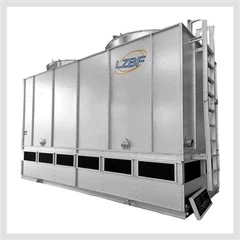
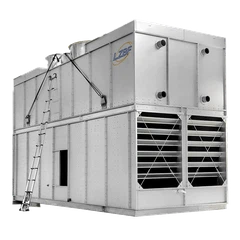
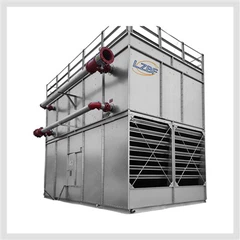
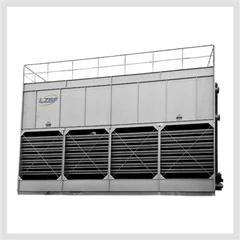
The Solution: A Custom Low-Noise Closed-Circuit Tower
Our team conducted an on-site acoustic assessment to identify the primary noise sources and establish a baseline measurement. The existing open tower was producing approximately 72 dB(A) at the property boundary-well above the 55 dB(A) limit.
Based on the assessment, we designed a custom low-noise closed-circuit cooling tower with the following features:
1. Wide-Blade, Low-RPM Fan
We specified a large-diameter fan with optimized blade geometry, running at a reduced speed of 250 RPM. This significantly lowered aerodynamic noise compared to the original fan, which operated at 720 RPM.
2. Variable Frequency Drive (VFD)
The VFD allowed the fan to run at even lower speeds during nighttime hours and lighter cooling loads, further reducing noise when it mattered most.
3. Acoustic Louvers on Air Intakes
Sound-absorbing louvers were installed on all air intake openings, reducing fan noise radiation without restricting airflow.
4. Elimination of Fill Media Noise
By switching to a closed-circuit design, the loud "waterfall" noise from water cascading over fill media was completely eliminated. The external spray water flows smoothly over the coil surface, producing minimal sound.
5. Vibration Isolation System
Spring isolators were installed under the fan motor and pump, and flexible connections were added to all piping. This prevented mechanical vibration from transmitting through the structure.
6. Same-Footprint Installation
The new tower was designed to fit within the existing foundation footprint, avoiding the need for civil construction and minimizing installation downtime.
The Installation Process
The retrofit was completed during a planned maintenance shutdown. The old open tower was dismantled and removed over two days. The new closed-circuit tower, which had been pre-fabricated and partially assembled off-site, was installed and connected over the following three days.
Total production downtime: five days-well within the plant's planned maintenance window.
The Results: Silence and Savings
Post-installation acoustic testing confirmed that the new tower produced 48 dB(A) at the property boundary during nighttime operation-7 dB(A) below the regulatory limit and 24 dB(A) quieter than the old tower.
The results exceeded expectations:
Zero noise complaints from residents in the six months following installation
Regulatory compliance achieved without the need for additional acoustic enclosures
35% reduction in water consumption compared to the old open tower
Improved cooling reliability during peak summer conditions
Lower maintenance costs due to the sealed process loop and reduced scaling
The plant manager also reported an unexpected benefit: improved employee morale. Workers in areas near the cooling tower noted that the reduced noise made the work environment more comfortable.
What the Plant Manager Said
"We were under enormous pressure from both the authorities and the community. The noise was affecting our relationship with our neighbors and putting our operating permit at risk. The new closed-circuit tower solved the problem completely. Not only did we meet the noise requirements, but we also saved on water and maintenance costs. It was a win-win."
Key Takeaways from This Project
This case study illustrates several important points for facility managers facing similar challenges:
Noise is a solvable problem. With the right engineering approach, cooling tower noise can be reduced to levels that satisfy even the strictest regulations.
Closed-circuit design offers inherent noise advantages. By eliminating fill media noise and enabling low-speed fan operation, closed-circuit towers provide a strong foundation for quiet performance.
Retrofit can be faster and cheaper than expected. A well-planned retrofit can minimize downtime and leverage existing infrastructure, reducing both cost and disruption.
Community relations matter. Investing in noise control is not just about compliance-it is about being a good neighbor and protecting your facility's reputation.
Is Noise a Problem at Your Facility?
If your cooling tower is generating complaints from nearby residents or approaching regulatory limits, it may be time to evaluate your options.
Our engineering team can conduct an on-site acoustic assessment and provide a detailed proposal for a low-noise closed-circuit cooling tower solution tailored to your specific situation.
Contact us today to schedule a noise assessment and discover how we can help you achieve quiet, compliant, and efficient cooling.
Send Inquiry