

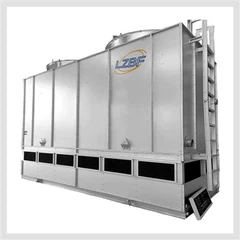
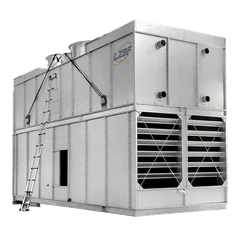
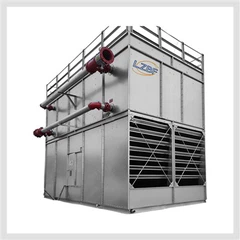
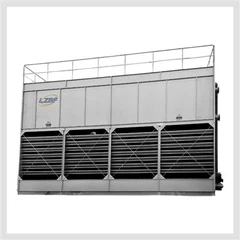

Air-Cooled Condenser
Sep 09, 2025
Leave a message
Working Principle
An air-cooled condenser is a device that uses air as the cooling medium. It achieves the refrigeration effect by heating air to a certain temperature, allowing it to absorb and carry away the condensation heat. This type of condenser is particularly suitable for occasions with extreme water scarcity or where water supply is unavailable, thus being widely used in small Freon refrigeration units.
According to different air flow modes, air-cooled condensers can be divided into two types: natural convection and forced convection. Natural convection refers to the flow of air in the condenser through natural forces such as thermal pressure difference. Forced convection, on the other hand, forces air to flow in the condenser through mechanical or other external forces.
Product Categories
Condensers can be divided into three types according to the cooling medium: water-cooled, air-cooled and evaporative. Water-cooled condensers use water as the cooling medium and take away heat through water circulation. Air-cooled condensers use air as the cooling medium and take away heat through the temperature rise of the air. Evaporative condensers spray refrigerant onto the cooling tube bundles and take away heat through evaporation.
Applicable Scope
Different types of condensers have different characteristics and applicable scopes. Water-cooled condensers are suitable for large-scale refrigeration, because water has a large specific heat capacity and can take away a large amount of heat. Air-cooled condensers are suitable for water-scarce or water-unavailable occasions, but their refrigeration effect is generally not as good as that of water-cooled condensers. Evaporative condensers are suitable for large refrigeration units, because their refrigerant spray volume is large and can take away a large amount of heat.
Key Advantages
Efficient heat dissipation: The latent heat of vaporization of water (about 2260 kJ/kg) is much higher than that of sensible heat exchange, which greatly improves the cooling efficiency.
Water-saving and environmental protection: Compared with traditional water-cooled systems, water consumption is reduced by about 60% - 80%.
Compact structure: It eliminates the need for cooling towers and some pipelines, occupying a small area.
Influencing Factors
Ambient humidity: The evaporation rate is faster in dry air, resulting in higher efficiency; high humidity environments may reduce performance.
Water quality management: Circulating water needs to be treated regularly to prevent scaling and microbial growth.
Application Scenarios
Widely used in refrigeration systems, industrial cooling, data centers and other fields requiring efficient heat dissipation, especially in water-scarce areas or regions with high water-saving requirements.
By synergistically heating air to a certain temperature to make it absorb and carry away condensation heat, thus achieving the refrigeration effect, air-cooled condensers perform excellently in energy saving and environmental protection, and have become an important choice in modern cooling technology.
Send Inquiry