

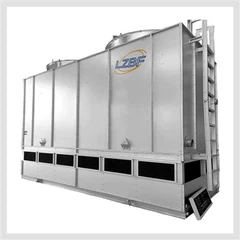
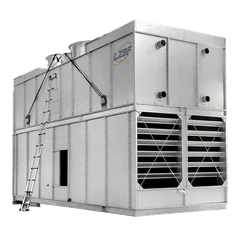
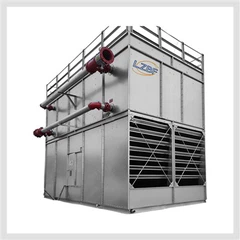
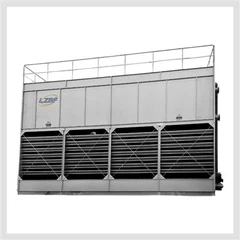

What are the different types of Indirect Evaporative Condensers available in the market?
Sep 10, 2025
Leave a message
In the realm of industrial cooling systems, indirect evaporative condensers play a pivotal role in maintaining efficient and cost - effective operations. As a leading supplier of indirect evaporative condensers, I am well - versed in the various types available in the market. This blog post aims to provide an in - depth analysis of these different types, their features, advantages, and applications.
1. Plate - Type Indirect Evaporative Condensers
Plate - type indirect evaporative condensers are characterized by their use of a series of plates to facilitate heat transfer. These plates are typically made of materials with high thermal conductivity, such as stainless steel or aluminum. The refrigerant flows through one side of the plates, while the cooling water and air flow on the other side.
The working principle of plate - type condensers is based on the transfer of heat from the refrigerant to the water film on the plates. As the water evaporates, it absorbs heat from the refrigerant, causing it to condense. The evaporated water is then carried away by the air stream.
One of the main advantages of plate - type indirect evaporative condensers is their high heat transfer efficiency. The large surface area provided by the plates allows for a greater amount of heat to be transferred in a relatively small space. Additionally, they are compact in size, making them suitable for installations where space is limited.
However, plate - type condensers may be more prone to fouling compared to other types. The narrow channels between the plates can accumulate dirt and debris over time, which can reduce the heat transfer efficiency. Regular maintenance, including cleaning of the plates, is therefore essential to ensure optimal performance.
2. Tube - Bundle Indirect Evaporative Condensers
Tube - bundle indirect evaporative condensers consist of a bundle of tubes through which the refrigerant flows. The tubes are usually arranged in a specific pattern to maximize heat transfer. Similar to plate - type condensers, the cooling water and air flow around the tubes to remove heat from the refrigerant.
The tube - bundle design offers several benefits. Firstly, it provides a large heat transfer surface area, which enhances the overall heat transfer rate. Secondly, the tubes are relatively easy to clean compared to the plates in plate - type condensers. This is because the tubes have a more open structure, allowing for easier access for cleaning tools.
Tube - bundle indirect evaporative condensers are commonly used in large - scale industrial applications, such as power plants and chemical processing facilities. Their robust construction makes them suitable for handling high - pressure and high - temperature refrigerants. However, they tend to be larger in size compared to plate - type condensers, which may require more installation space.
3. Evaporative Type Of Condenser
The evaporative type of condenser combines the principles of evaporation and heat transfer to achieve efficient cooling. In this type of condenser, the refrigerant is condensed by the evaporation of water on the outer surface of the heat exchanger.
The evaporative type of condenser typically consists of a heat exchanger, a water distribution system, and a fan. The water is sprayed onto the heat exchanger surface, where it forms a thin film. As the air is drawn through the condenser by the fan, the water evaporates, absorbing heat from the refrigerant.


One of the key advantages of the evaporative type of condenser is its high energy efficiency. The evaporation process requires less energy compared to traditional air - cooled condensers. Additionally, it can operate at lower condensing temperatures, which can improve the overall efficiency of the refrigeration system.
However, the evaporative type of condenser requires a continuous supply of water. In areas where water is scarce, this can be a significant drawback. Moreover, the water used in the condenser may contain impurities, which can lead to scaling and corrosion of the heat exchanger over time.
4. Evaporative Surface Condenser
Evaporative surface condensers are designed to provide efficient heat transfer through the evaporation of water on the surface of the condenser tubes. These condensers are often used in applications where a high degree of heat removal is required, such as in large - capacity refrigeration systems.
The working mechanism of an evaporative surface condenser involves the spraying of water onto the outer surface of the tubes. The water forms a thin film, which evaporates as the air passes over it. The heat from the refrigerant inside the tubes is transferred to the water film and then removed by the evaporation process.
Evaporative surface condensers offer several advantages. They have a high heat transfer coefficient, which means they can transfer heat more effectively compared to some other types of condensers. They also have a relatively low operating cost due to their energy - efficient design.
On the downside, evaporative surface condensers require regular maintenance to prevent the growth of algae and bacteria in the water system. The presence of these microorganisms can reduce the heat transfer efficiency and may also cause health hazards if the condenser is used in a sensitive environment.
5. Dry - wet Condenser
Dry - wet condensers combine the features of both dry and wet cooling systems. In a dry - wet condenser, the refrigerant first passes through a dry section, where it is cooled by air only. Then, it enters a wet section, where the cooling is enhanced by the evaporation of water.
The dry - wet design offers several benefits. During periods of low ambient temperature, the dry section can operate alone, reducing the water consumption of the condenser. This is particularly useful in regions where water is scarce. When the ambient temperature rises, the wet section can be activated to provide additional cooling capacity.
Dry - wet condensers are also more flexible in terms of operation. They can adapt to different environmental conditions, which makes them suitable for a wide range of applications. However, the design of dry - wet condensers is more complex compared to other types, which may result in higher initial investment costs.
Applications and Considerations
The choice of an indirect evaporative condenser depends on several factors, including the application requirements, the available space, the water availability, and the budget. For example, in a small - scale commercial refrigeration system with limited space, a plate - type indirect evaporative condenser may be the best choice. On the other hand, a large - scale industrial plant may require a tube - bundle or an evaporative surface condenser to handle the high heat loads.
Water availability is also a crucial factor. In areas with abundant water supply, evaporative - based condensers such as the evaporative type of condenser or the evaporative surface condenser may be preferred. In contrast, in water - scarce regions, a dry - wet condenser or a plate - type condenser with a closed - loop water system may be more suitable.
Budget is another important consideration. While some types of condensers may have a lower initial cost, they may have higher operating and maintenance costs over time. It is essential to consider the total cost of ownership when selecting an indirect evaporative condenser.
Conclusion
As a supplier of indirect evaporative condensers, I understand the importance of providing the right solution for each customer's needs. The market offers a wide range of indirect evaporative condenser types, each with its own unique features, advantages, and limitations. By carefully considering the application requirements, space availability, water availability, and budget, customers can select the most suitable condenser for their operations.
If you are in the market for an indirect evaporative condenser, I encourage you to contact us for a detailed consultation. Our team of experts can help you assess your needs and recommend the best type of condenser for your specific application. We are committed to providing high - quality products and excellent customer service to ensure your satisfaction.
References
- ASHRAE Handbook of Refrigeration.
- Industrial Refrigeration Systems: Principles and Applications, by Peter D. Christensen.
- Heat Transfer: A Practical Approach, by Yunus A. Cengel.
Send Inquiry