


Cooling Medium And Application Industries Of Closed-Circuit Cooling Towers
Mar 22, 2026
Leave a message
Cooling Medium and Application Industries of Closed-Circuit Cooling Towers
I. What Can the Cooling Medium Be?
Closed-circuit cooling towers adopt a dual-circuit system design, with different mediums in the two circuits:
1. Internal Circuit Medium (Process Side)
Soft Water:
Most commonly used; purified water after softening treatment, not prone to scaling.
Demineralized Water:
Used for processes with extremely high water quality requirements.
Antifreeze (Ethylene Glycol Solution):
Used in winter or cold regions to prevent pipe freezing.
Deionized Water:
Used in precision manufacturing fields such as electronics and semiconductors.
2. External Circuit Medium (Spray Side)
General Industrial Water:
Used for spray cooling; does not come into contact with the internal circuit medium.
Tap Water:
Can be used as makeup water for the external circuit.
Core Advantage:
The internal circuit is a fully enclosed system, completely isolating the cooling medium from outside air, fundamentally eliminating issues of contamination, scaling, and corrosion.
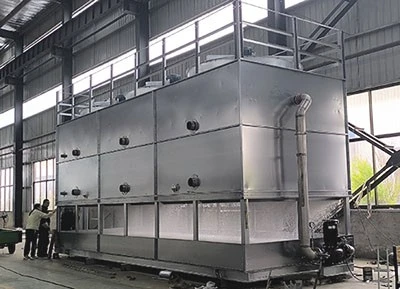
II. Which Industries Are They Applied In?
Closed-circuit cooling towers are widely used in the following industries due to their advantages of high efficiency, energy savings, water conservation, environmental friendliness, cleanliness, and reliability:
| Industry Sector | Specific Application Scenarios | Case / Description |
|---|---|---|
| Steel & Metallurgy | Converter oxygen lances, refining furnaces, crystallizers, internal cooling systems | Shougang Qian'an project, total cooling water flow 11,600 m³/h |
| Power Industry | Auxiliary cooling for generator sets, transformer cooling | Auxiliary cooling for thermal power plants and nuclear power plants |
| Petrochemical | Reactor cooling, process medium cooling, refining units | Stable cooling required for strongly exothermic reactions |
| Coal Chemical | Zero-discharge projects, supporting cooling for high-salt wastewater treatment | A project in Shaanxi achieved water savings of 57% |
| Data Centers | Server cooling, precision air conditioning systems | 24/7 uninterrupted cooling demand throughout the year |
| Electronics & Semiconductors | Circuit power supply cooling, high-precision equipment cooling | Extremely high requirements for water cleanliness |
| Food & Pharmaceutical | Fermentation tank cooling, process water cooling | Hygienic grade requirements, contamination must be eliminated |
| Photovoltaic & Glass | Crystal pulling furnace cooling, slicing equipment cooling | Water temperature stability directly affects product quality |
| Industrial Furnaces | Medium-frequency furnaces, induction heating equipment cooling | High-temperature conditions requiring reliable cooling |
| LNG / New Energy | Liquefied natural gas, lithium battery production cooling |
Applications in emerging fields
|

III. Why Do These Industries Choose Closed-Circuit Cooling Towers?
Ensuring Product Purity:
Fully enclosed circulation eliminates external contamination, making it suitable for industries with high cleanliness requirements such as electronics and pharmaceuticals.
Precise Temperature Control:
Intelligent control systems can maintain outlet water temperature fluctuation within ±1℃, meeting the demanding needs of precision processes like crystal pulling and polymerization.
High Efficiency & Water Savings:
Achieves over 50% water savings compared to open-circuit towers, making it ideal for water-scarce regions.
Corrosion Resistance:
Optional 304/316 stainless steel coils and magnesium-aluminum-zinc coated plate shells make them suitable for harsh conditions like coastal areas and chemical industrial parks.
Reduced Maintenance Costs:
Enclosed circulation reduces scaling and bacterial growth, significantly lowering cleaning frequency and maintenance expenses.

Send Inquiry