


Working Principle Of Closed Cooling Tower
Aug 07, 2026
Leave a message

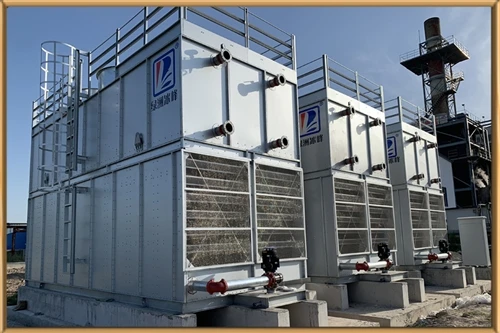 Also known as sealed cooling towers, closed cooling towers feature heat transfer media circulating entirely inside sealed pipelines without direct contact with ambient air.
Heat transfer is realized through a dual mechanism consisting of spray water evaporative heat exchange and air convective heat dissipation, which differentiates them from open cooling towers that adopt exposed water heat exchange.
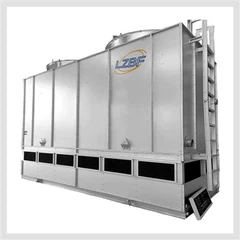
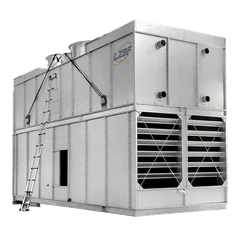
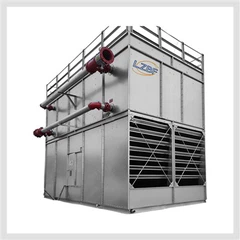
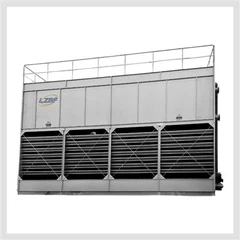
The complete system consists of three core modules: an internal sealed circulating heat exchange loop, an external spray cooling loop and an air guiding heat dissipation unit. It delivers stable and clean operation, making it suitable for high-precision industrial cooling applications.

Heat-carrying media such as ethylene glycol aqueous solution and softened water requiring temperature control flow through the internal circulation pipelines.
 These media absorb high-temperature waste heat generated by production equipment, injection molds, generator sets, chemical reactors, computing power servers and other facilities, then are delivered to the sealed heat exchange coils inside the unit by pressurized circulating pumps.
The coils are surrounded by a water film formed by intermittent water spraying. As the high-temperature media flows inside the coils, heat transfers through the metal tube walls to the spray water film attached to the outer coil surfaces. This stage only involves thermal conduction; the internal circulating fluid remains fully isolated from external dust, impurities and insects, fundamentally preventing water turbidity, scaling and pipeline blockages.

The external spray system is composed of a water storage tank, spray water pumps, water distribution pipelines and atomizing spray nozzles. The spray pump extracts cooling water from the bottom water tank and sprays it evenly over the outer surfaces of the heat exchange coils to form a uniform continuous thin water film.


Meanwhile, the axial flow fan mounted on the top continuously draws in ambient air, which flows upward through the gaps between the water-covered coils. Part of the spray water evaporates rapidly upon contact with flowing air; the evaporation process absorbs substantial latent heat of vaporization and removes most heat conducted through the coil walls.

Un-evaporated spray water flows back to the bottom collecting tank by gravity for cyclic spraying. Only a small volume of water is lost to evaporation, and regular simple water replenishment is sufficient to maintain the liquid level.

Convective air driven by the fan carries away water vapor and excess heat, and hot humid air is exhausted from the top of the equipment. With continuous cooling of the coils, the temperature of the internal high-temperature heat-carrying media drops.

The cooled media is sent back to production lines by circulating pumps to absorb waste heat again, forming uninterrupted closed circulating cooling. The supporting electric control system automatically adjusts fan rotating speed and spray system operation based on ambient wet-bulb temperature and return water temperature of the media.

Spraying is shut down under low ambient temperature to rely solely on dry air cooling and avoid pipeline freezing in winter; the fan runs at full load paired with spray evaporation under high-temperature working conditions to guarantee qualified heat exchange efficiency.

Throughout operation, the internal circulating water has no exposure to the atmosphere and cannot absorb airborne dust, sulfates or calcium ions, greatly lowering the risks of scaling and corrosion inside heat exchangers, pipelines and main equipment.
Frequent water replacement and chemical descaling treatments are unnecessary, resulting in far lower daily maintenance workload and water consumption compared with open cooling towers. Centered on latent heat evaporation supplemented by convective heat dissipation, closed cooling towers operate stably under normal ambient temperatures and can adapt to low-temperature winter service with anti-freezing formulated media.
Boasting advantages including water conservation, pipeline protection, low maintenance costs and stable water quality, they are widely deployed in industries with strict requirements on cooling water quality such as new energy energy storage, precision machinery, pharmaceutical chemical engineering and power transformation.

Send Inquiry