


Why Are Closed-Circuit Cooling Towers More Reliable?
Nov 19, 2025
Leave a message
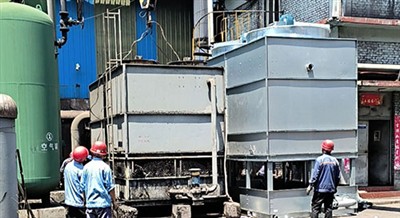
A closed-circuit cooling tower consists of two separate circulation systems

Internal Circulation Water System:
The cooled circulating water inside the coil exits the tower body and is delivered to the heat source (equipment to be cooled) by the system circulation pump. After absorbing heat and increasing in temperature through heat exchange, the circulating water flows back into the coil for cooling again.
External Circulation Water System:
The external spray water achieves the purpose of cooling the circulating water inside the coil through heat exchange with the coil and packing of the closed-circuit cooling tower. Subsequently, it drops into the lower water tank and is pumped back to the spray tank by the spray pump for recirculation.

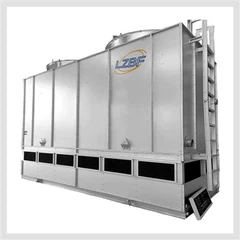
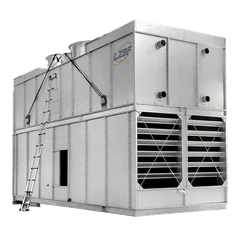
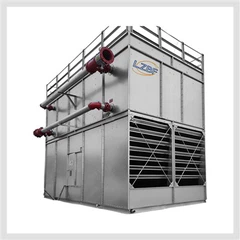
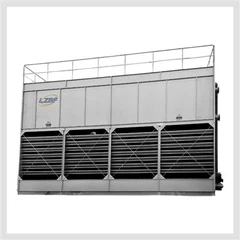
closed-circuit cooling tower
The circulating water in the internal loop of the closed-circuit cooling tower undergoes heat and mass transfer with the external spray water and air through the coil. This design prevents water quality contamination that would otherwise occur if the cooled water came into direct contact with air.
Moreover, the spray water is pre-cooled by the PVC packing, significantly enhancing the heat exchange efficiency.


Spray and Fan Control
1
The operational sophistication of closed-circuit cooling towers is fully reflected in the precise control of their fan and spray systems. This control logic is far more than simple on-off switching; it is an elaborate coordination aimed at dynamically balancing cooling efficiency, energy consumption, and water loss. Its core benchmark is the set outlet temperature of the process fluid (i.e., the closed-loop circulating water to be cooled), and all actions of the control system are centered on maintaining this target temperature.

2
Essentially, the entire cooling process is an organic combination of sensible heat exchange and latent heat exchange. The control strategy needs to intelligently adjust the proportion of these two cooling methods according to changes in the external environment and internal heat load, so as to achieve the ultimate cooling goal at the lowest cost.

3
During periods of low cooling load, such as nights or cool seasons when the ambient wet-bulb temperature is low, the control system will prioritize activating the most energy-efficient mode. At this time, it may only start the spray pump to spray a small amount of water evenly on the coil surface, forming a thin water film. Through natural evaporation, this water film can dissipate a considerable amount of heat from inside the coil while the fan remains idle. In this mode, the system's energy consumption is only the power consumed by the spray pump, achieving basic "free cooling" and embodying operational economy.

4
However, when the ambient temperature rises or the process heat generation increases to the point where natural evaporation of the spray water alone can no longer cool the fluid to the set temperature, the control system will promptly start the fan. The operation of the fan marks a qualitative leap in cooling capacity. It forces a large volume of ambient air to sweep across the wetted surface of the coil. The intense air flow drastically accelerates the evaporation rate of the water film, thereby leveraging the powerful latent heat cooling mechanism of "heat absorption through evaporation" and increasing heat dissipation efficiency by orders of magnitude. At this stage, the system enters a full-capacity state where the fan and spray pump operate in synergy.
5
Yet the ingenuity of modern control systems goes far beyond this. With both devices activated, a more advanced strategy lies in their stepless precision regulation - a scenario where frequency conversion technology plays a pivotal role. Instead of operating in an on-off manner, the fan speed can be smoothly and steplessly adjusted via a frequency converter based on real-time feedback of the outlet temperature. Under partial load conditions, appropriately reducing the fan speed yields significant energy savings. This is because the power consumption of a fan is proportional to the cube of its speed; a slight decrease in speed can lead to a substantial reduction in energy consumption.

6
Similarly, the spray pump does not need to operate at full flow capacity at all times. By adopting frequency conversion control for the pump or combining multiple pumps with sequential on-off operation, the system can accurately match the required spray water volume to the actual heat load. On the premise of ensuring the coil is fully wetted and maintaining evaporation efficiency, moderately reducing the spray volume not only directly lowers the energy consumption of the water pump but also reduces water drift loss and the consumption of chemical agents simultaneously, achieving the dual benefits of energy conservation and water saving.
Send Inquiry