


Core Secret of Cooling: How Evaporative Heat Dissipation Cools Down Equipment Hubs?
Oct 28, 2025
Leave a message
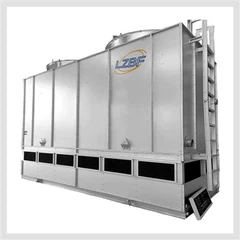
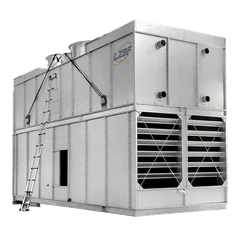
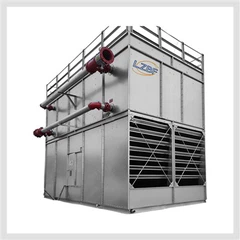
A cooling tower is a device for heat exchange between water and air. It mainly consists of a structural frame, maintenance side panels, a fan, a motor, fill material, a water distribution system, a tower body, and a water collection basin. Heat exchange is primarily achieved through the thermal interaction between relatively low-temperature air (driven by the fan) and water in the fill material, thereby reducing the water temperature. For data center projects, the total heat load of equipment and electrical devices remains relatively stable. The chilled water system, cooling water system, and cooling tower design are all critical for ensuring continuous cooling in the computer room. Therefore, cooling towers need to operate uninterruptedly year-round (data centers in northern regions typically adopt water-side free cooling for their chilled water systems, which also run throughout the year).
Working Principle of Cooling Towers
The working principle of cooling towers is based on evaporative heat and mass transfer. Driven by the fan, hot water is sprayed onto the surface of the heat dissipation material and comes into contact with the moving air passing through it. At this point, heat and moisture exchange occurs between the hot water and cold air. Simultaneously, part of the hot water evaporates, and the latent heat of evaporation is released into the air. Finally, the cooled water falls into the water tank, and then circulates back to the required equipment for reuse. In wet cooling towers, the hot water has a high temperature while the air flowing over the water surface has a low temperature. The water transfers heat to the air, which carries it away and dissipates it into the atmosphere. Water dissipates heat to the air in three ways: (1) Sensible heat transfer; (2) Evaporative heat transfer; (3) Radiative heat transfer.Cooling towers mainly rely on the first two heat transfer methods. Radiative heat transfer is negligible due to its small magnitude. Among them, evaporative heat transfer is accomplished through mass transfer, specifically the continuous diffusion of water molecules into the air. Water molecules possess varying levels of energy, with the average energy determined by the water temperature. Near the water surface, some water molecules with high kinetic energy overcome the attractive forces of neighboring molecules, escape the water surface, and become water vapor. As these high-energy molecules escape, the energy of the water near the surface decreases, resulting in a drop in water temperature. This is evaporative heat transfer. It is generally believed that evaporating water molecules first form a thin layer of saturated air near the water surface, with a temperature equal to that of the water surface. The rate at which water vapor diffuses from this saturated layer into the atmosphere depends on the pressure difference between the water vapor in the saturated layer and that in the atmosphere.
Basic Structure of Cooling Towers
Tower frame: Provides external support.
Heat exchange fill material: Maximizes the heat exchange area between water and air.
Water storage tank (cooling water basin): Located at the bottom of the cooling tower to collect cooled water.
Water distribution nozzles: Ensure uniform distribution of water over the heat exchange fill material.
Axial flow fan: Accelerates air flow.
Classification by Flow Direction of Water and Air
Cooling towers are categorized into counterflow cooling towers and crossflow cooling towers based on the flow direction of water and air.
Counterflow Cooling Towers
Tower body: Suitable for areas with variable wind directions.
Water distribution fill material: Ideal for environments with good water quality.
Fan: Counterflow towers have slightly higher static pressure, and some models require motors with slightly higher power.
Environmental constraints: A single crossflow tower of the same model occupies more area than a counterflow tower. However, when multiple towers are used, crossflow towers can be connected in parallel, while counterflow towers require a distance of more than half a tower diameter between two units. Thus, combined crossflow towers can reduce floor space. Counterflow towers are advantageous in areas with surrounding high-rise buildings, chimneys, or other heat sources, as well as in scenarios requiring a small number of cooling towers, due to their compact footprint.
Drift and noise: Offer good ventilation, making them suitable for areas with less strict environmental protection and noise requirements.
Daily maintenance: Filler replacement is cumbersome, so they are suitable for use in areas with clean water quality and low sand and dust levels.
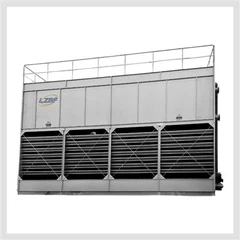
Crossflow Cooling Towers
Tower body: Crossflow towers use a steel frame as the main support structure, resulting in higher material consumption and a heavier tower body compared to counterflow circular towers. They can be connected in parallel and are suitable for open areas.
Water distribution fill material: The fill material volume of crossflow towers is approximately twice that of counterflow towers, leading to higher costs. They are suitable for environments with poor water quality.
Environmental constraints: Combined or large crossflow towers are suitable for open areas with large cooling water demand and limited space, as they are more compatible with surrounding buildings.
Drift and noise: Crossflow towers have a lower inlet air velocity than counterflow towers, resulting in smaller drift losses (0.005% for crossflow towers versus 0.1% for circular counterflow towers). Noise from counterflow towers mainly comes from water falling and fan operation, while crossflow towers primarily generate fan noise with minimal water noise. Thus, the overall noise level of crossflow towers is lower than that of counterflow towers, though ultra-low noise counterflow towers also operate quietly. In summary, crossflow towers perform better in areas with strict noise and environmental protection requirements.
Energy consumption: Crossflow towers have large air inlets, low wind speed, and small resistance losses, so some models have lower motor power than counterflow towers. Comparing the costs, transportation fees, maintenance expenses, and motor energy consumption of the two types, their total costs are roughly similar within 2-4 years. The longer the service life, the lower the relative cost of crossflow towers.
Daily maintenance: Replacement and maintenance of various components in crossflow towers are convenient, whereas maintenance of the water distribution system and replacement of fill sheets in counterflow towers are cumbersome. Crossflow towers are more adaptable to projects with poor water quality and require simpler daily maintenance for users.
Send Inquiry