

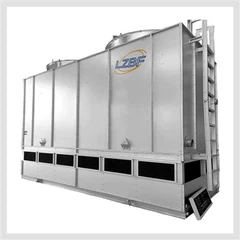
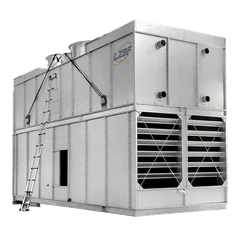
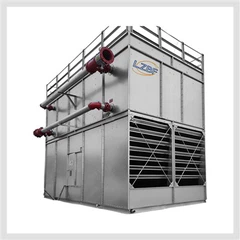
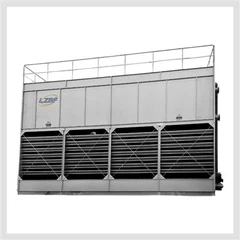

Closed Cooling Tower Spray System
Nov 12, 2025
Leave a message

The development of closed cooling towers is closely linked to the upgrading of industrial cooling needs, the rising awareness of resource conservation, and technological progress. With the advancement of industrial technology, industrial production has increasingly higher requirements for the purity of cooling media. Many industries such as electronics, pharmaceuticals, and chemical engineering require their cooling media (e.g., lubricating oil for precision machine tools, cooling fluid for electroni
Spray System
The spray system is the "blood circulation system" of a closed cooling tower, and its performance and stability directly determine the tower's heat exchange efficiency and operational reliability. The spray system mainly consists of four subsystems: water supply, water distribution, recovery, and filtration, ensuring uniform water distribution on the coil surface and effective circulation.
Spray Water Pump
Component Description: Usually a centrifugal pump, serving as the power core of the entire spray system.
Core Function: Provide the required pressure and flow rate for spray water, transporting water from the sump to the top water distribution system. Its head and flow rate must match the tower's design specifications.
Spray Water Piping
Component Description: Includes main pipes, branch pipes, and related valves, flanges, and unions.
Core Function: Form the delivery channel for spray water. Piping is typically made of PVC, galvanized steel, or stainless steel (e.g., 304/316) to prevent corrosion and scaling.

Spray Water Tank/Collection Sump
Component Description: Located at the bottom of the tower, used to collect spray water after it falls through the packing and coils.
Core Function: Store spray water and provide suction conditions for the pump. It is usually equipped with a water make-up port, overflow port, and blowdown port.
Water Distribution System (Spray Water Distribution System)
It is a key part ensuring efficiency, mainly available in two forms:Nozzle-Type Water Distribution
Component Description: Composed of multiple solid-cone or hollow-cone nozzles.
Core Function: Uniformly spray water into fine droplets, maximizing coverage of the underlying coil surface and avoiding "dry spots."
Gravity Disk-Type Water Distribution
Component Description: Achieved through openings at the bottom of water distribution pipes or installed overflow troughs.
Core Function: Utilize gravity to allow water to fall naturally, forming a water curtain. Its advantage is large pore size, which is not easily clogged, making it suitable for environments with hard water or high scaling tendency.

Filtration Device
Component Description: Typically a Y-type filter or basket filter, installed in the inlet pipeline of the pump.
Core Function: Trap suspended solids, impurities, and scale in water, preventing clogging of nozzles and coils. It is a key protective component for maintaining efficient system operation.
Spray Water
Component Description
Core Functions:Direct Evaporative Cooling: Water evaporates on the coil surface, absorbing heat from the process fluid inside the coil-this is the main heat dissipation method.
Convective Heat Transfer: Low-temperature spray water contacts the high-temperature coil surface for convective heat exchange.
Coil Cleaning: Continuous water flow washes dust off the coil surface, keeping it clean and indirectly improving heat exchange efficiency.
Advantages of Closed Cooling Towers
Contamination Prevention: The system completely isolates the thermal fluid from external air and spray water, avoiding contamination by impurities, dust, microorganisms, etc. It meets the production needs of industries with strict requirements for cooling medium purity, such as electronic chip manufacturing and pharmaceuticals.
High Efficiency and Energy Conservation: Combines the advantages of air cooling and water evaporative cooling, with evaporative heat dissipation accounting for 70-90% of the total heat dissipation and high heat exchange efficiency. The intelligent control system automatically adjusts equipment operation according to load, reducing unnecessary energy consumption and lowering operating costs.

Send Inquiry